Sonship is Full-Time Ministry
(Intro Video and Sharable PDF) This Blog is a follow-up to “Adding Ecclesia to Your Kingdom Business ” — that piece ended by asking who actually helps entrepreneurial sons and daughters get there: “a pastor, minister, CEO, or manager? Someone fluent in Ascension, Courts of Heaven, God’s Council, Sonship, and Reformation?” The answer follows:
From Servant to Son
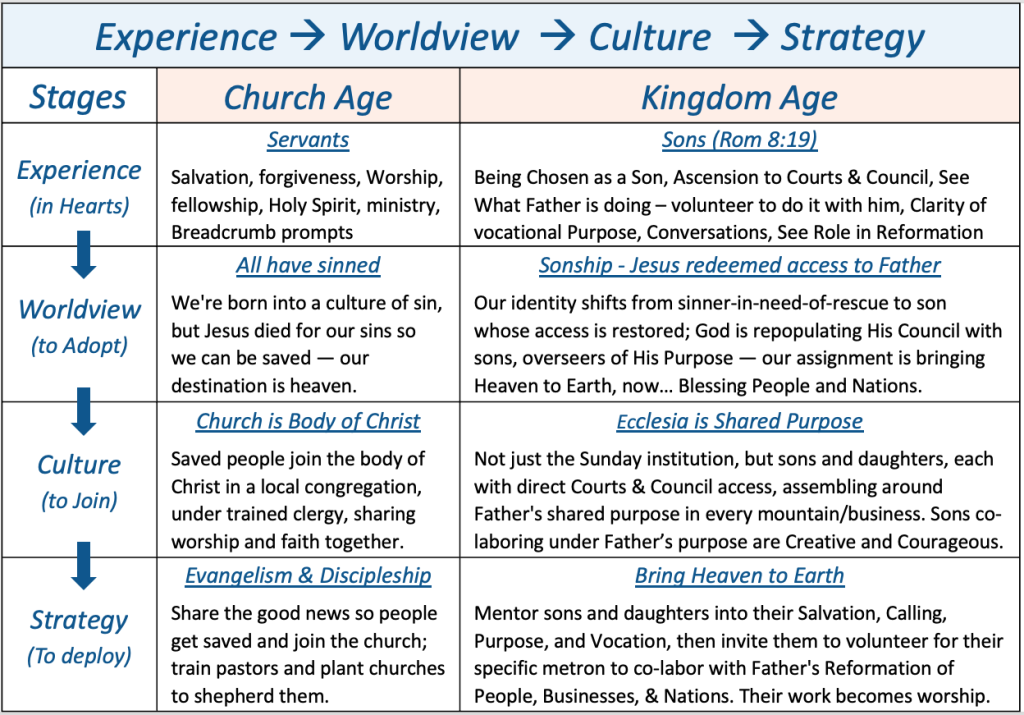
The difference between serving God and being His son or daughter is experienced before it’s ever explained. A servant works to earn a hearing and get an answer; prayer was my wish list. A son or daughter already has access to conversations with Father and works from those Living Words instead. Four shifts capture what that actually looks like in practice:
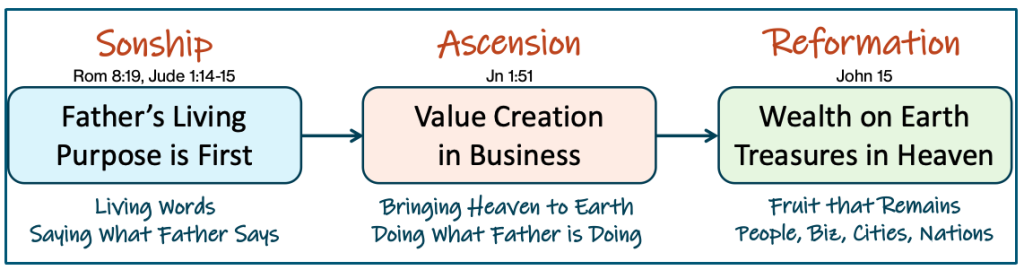
Sonship – I feel chosen as a son when Father speaks to me — not when I’ve earned the right to be heard. Now, I’m part of a family, a strategy, an army carrying Father’s purpose.
Ascension – I’m routinely in the Courts of Heaven to deal with accusations in the Spirit, and in the Council having conversations with Father, Jesus, and the Seven Spirits (Jn 1:51, 15:16, Rev 4:1). I’m releasing Father’s prophetic decrees from Heaven onto Earth, not waiting for permission.
Creating Value – My salvation has a thread that runs straight into my vocation or business, carried by Father’s Living Words and direction — not by my self-ish strategy alone.
Reformation – Based on the conversations in Heaven, I’m bringing Living Words, clear purpose, and Father’s power onto Earth in a way that redeems people, businesses, cities, and nations.
Church moved discipleship into a living room and called it home groups — same hour a week, same leader up front, same inward focus on fixing the people in the circle. Ed Silvoso’s marketplace-ekklesia work went further: business itself can be a legitimate site of transformation, not just a mission field church people visit on their mission trips. But even there, ministry is still something imported into business from the outside — a layer added on top of the actual work, not the work itself. There’s a further step neither model quite takes.
The Purpose Is Shared, Not Imported
The Kingdom purpose of the business isn’t a program bolted onto operations; it’s Father’s reason for starting the business in the first place — it can be shared by the staff and often felt by clients and customers too. That single shift changes the math entirely. A church gets an hour a week, at best, to disciple someone toward their purpose. A business gets forty. The maturing of sons doesn’t happen in a separate meeting about the work; it happens inside the actual work, because the work and the purpose were never two different things to begin with.
Leadership Still Exists — It’s Just Not a Separate Class
This isn’t leaderless. The fivefold functions — apostle, prophet, evangelist, pastor, teacher — are still credible functions. They’re just carried by the CEO and management team as part of running the business and mentoring the staff, not delegated to a professional clergy class meeting once a week in a different building. The discipling function and the operating function are the same people, doing the same job, at the same time to meet the same purpose creating the same value.
Ministry Isn’t Fixing People — It’s Connecting Hearts to Purpose
The traditional posture — people need fixed — gets superseded by something more accurate:
- To: connect a person’s heart with their own unique identity, purpose, and calling
- So That: They are motivated and equipped as sons to fix themselves, for a lifetime in the actual vocational setting where they spend most of their waking life (work).
People still get fixed. But it happens in the context of their own vocational and spiritual purpose, not as a separate project run on them. People feel seen at work — genuinely seen at a heart level, not managed. And once someone is connected to purpose and Ecclesia at work, their labor stops being labor. It becomes worship: co-laboring with Father, straight out of the Council, Monday through Friday.
Col 3:23-24 – Whatever you do, work at it with all your heart, as working for the Lord…
It is the Lord Christ you are serving.
The Nine Council Conversations, Applied at Work
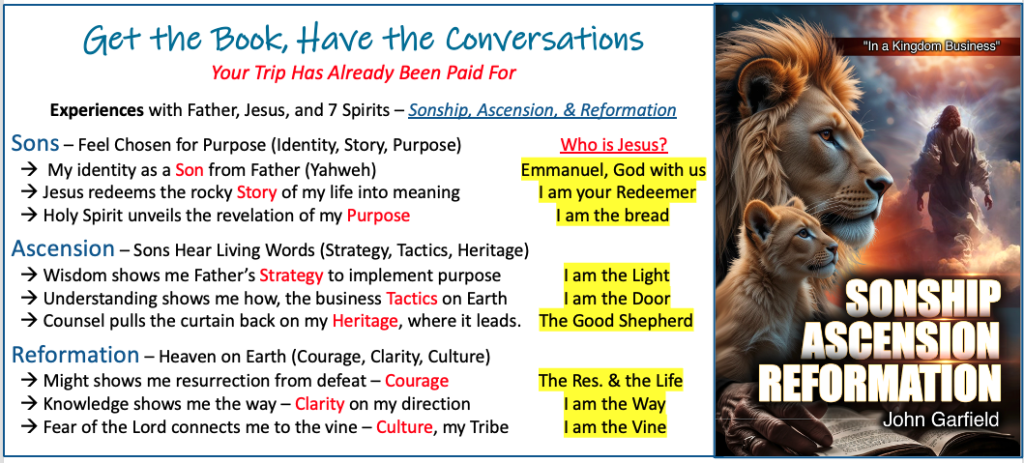
The same framework that shapes a person’s walk with Father shapes how this gets lived out inside a business — nine topics, worked through as real Council Conversations rather than a curriculum:
Identity, Story, Purpose → Strategy, Tactics, Heritage → Courage, Clarity, Culture
And the results build in a sequence that can be mentored intentionally in a business:
Sonship → Purpose → Innovation → Value → Vocation → Reformation / Fruit
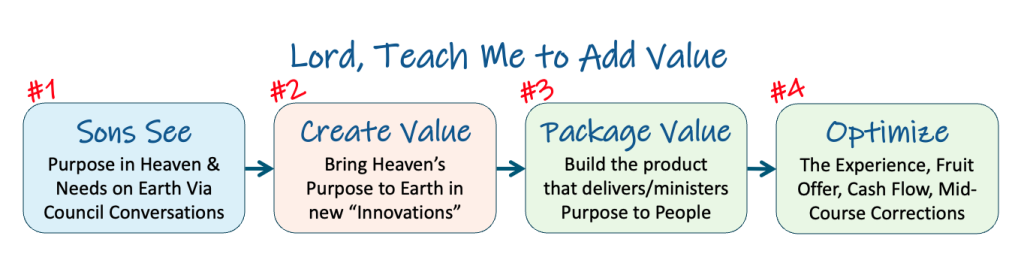
The Bridge This Actually Builds
Here’s the biggest impact, and the real difference from everything else in this conversation: this builds a bridge from spiritual identity straight into practical vocation. Church gave people an identity on Sunday and left them to figure out Monday alone. House church moved the meeting but kept the same gap. Marketplace ministry sent people into the gap with a mission to complete inside it.
Sonship in Business closes the gap entirely — sons and daughters bringing Heaven to Earth not as a separate assignment from their work, but as their work, forty hours a week. They are full-time ministry. Business is the perfect place to learn to bring Reformation from Heaven to Earth by adding value to people in both spiritual and practical ministry. The curtain between spiritual and natural is finally breached. Dualism is defeated when Father tweaks our religious worldview. If you want to see exactly how this gets mentored day to day, take a look at the attachment.
Attachment – The Sonship Mentoring Sequence in Business
Sonship → Purpose → Innovation → Value → Vocation → Reformation / Fruit
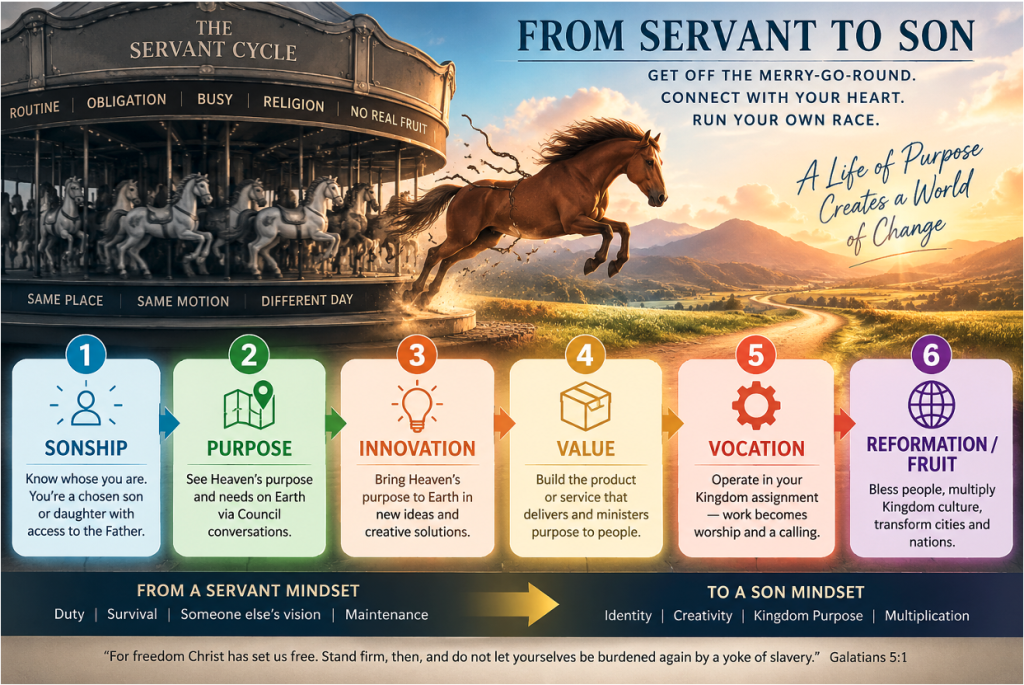
Sonship – is the post-salvation experience of being chosen as a son or daughter specifically invited to the Courts and Council of Heaven via the ascension and access to Father that Jesus redeemed (Jn 1:51). The invitation is to co-labor with what Father is doing (Jn 5:19).
How to: We introduce people to sonship with an experience in the Courts or Council. We look for the earliest opportunity to simply take them first and explain it second. Father communicates choosing in that experience; it’s not our theological/intellectual explanation that makes the difference. Sound doctrine is confirmation; the experience with the Spirit(s) of Truth is convincing. When Father speaks to us we feel chosen.
Purpose – Sons shift from a servant focused on their own dream to a son who puts Father’s Kingdom purpose first. In the course of making that trade, they find the synergism in their own heart. Father wrote shared Kingdom purpose in our hearts in the first place – He’s way ahead of us.
How to: We use a purpose profile graphic to get Father’s purpose in writing and capture where that purpose leads in next steps or goals we call aspirations. I share the graphics on Zoom, and we populate purpose and aspirations as we get clarity from the Lord… eat the chicken and throw out the bones. See the Coaching Roadmap with links to templates and examples.
Innovation – The umbrella of purpose surprisingly gives us more focus for creativity, not less. We even have access to conversations with Wisdom for Strategies and Understanding for Tactics. It’s not all predestined, but we share a role in being creative and innovative like our Father.
How to: The innovative ideas to implement individual goals that flow from the central purpose are part of the aspirations process. We share the file on Zoom and fill it out as we get something prophetically credible.
Value – Father’s purpose is implemented through new, creative ideas. The earmark of the value we create is that it blesses other people; they want to buy it, own it, and share it. It’s an exciting process that blesses us too, but fundamentally it is value or ministry for other people.
How to: The purpose and aspirations are expressed in a business offer integrated with our conviction story that we capture in writing. It’s also expressed as a business plan with cash flow and summarized in a brochure.
Vocation – Making that idea/value available to other people is an entrepreneurial process that happens inside a business and all the processes to manufacture and package it for a consumer. The work to express Father’s purpose feels like Worship (Worship@Work).
How to: Everything we get in terms of sons carrying purpose is naturally expressed in their business and vocation. That becomes inherently obvious in this process as their opportunity to implement what they get, make the mid-course corrections, and celebrate the results. Vocation is where the payoff lands, and it feels practically connected with the desires in my heart and Father’s calling on my life.
Reformation/Fruit – When other people are in possession of the value/product we create, we can see the blessing it imparts. We can also connect the dots to our role in what Father is doing in Nations (Reformation across people, business, Cities, and Nations).
How to: Sonship carries a revelation of Kingdom Culture. We can see and celebrate purpose in other people – it’s no longer just about me, my ministry, or my work. We can experience the dynamic of shared Kingdom purpose in business (Ecclesia@Work). And we are part of Father’s larger strategy for Reformation. We’re part of a much larger team that we hadn’t seen before; Father is calling the Ezekiel 37 army of sons to the fore.
Click the graphic below for access to the live links (how-to details, templates and examples)
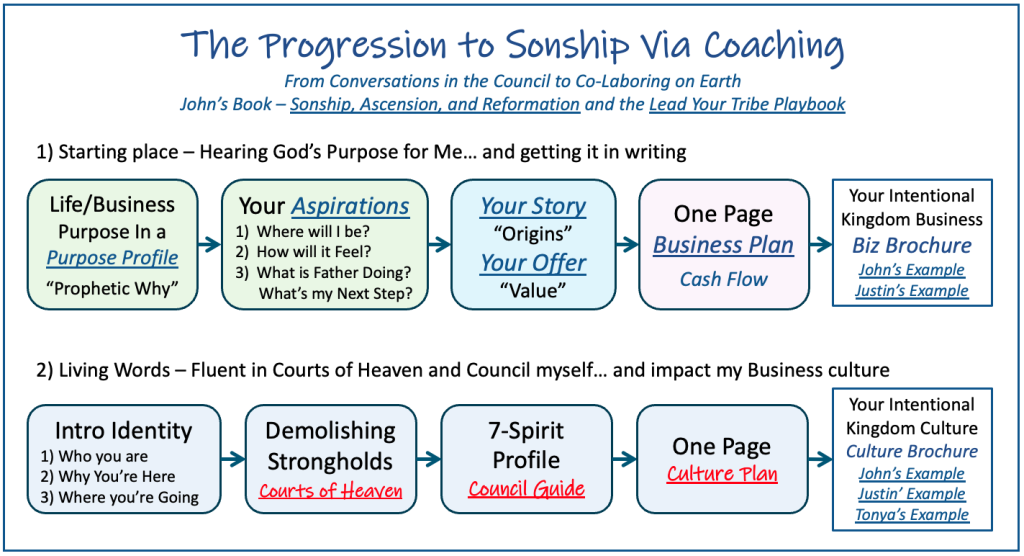
How to Father Your Sons and Daughters
Sonship is intentional mentoring that needs leadership, especially in a business context; intentional fathering that has these attributes:
Learning to Listen – Spiritual fathers are teaching sons and daughters to hear Living Words from the Council. People learn to hear the voice of God by recognizing what Father is saying to them. In the beginning, you help articulate those living words for them in 1-on-1’s. It’s like riding a bicycle; once you learn how, it’s easy. People feel chosen by God when they hear what He is saying to them. It feels like love. It’s what builds a Kingdom culture in your business (Ecclesia@Work)
Get it in Writing – Learning to write what you hear is how Living Words are discerned and preserved for action. No one does this initially. We write it down for them in the beginning until they see the benefits of having their purpose on paper. We use specific written graphics and deliverables to get clarity on prophetic purpose and direction.
Put it to Work – Fathering doesn’t stop with the theory and theology for sonship. It’s the execution of that purpose in the context of business into a valuable product or service that makes a difference. The thousands of decisions that go into making the business sustainable are all candidates for conversations in the Council. All the obstacles and accusations are taken to the courts of Heaven and decrees from Father are released to replace them. Work becomes co-laboring with Father, it feels like worship. You can feel His pleasure, His blessing, and His participation in open doors, divine appointments, etc. Kingdom business has a miraculous ingredient that feels like wind in our sails and sales. (Worship@Work).
Intercession – Jesus still lives to make intercession; so do we for our sons. People feel chosen when Father speaks to them. As an earthly father, you are in the council on their behalf, passing on what you get. Intercession (G1793) means to meet and confer (with Father in the Council regarding your sons). Having an earthly father who sees our hearts, has our back, and occasionally reads our mail is greatly encouraging.
Take the Next Step:
Progression to Sonship – Your Kingdom purpose and redemptive stories form the basis for your personal identity, purpose, value creation, and your business offer. Becoming your authentic self is the Father’s non-religious key to flow and fruit in business and life. We offer practical and prophetic coaching to help you get there, flowing with your Father (co-laboring) instead of fighting circumstances and resistance alone. Is this You?
Read the book and Zoom with John for an overview of our process in Kingdom Business Coaching.