What If Your Business Discipled Sons and Daughters?
(Intro Video) Walk into most charismatic or evangelical congregations and you’ll find a consistent architecture underneath the worship style: everything orbits the church’s vision. Spiritual gifts get defined as things you do for the church — worship team, children’s ministries, ushering, small groups, hospitality, missions. Apostolic covering and five-fold ministry get framed as the structure every believer needs to be rightly aligned. And underneath all of it sits an unstated assumption so common it rarely gets questioned out loud: your ministry is in the church, in this building, under this vision.
It sounds healthy. It produces something else.
The Filter
Every system selects for something, whether it means to or not. A system built around supporting the pastor’s vision and staying rightly covered under the local church’s structure will, over time, filter for exactly one kind of person: someone whose identity and purpose are found almost entirely inside the church, in the ministry. Entrepreneurial and creative people — the ones wired to build, risk, invent, and lead in the marketplace — don’t fit that filter well. Either they get slowly absorbed into it, spending their gifting on internal church functions instead of the business mountain they were actually called, or they quietly drift out, unable to find a theology or support anywhere in the building for what they’re actually wired to do.
Somewhere in that process, meeting together stopped being a means and started being treated as the purpose itself, a self-perpetuating religious introversion consumed by the system and prone to miss what Father is doing. Hebrews 10:25 gets preached as though showing up were the finish line, instead of what it actually says — not neglecting to meet together, so that we can spur one another toward love and good deeds. The gathering was always meant to launch people outward into their calling. In practice, it’s often become the calling.
What Gets Taught, Even If It’s Never Said Out Loud
The message a lot of sincere, gifted people absorb — not from a single sermon, but from years of cumulative church culture — is that staying, serving, and remaining under covering is the will of God for their life. Faithfulness gets measured by attendance, service hours, and giving, not by fruit in the actual sphere someone was called to oversee. A gifted entrepreneur who builds a Kingdom-purposed business and multiplies value in the marketplace can quietly come to believe they’re less spiritual than the person running the parking team — because nobody ever taught them that their business can have a Kingdom purpose and can be an incubator to disciple more sons and daughters into their purpose. That’s the real goal of Reformation on a personal level. Now add to that the opportunity for those sons and daughters to bring Reformation to Cities and Nations — the motivation!
The Bill Comes Due
Here’s where the theology and the balance sheet finally meet. A growing number of congregations can no longer financially sustain a full-time pastor, a staff, a building, and equipment. It’s a purpose problem wearing a budget disguise. The system has centuries of tradition and a well-developed theology explaining why it should be supported. What it increasingly lacks is a contemporary purpose connected to what Father is actually doing in this Reformation — because the model was built for a world where the church building was the primary place Kingdom activity happened, and that world is not the one we’re actually living in anymore.
Meanwhile, the very people who could champion real Kingdom expansion — entrepreneurial and creative sons and daughters — have often been discipled into believing their highest calling is funding institutional overhead, rather than being released to build businesses that are themselves legitimate Kingdom ministry. That’s not a small miscalculation. It’s a structural reason the traditional model is buckling in real time. That treadmill isn’t motivating for a lifetime.
The Opportunity: Ecclesia Around Shared Purpose (Sonship)
Here’s the good news underneath the diagnosis: Ecclesia was never meant to be a building with a budget. It’s simply shared purpose — “where two or three are gathered in My name” (Mt 18:20) — and that gathering is every bit as legitimate around a business’s Kingdom purpose as it is around a Sunday service. A team of sons and daughters aligned around a shared Kingdom purpose inside a company is Ecclesia, whether or not it meets in a sanctuary. I love prophetic praise and worship, but the real definition of Kingdom worship is bearing fruit that remains and creating value that multiplies.
That reframe changes everything about spiritual and vocational gifts. An entrepreneur doesn’t need an apostolic covering to validate their calling in business — they need access to God’s Council, the same access every believer has been given, and the courage to actually build from what they hear there. A creative doesn’t need to wait for a platform inside a church service to minister their gift; the marketplace is already the platform, and it’s been waiting on them the whole time.
This doesn’t make the local church irrelevant — it makes it what it was always supposed to be: a beacon pointing every mountain toward Reformation, not a filter that retains people until their identity has nowhere else to go. The church that survives what’s coming won’t be the one with the best Sunday production. It’ll be the one that actually equips and releases its most gifted people into their own Ecclesia — in the businesses, studios, and marketplaces where Father’s purpose was waiting for them the whole time. Father is integrating Salvation, Calling, Purpose, and Vocation under the umbrella of His Kingdom Purpose.
Ecclesia – Shepherd Creative Sons instead of Loyal Servants?
The financial question is “What’s the value you create that other people want to buy?” What if our product was prophetic clarity on Son’s and Daughter’s vocation, career, calling, and contribution?
What if it didn’t functionally matter if the sending was from a church or a business? What if the church and the business mountain collaborated instead of competing for staff and attendees.
Picture what that actually looks like on a Tuesday morning instead of a Sunday. A construction company’s leadership opens the week the same way a church staff opens a service — not with an agenda, but with an actual Council conversation: what is Father doing in this project, in this city, in these specific relationships this week. How do we co-labor with Him?
A business runs a purpose-profile process for every new hire, the same discipleship pathway a church might call a membership class, except the fruit shows up in campaigns that carry Kingdom values and clients who leave every meeting sensing something different was in the room. A restaurant’s staff meeting doubles as a prayer meeting, not bolted on as a nice extra, but because feeding a neighborhood well and discipling the waitstaff were never two separate assignments to begin with.
Call it what it actually is: church. Not church-adjacent, not a para-church ministry a business does on the side — Ecclesia, gathered around shared purpose, exactly the way Matthew 18:20 describes it. Offerings and generosity are abundant, now it puts the Kingdom first — one Kingdom business investing in another’s launch, a marketplace apostle mentoring five founders instead of pastoring one congregation (planting business Ecclesia’s instead of traditional churches), revenue reinvested directly into the next assignment instead of routed through overhead a shrinking membership can no longer sustain. Buildings still matter, but they stop being the default location for where “church” happens; a business’s Tuesday staff meeting and a church’s Sunday gathering both simply become rooms Ecclesia meets in, neither one more legitimate than the other.
That’s the actual redefinition on the table: church stops being a place you attend and becomes Sons and Daughters who gather around shared Kingdom Purpose — most often in a business — wherever purpose is actually being translated to Reformation in our culture via businesses. The entrepreneurial son who builds that company isn’t a cash cow “supporting the ministry.” He’s leading one. He’s part of the Ecclesia, an army of sons and daughters bringing Kingdom culture from Heaven to Earth.
Why Not?…
What if apostolic ministries had a vision for Reformation and planted Kingdom businesses that created great value in the marketplace and discipled sons and daughters 40 hours a week on the job? What if Son’s prophetic calling came with a bridge to their marketplace vocation? What if there was someone to help them get there… a pastor, minister, CEO, or manager? Someone fluent in Ascension, Courts of Heaven, God’s Council, Sonship, and Reformation? Why not?
That’s not a rhetorical question. See “Sonship is Full-Time Ministry” for what that actually looks like — who carries the five-fold functions inside a business, what ministry becomes instead of “fixing people,” and the concrete framework for getting there.
The exciting (albeit traumatic) shift from the Church age to this age of Kingdom is contrasted in the table below. In truth this blog is conceptual and the Sonship, Ascension, and Reformation functions between business and church are still being revealed. What we can say with certainty is that we’re not just duplicating the church model in Kingdom business. There’s a fresh wind blowing and an age change is underway. Reformation via Sons and Daughters is on Father’s heart, Rom 8:19.
The New and Living Way
The Old – Get on board with our corporate Vision (our way or the highway)
or find a new church; or get a job in a different company
The New – A big wing of our Church or business is Sonship
- Help you connect with your Identity, Purpose, Vocation, Reformation
- Spiritual food is you learning to do what Father is doing
(not us preaching the word or indoctrinating corporate values) - We’re mentoring Sons into two things:
#1). they have their own unique purpose, Identity, Calling (motivation)
#2). there is an overlap/Ecclesia if they share the purpose Father has given us
(they bring magnified creativity and initiative… anointing)
- We’re looking for what people can do (skillset, experience, recommendations),
but even more for what God can do through them - If they don’t share our purpose we graduate them into theirs
- Into the path and purpose God is giving them
- That we helped them find! (via Sonship, Ascension, and Reformation)
Attachment 1 – the Age Change Explained
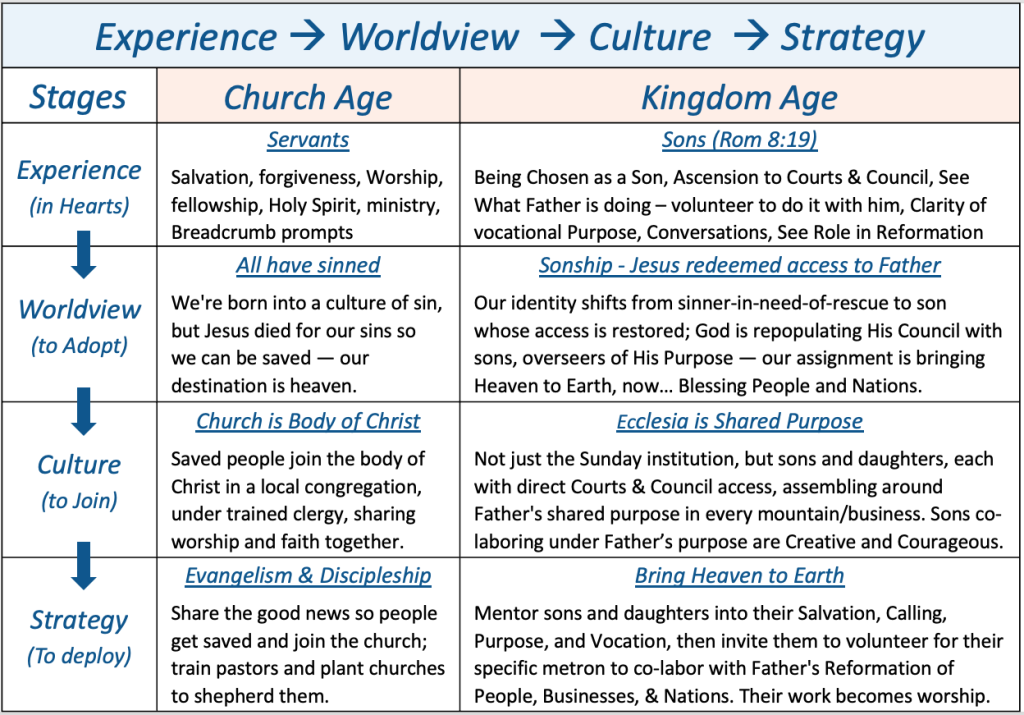
The Experience — We believers all begin our journey with an experience. It’s all the examples of sharing the good news in the gospels and Acts we’re accompanied by at least one of the gifts of the Spirit (signs and Wonders). We don’t decide intellectually to get saved, we have an experience with the Lord and say, “Yes or No.”
The Worldview Shift — Everything downstream depends on where you start.
Worldviews are an intellectual construct; our theological lens for making decisions. Our Kingdom world view embraces Sonship, Ascension, and Reformation. The lens is that we can have conversations with Father in the Courts and Council and get Living Words. It’s not just a lens for making our own decisions with a Bible verse or principle to explain why it’s OK. Worldviews can be a theological confirmation bias that enables presumption and invites charismatic breadcrumbs instead of hearing Living Words in Council conversations.
- If the operating worldview is that all have sinned, the posture that follows is rescue and management: stay safe, stay saved, stay covered, don’t stray from what saved you.
- If the operating worldview is that access to Father has been restored, the posture that follows is conversations: sons don’t manage guilt, they carry assignments from Heaven.
Same cross, same salvation — but one worldview produces people waiting to go to heaven, and the other produces people bringing Heaven here. That’s the fork in the road everything else in this table runs from.
The Culture Shift — People with a common worldview join others who share the same values.
- A congregation gathered under trained clergy in a building will naturally organize its best people around what that building needs — childcare, youth classes, worship teams, ushers, small group leaders.
- Ecclesia gathered around shared purpose organizes its best people around what Father is doing in their actual sphere — a construction site, a studio, a boardroom.
The first culture asks, “how do we serve the church?” The second asks, “what is Father doing here, and how do we co-labor with it?” Both are legitimately gathering in His name. Only one of them requires a sanctuary to make it happen.
The Strategy Shift — Common worldviews and cultures spawn strategies that support them:
- Evangelism and institution-building measures success in salvations and square footage: how many got saved, attendance, how many pastors got trained, how many churches got planted.
- Bringing Heaven to Earth measures success in Reformation: how many people got connected to their salvation, calling, purpose, and vocation, and released into their metron to actually co-labor with Father’s Reformation… and make a difference.
The first strategy’s finish line is a full building. The second strategy’s finish line is Kingdom Culture — a son or daughter sent by God can go on to plant seeds and harvest Reformation in People, Businesses, Cities, or Nations.
This blog was inspired by three Council Sessions you will enjoy:
Attachment 2 – What Ecclesia Meant in Jesus’ Day
There is an important historical layer underneath that word. Ecclesia (Greek: ekklēsia) was not originally a Christian word for a religious building or Sunday service. King James intervened in the translation of Ekklesia to mean church when it really points to assembly (in order to bolster the authority of the Church of England and it’s hierarchy). In the Greek-speaking world of Jesus’s day, it commonly meant an assembly — a civic assembly of leading citizens called together to deliberate and conduct the city’s business. Under Roman rule, Greek cities continued to use this civic vocabulary when the new territories were acquired, and cultures needed to be “Re-formed.” Teams were sent out to be the nucleus of an Ecclesia that would reform the city to align with Roman culture.
Acts 19 gives us a useful New Testament snapshot. Luke uses Ecclesia for the gathering in Ephesus three times: for the confused assembly (Acts 19:32), for the lawful civic assembly that could settle public matters (19:39), and again when the city clerk dismissed the assembly (19:41). The same Greek word is translated elsewhere as “church.” So Jesus’s use of Ecclesia would not naturally have meant a building. It named an assembled people — a body gathered around a shared purpose.
That historical background strengthens the point of this blog without requiring us to equate Jesus’ Ecclesia with Roman government. Jesus takes a familiar assembly word and makes the people His: “I will build My Ecclesia” (Mt 16:18). The authority, identity, and purpose now come from the King of kings. His people gather in His name, discern what Father is doing, and carry His Kingdom into the world around the shared purpose of building Kingdom cultures.
That is why Ecclesia can happen in a sanctuary, a boardroom, a studio, a ranch, or a job site. The location is secondary. The defining reality is the people: sons and daughters gathered around Father’s purpose via Living Words and sent to express His Kingdom where they have been called. In that sense, Ecclesia is not primarily a church you attend. It is a people you are part of for the cause you share — gathered around Kingdom purpose to co-labor with Father on Reformation… of People, Business, Cities, and Nations.
The Kingdom Business purpose isn’t generic, it’s unique based on every living word that proceeds from Father (Mt 4:4), and that purpose is dynamically unfolding over time as we follow the Lamb and keep in step with Holy Spirit. When the cloud moves, so do we! Ecclesia is made up of sons and daughters, Seers and Doers who are spiritually agile and have ears to hear, eyes to see!
Acts 7:38 – He (Moses) was in the assembly (Ekklesia/Church) in the wilderness,
with the angel who spoke to him on Mount Sinai (God’s Council of Sons),
and with our ancestors (Cloud of Witnesses);
and he received living words to pass on to us. (From Council Conversations)
Heb 12:12 – But you have come to Mount Zion (Council) and to the city of the living God,
the heavenly Jerusalem, and to innumerable angels in festal gathering.
PS: This is a YouTube video making the same point: https://www.youtube.com/shorts/fuQuJVuEdF8
Take the Next Step:
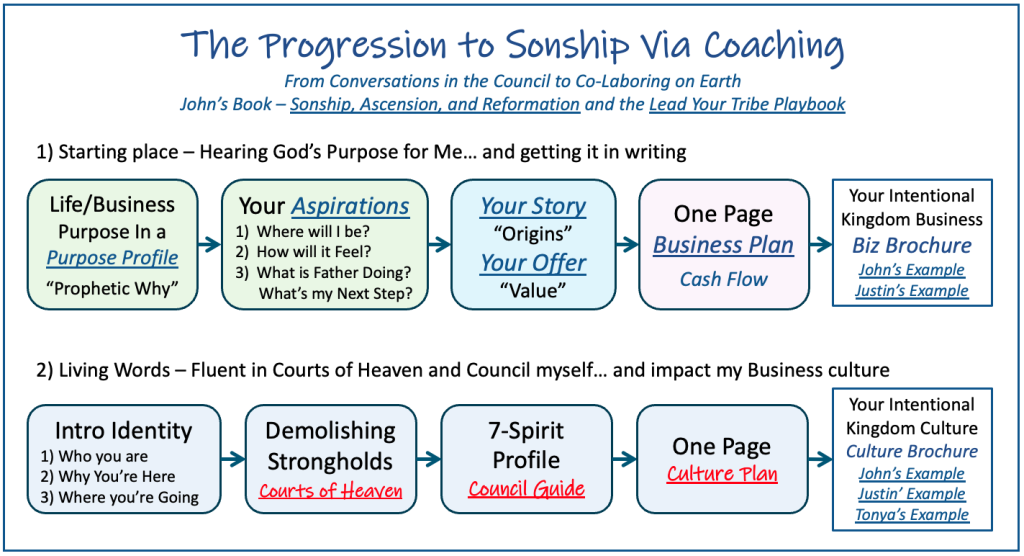
Progression to Sonship – Your Kingdom purpose and redemptive stories form the basis for your personal identity, purpose, value creation, and your business offer. Becoming your authentic self is the Father’s non-religious key to flow and fruit in business and life. We offer practical and prophetic coaching to help you get there, flowing with your Father (co-laboring) instead of fighting circumstances and resistance alone. Is this You?
Read the book and Zoom with John for an overview of our process in Kingdom Business Coaching.
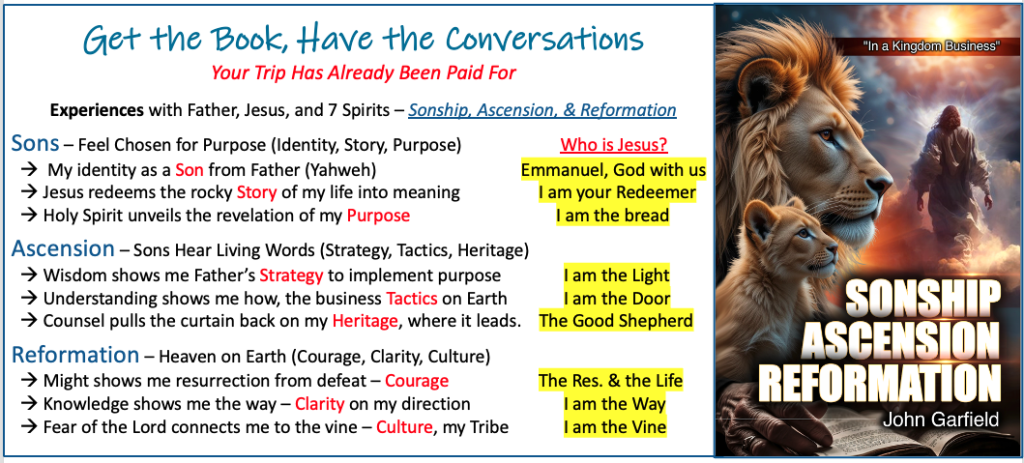
Click the graphic below for access to the live links (how-to details, templates and examples)