Will You Lead With Compelling Purpose?
(or Manage With Competing Personalities)
(Intro Video and Sharable PDF) Most leadership and staffing advice starts with finding the right people: the Guardian for finance, the Connector for sales, the Pioneer for the corner office. It’s efficient shorthand, but it puts the wrong priority in the foundation. If personality is the starting point, you end up building a business around five fixed egos’ instead of around a purpose that is, by its own nature, alive and moving. People will surrender their ego’s at the door if the Kingdom Purpose is compelling and resonates prophetically; if purpose is absent, unclear, or unheard your team will revert back to an all-about-me entitlement work ethic.
Following Purpose Instead of Personality
Here’s the reframe that actually changes how you assemble and relate to your team: purpose and personality are both dynamic, and it’s purpose that aligns personality around what’s currently needed (what Father is doing, Jn 5:19). Nobody carries one gift or one personality profile for a lifetime. What changes in roles and personalities is the written clarity of two dynamics:
#1). Corporate purpose (what Father is doing through the business right now) and
#2). Personal purpose (what Father is doing through me right now).
These purpose dynamics are the agility variables that define your hiring objectives and staff motivations.
Pioneers make the pattern easiest to see, because in a healthy Pioneer, both clarities are unusually well aligned — personal purpose and corporate purpose sit on top of each other almost perfectly, which is exactly why a good Pioneer can cast a vision that makes an entire room lean in. That alignment isn’t a personality trait; it’s a maturity of hearing purpose. Plenty of people on the same team can share the same corporate purpose sincerely and effectively while their own personal purpose is still coming into focus — and that’s not a lesser contribution, it’s just an earlier point in a process every seat eventually walks through.
Practically, this means you’re not hiring five fixed personality types once and calling the org chart finished. You’re staffing a purpose that is moving, with people whose own clarity keeps morphing — which is why the same person can look like a different “voice” on the same project eighteen months apart, without ever becoming a different person.
Inviting people to fossilize their identity around a personality profile or a spiritual gift inventory is the religion of self that actually moves us away from learning to follow the Lamb (Rev 14:4) and keeping in step with the Holy Spirit (Gal 5:25). Sons and Daughters have an organ of perception to hear from outside themselves and the agility to move with the cloud, with Father’s dynamic purpose. It works really well in business! We want a staff with ears to hear corporate and personal purpose, and we want to collaborate with them on the synergism between the two — The goal is co-laboring with Father.
The Five Seats a Growing Purpose Needs
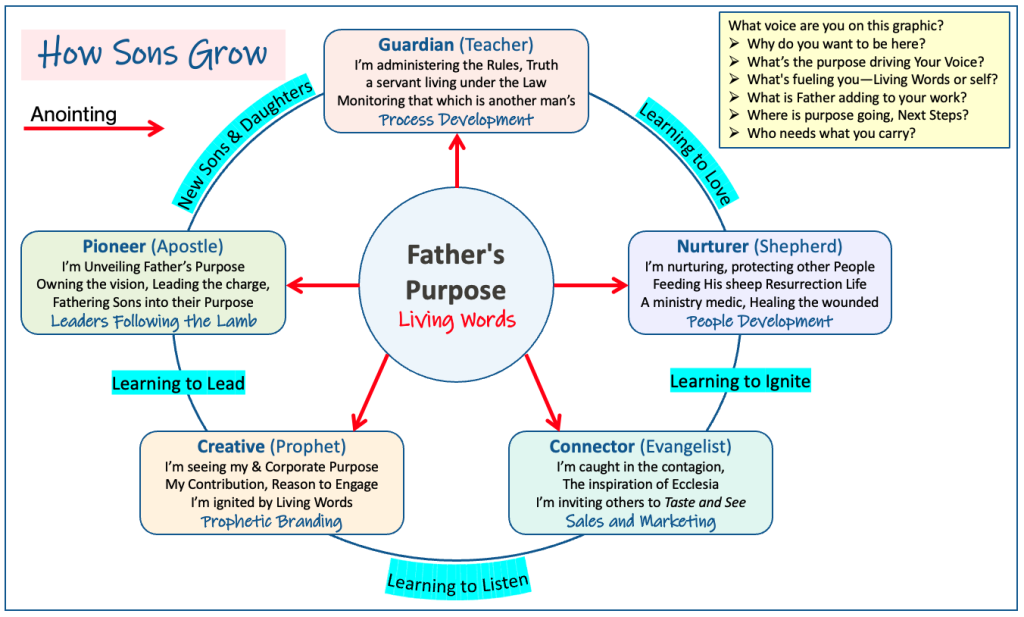
The “How Sons Grow” graphic lays out five functions any growing purpose actually requires, in roughly the order a business tends to need them — not as a ladder someone climbs once and leaves behind, but as five seats a healthy Ecclesia keeps filled at the same time, with people moving between them as both they and the purpose mature.
Guardian (Teacher) — Process Development
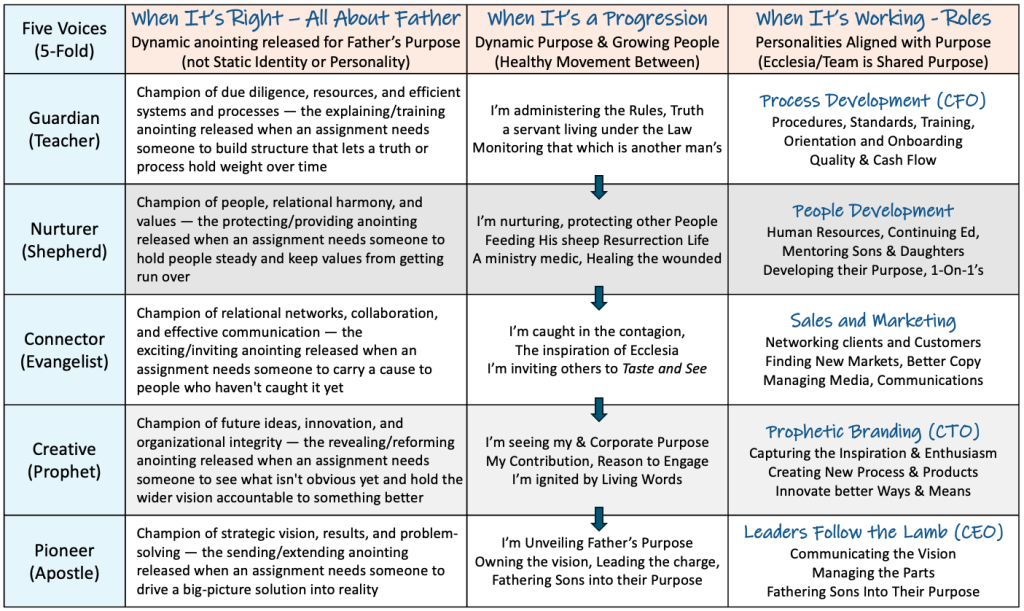
Every business survives the stormy seas of growth and market fluctuations because someone is watching it — the systems, the cash flow, the quality control nobody notices until it’s missing. This is the person who writes down the onboarding process nobody else has time to document, who builds the training manual before the company has grown enough to need one, who catches the invoice that would have slipped through. It rarely looks glamorous, and it doesn’t need to; the personality behind it is comfortable being faithful in that which is another man’s, at ease with detail and due diligence rather than needing to already own the bigger picture.
This personality only turns unhealthy when the process stops serving the mission and starts serving the fear underneath it — rigidity that resists a genuinely better way because change itself feels dangerous, rather than diligence that’s simply doing its job well.
Nurturer (Shepherd) — People Development
A purpose can’t outrun the health of the people carrying it, and this is the seat that makes sure it doesn’t have to. Picture the HR lead or team mentor who notices the account rep quietly burning out three weeks before anyone else does, who has the one-on-one conversations to grasp a person’s real situation and motivation, who invests in someone’s growth long before that growth shows up on a performance review. The personality here runs on relational harmony and something close to a ministry-medic instinct — drawn to the wounded and the overlooked, genuinely energized by someone else’s healing and promotion.
Nurturing tips into its counterfeit the moment care becomes about the caregiver’s own standing — propping people up to avoid conflict, or avoiding a hard conversation because it might cost the relationship, which looks like kindness right up until it stops actually helping anyone.
Connector (Evangelist) — Building the Team
A Kingdom business purpose that goes public becomes an Ecclesia. This is the good news seat that turns an idea with legs into a shared one. Think of the marketing lead who takes a half-formed product concept and gets an entire market excited about it before it’s even finished, or the networker who introduces the right two people at exactly the right moment and watches something catch fire. The personality is contagious almost by definition — relational, energetic, genuinely lit up by bringing people into something bigger than themselves.
Connectors turn counterfeit when that same energy starts rallying people around personal likability rather than an actual word received for them — charisma standing in for substance, momentum built on charm and influence instead of truth.
Creative (Prophet) — Communicating the Brand
Before a business can build the vision for purpose, someone has to actually see it — this is the seat that catches what’s next and makes it visible enough for everyone else to play their role. It’s the product lead who sketches out where the brand needs to go two years before the market catches up, or the person in the room who keeps asking “why are we still doing it this way” until the room finally sees what they’re seeing. The personality is future-facing and genuinely restless with the status quo — not for its own sake, but because something better is visibly, urgently there.
Creatives curdle when the vision stops being received and starts being manufactured to stay relevant — restlessness with the mundane tipping into envy of someone else’s spotlight, innovation performed for attention rather than value.
Pioneer (Apostle) — Owning the Purpose
Somewhere, someone has to actually carry the whole thing — organize the effort, set the pace, and own the outcome in a way no one else on the team is positioned to. This is the founder who can stand in front of a room and make the mission feel obvious, the leader whose personal sense of why they exist and the company’s reason for existing have quietly become the same sentence. The personality is strategic and catalytic, built for weight and comfortable setting a pace others can follow.
Pioneers become pretentious when impatience can’t wait on timing — pushing the assignment forward on raw drive because waiting feels like losing momentum, a restless discontent that’s never satisfied and never stops to celebrate no matter how much has already been built.
Reading the Room, Not the Résumé
None of this means throwing out the assessment. They can be a conversation starter to identify the purpose driving their preferences (or lack of purpose). Before you hire or reassign, the more useful questions are the ones underneath the diagnostic — what does the purpose actually need at this stage? And is the person expressing the healthy version of that seat or its fear-driven counterfeit? What’s leading you? What’s feeding You?)
- An intellectual reason for serving self?
- A son’s invitation to purpose from Father?
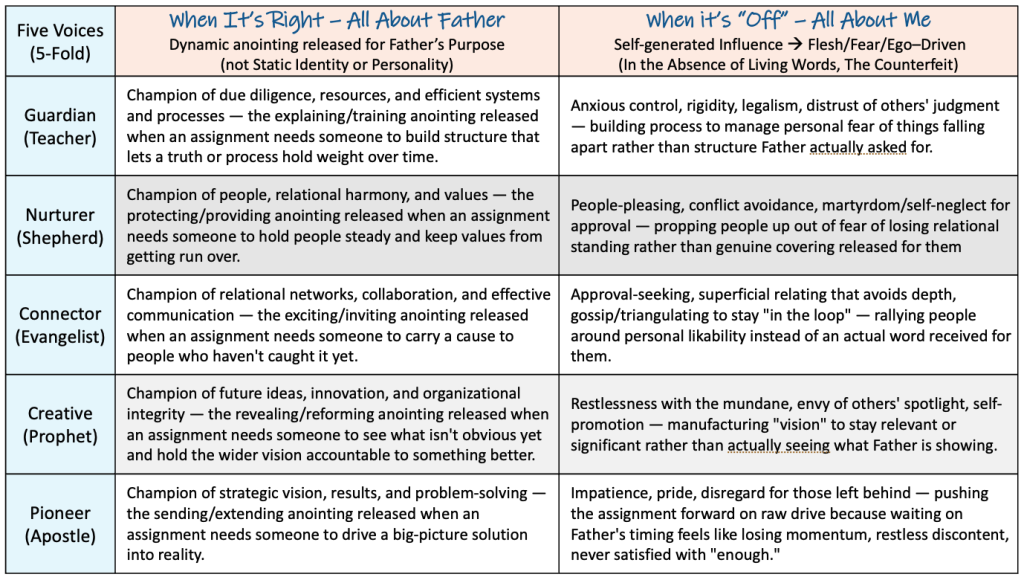
That last question matters as much as the seat itself. Every one of the five has a counterfeit — process that manages fear instead of serving the mission, care that avoids conflict instead of truly covering people, charisma that substitutes for substance, vision that’s manufactured instead of seen, drive that can’t wait on timing. Staffing well means watching for the fruit, not just the function — the same title can be carried in security or carried in self-effort, and only one of those actually builds something that lasts.
Staffed this way, an org chart stops being a static grid of boxes and starts being closer to what it actually is: a living map of where a purpose currently needs to be heard, filled by sons and daughters whose own ability to hear Father is still growing every day.
- This blog was inspired by a Council Session – 2026-09-26 Council – Five Voices
- and some Claude research on personality profiles – 2026-09-24 5 Voices Contrast
Attachment – When Agility is Missing
One common staff mistake that causes a lot of heartache is hiring based on resumes, gifts, and personalities. If we assume that various categories of talent are fixed for a lifetime, people get left behind when the cloud moves. Personality profiles can be an identity placebo for Prophetically correct purpose.
Purpose and personalities are dynamic. We hire for agility and the prophetic resonance that comes from Living Purpose; if we assume people are fixed or allow stagnation, our business can become a relational, financial, and spiritual trainwreck.
Change is painful unless we plan for it. People not connected to Living Words and dynamic purpose get fearful and start to fake-it-till-they-make-it. Pretension is a corporate cancer that kills people and businesses; it’s viewing life through the lens of me; the disease we call it’s-all-about-me! (see graphic)
The escape velocity from the gravity of mediocrity for a Kingdom business is putting Father’s heart first: bringing His purpose to earth in a Reformation of People, Businesses, Cities, and Nations. Sons and daughters volunteer to take up their cross, lay down their ego, and follow their Father’s purpose – it’s more promotion than sacrifice. Leadership is really just prophetic clarity on the path Father has for us, near term and long term (Leaders who can listen!).