A Theology For Sonship
(Intro Video) There’s a version of sonship theology that sounds airtight, and it usually starts with a genuinely good insight. Someone reads Ephesians 2:6 closely — “God raised us up with Christ and seated us with Him” — and notices something real: the subject of that sentence is God. Not me. God raised. God seated. I’m the object, not the actor. Whatever that seat is, I didn’t climb into it, and I don’t have to climb into it again tomorrow. It’s not a place I visit. It’s where I already am.
Followed further, this reading becomes something almost restful. Prayer stops being a strategy meeting and becomes communion. Discernment stops being information-downloading and becomes familiarity with a Person. Purpose stops being an assignment and starts being a relationship — closer to two friends fishing in silence than to a role in Reformation. That’s not a bad place to land. It’s actually beautiful, and it’s true as far as it goes.
Ask Where It Leads
Here’s the honest tension: this reading, taken all the way to its logical end, quietly closes the door on ascension, on the Courts, and on the Council — on anything that looks like ongoing movement between heaven and earth. If the seat is purely a past-tense fact I simply enjoy, there’s nothing left to pursue. I already have all that stuff. Why would I need to ascend anywhere I’m already sitting?
It’s worth taking that argument seriously rather than arguing past it, because the grammar really is there — “raised” and “seated” really are things God did, not things we did. But grammar isn’t the whole text. John 1:51 describes something that doesn’t fit a one-time transaction: “you will see heaven opened, and the angels of God ascending and descending on the Son of Man” — a direct echo of Jacob’s ladder, describing ongoing, active traffic between heaven and earth, in the context of sons, not just angels. Genesis 6 and the Enoch tradition describe a corrupted, illegitimate version of that traffic; John 1:51 shows Jesus redeeming and restoring the legitimate version. John 14:2-3 adds another layer that’s hard to square with pure passivity — Jesus going to prepare a place and coming again to receive us. None of that ongoing movement has anywhere to attach if the seat is only something to enjoy and never something to walk out.
And Scripture doesn’t actually treat positional truth and active pursuit as opposites. Hebrews 4:16 says “let us approach the throne of grace with confidence” — an active verb, aimed at access that’s already secured. James 4:8: “draw near to God and He will draw near to you.” Both commands assume the same thing: what’s already true is exactly what you’re invited to keep walking into. Seeking isn’t the opposite of resting in what’s finished. It’s the redeemed form of actually inheriting it.
The Aha Moment
Seated and ascending were never in competition. You do have your Eph 2:6 seat, you do have a place in Heaven (Jn 14:2-3). It was never meant to be where the story ends. Jesus redeemed the access to Father’s Council (our seat and place), it’s still our job to show up and participate in the conversations. Your Ticket is paid for, but you still have to want it, show up, and use it to get in.
Ps 84:4 – Blessed are those who dwell in Your house! They are ever praising You. Selah
5) Blessed is the person whose strength is in You, In whose heart are the roads to Zion!
6) Passing through the Valley of Baca they make it a spring;
The early rain also covers it with blessings.
7) They go from strength to strength, Every one of them appears before God in Zion.
The Same Argument Cessationists Make
Here’s the part worth sitting with longest: “it’s already accomplished, so we don’t need to actively pursue it” is precisely the logic cessationists use about healing and the gifts. Healing’s in the atonement, the canon is closed, we don’t need ongoing supernatural engagement — that reasoning, followed consistently, quietly retires the very things Scripture keeps commanding us to actively pursue (1 Cor 14:1). If “it’s positional, therefore don’t strive for it” holds for the heavenly seat, it’s hard to see why the same logic doesn’t dissolve prayer for healing, prophetic words, or the miraculous too. Most people making the seated-and-done argument don’t actually want to end up there. But the logic, followed all the way, gets you there anyway.
The Real Dilemma Underneath – Independence
There’s an honest reason this version of the theology is attractive, and it’s worth naming directly: we’re smart enough to take care of ourselves, and we’re pretty holy and wise too — we don’t need more “works” put on our plate. That’s a real, human dilemma in business, not a strawman. But if we build a theology that supports that passive independence, we may wake up decades from now and realize we haven’t moved the needle away from New Thought in business at all. We just gave the child what he wanted so he’d stop crying.
A Litmus Test Worth Using
If sonship isn’t just a seat to enjoy, what does it actually look like lived out? Five things:
#1). Ascension — actual ascending and descending, per John 1:51, not a one-time trip. The role of sonship is bringing Heaven (God’s Kingdom) to Earth. Father is repopulating His council with Sons/Overseers (you and I, when we ascend).
#2). Access to the Courts and the Council — real conversations you can take notes on. I’m routinely in the Courts of Heaven to deal with accusations in the Spirit, and in the Council having conversations with Father, Jesus, and the Seven Spirits (Jn 1:51, 15:16, Rev 4:1). I’m releasing Father’s prophetic decrees from Heaven onto Earth, not waiting for permission.
#3). Living words you bring back and deploy as decrees on earth — prophetically calling things that are not into being, releasing Father’s power for greater works.
#4). Clarity on your own purpose — your specific role in Reformation, not a generic one. Based on the conversations in Heaven, I’m bringing Living Words, clear purpose, and Father’s power onto Earth in a way that redeems people, businesses, cities, and nations.
#5). Practical fruit that remains — in business, and in other sons and daughters you father along the way. Ecclesia@Work forms around shared prophetic purpose. It’s alive.
The Fruit of Sonship
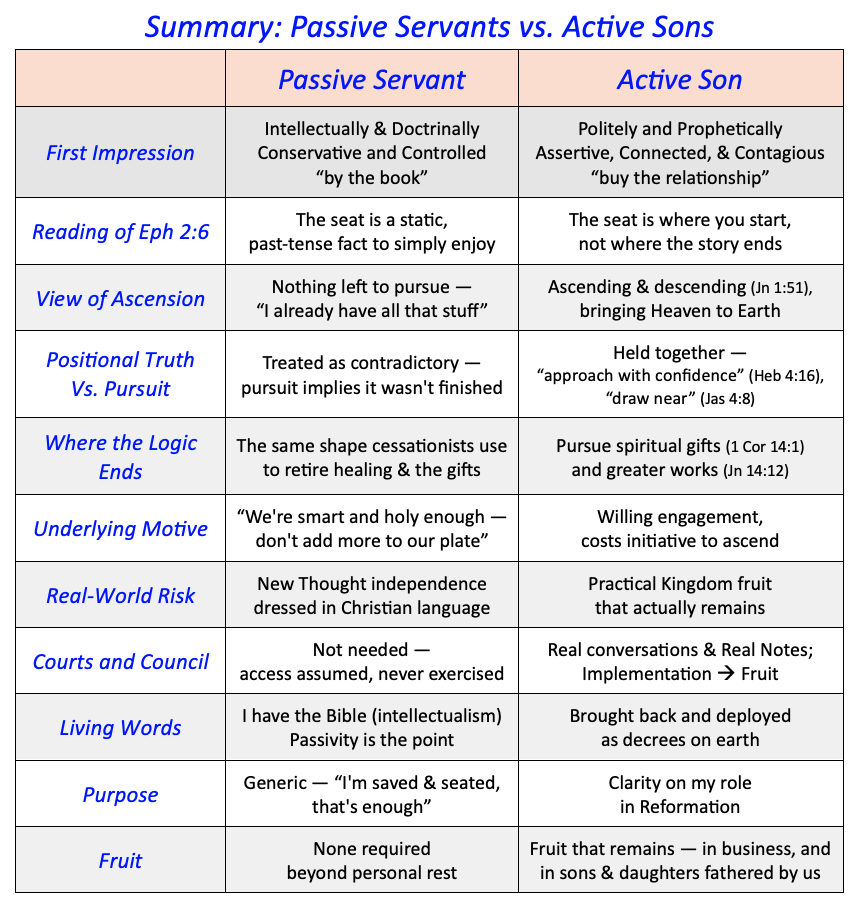
This isn’t a judgment on sincerity, but the posture does tend to show up in first impressions.
-
- Servants who take the “already finished work” route are conservative intellectually and doctrinally. They come across as controlled, controlling, Bible-based, and rule-oriented.
- Sons who have conversations in the Council return with Living Words that are politely and prophetically assertive. They come across as connected, inviting, contagious, and people-oriented.
Think of the difference as stages of growth. As a child we know God by His Biblical values for living, but when we become sons and family we know Him by the passion and the purpose in His heart. We all grow from intellectually living by the principles to relationally following the Lamb. Jesus’ redemption is finished, but the story of Sons inheriting Reformation on Earth has only just begun.
Attachment
2026-09-18 Michael Heiser Interview
https://www.facebook.com/reel/1079297401745878 – 3 min
https://www.youtube.com/watch?v=eGzprqZfw3U – 30 min
In the Unseen Realm, you unpack the Divine Council paradigm: the understanding that God is one of a pantheon of gods, but not in the way you might understand a polytheistic pantheon. He is like the Most High, and then there are other lesser Elohim, lesser gods, if you will, small-g gods.
How does that conflict play out in the New Testament, and how would we recognize this concept in our own world today? It plays out because, in Psalm 82, the very first verse, God Elohim is presiding over a council, an assembly of Elohim (The Gen 6 fallen sons). That’s where the concept really takes hold because of what’s happening in the psalm: God is judging these other Elohim who are over the nations but are corrupt.
That goes all the way back to Deuteronomy 32:8-9, where the nations were assigned, allotted to the other gods and the other gods to them. It’s part of the judgment at Babel, when the nations are scattered. God essentially divorces them, disinherits them from a direct relationship with him, and he puts them under the authority of the sons of God (the Gen 6 fallen sons). They become corrupt, and they seduce the Israelites into worshiping them. That’s why they’re being judged in Psalm 82.
This whole worldview is that the world is really Israel, Yahweh’s own domain, and all the other nations are under the dominion of other gods who become hostile to Yahweh. So Yahweh against the gods, Israel against the nations. Paul inherits this worldview, and these other gods are the principalities, powers, thrones, and dominions, all these geographical dominion terms that Paul uses.
The powers of 6:12, when he says, “We wrestle not against flesh and blood, human opponents, but against principalities, powers.” He’s talking about literal evil intelligences, the evil intelligences that are over the nations under dominion. Israel is the people of God.
The New Testament, again, that fades into the background because you have the church, which is the circumcision, neutral body, Jew and Gentile. The conflict becomes really everywhere that the presence of God is, and that’s in believers. There’s spiritual conflict wherever they are, not just in the 70 nations that the Old Testament writer knew that are listed in Genesis 10, but everywhere on the globe.
God’s plan is to use believers (Sons and Daughters) to take dominion over every place, not just what we’re restricted to in the Old Testament worldview, but every place. Again, the advance of the kingdom of God is framed. Really, in spiritual warfare terms. We’re used to hearing about the kingdom of God and doing nice things to your neighbor, witnessing to people. Those aren’t excluded, but the Bible, actually from the get-go, frames it in terms of a spiritual conflict.
Take the Next Step:
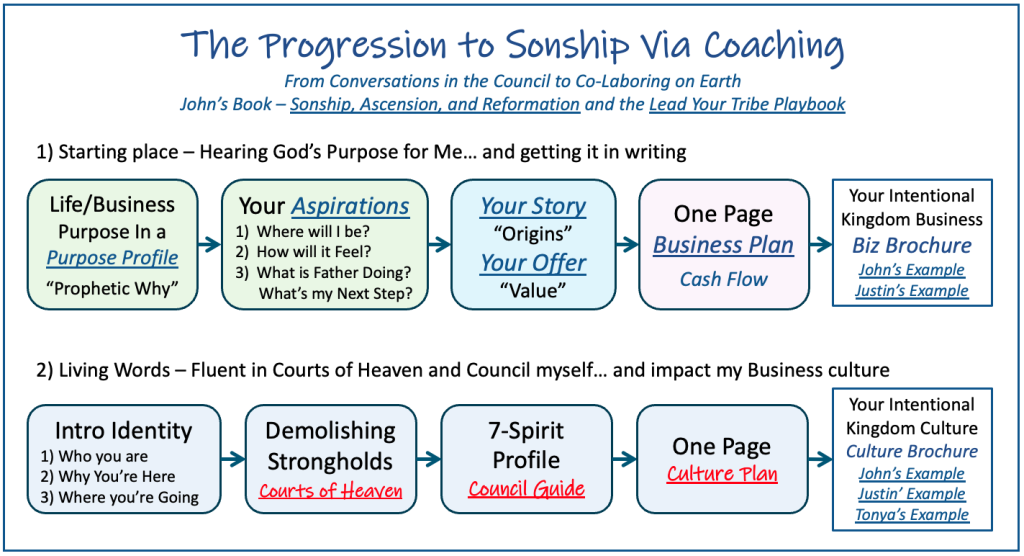
Progression to Sonship – Your Kingdom purpose and redemptive stories form the basis for your personal identity, purpose, value creation, and your business offer. Becoming your authentic self is the Father’s non-religious key to flow and fruit in business and life. We offer practical and prophetic coaching to help you get there, flowing with your Father (co-laboring) instead of fighting circumstances and resistance alone. Is this You?
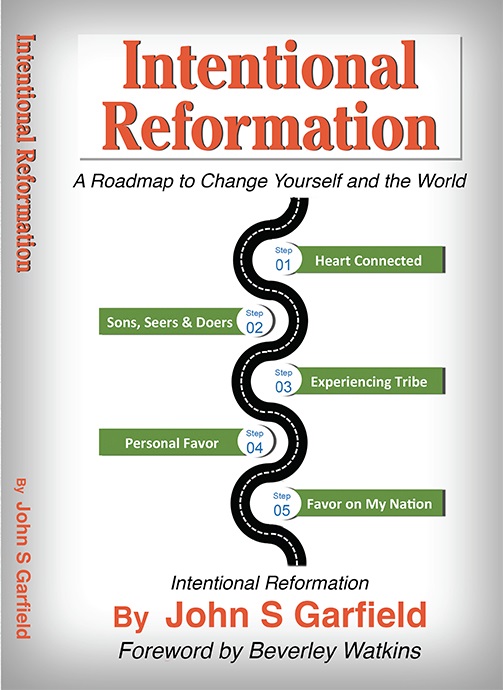
Read the book and Zoom with John for an overview of our process in Kingdom Business Coaching.
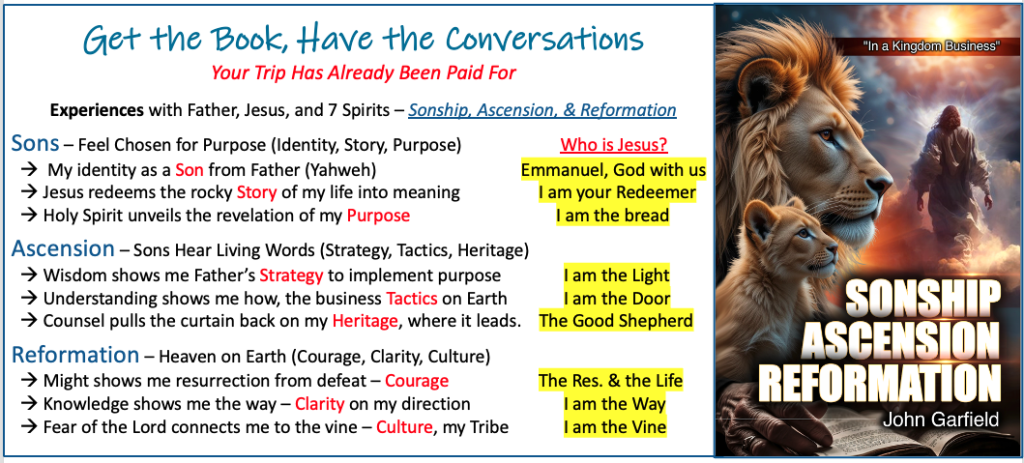
Click the graphic below for access to the live links (how-to details, templates, and examples)