Helping People Find Their Purpose in Your Business
(The most important job of leadership)
There’s a question underneath every staffing decision, every performance review, every incentive structure a business builds, and it’s rarely asked directly: what are we actually inviting people to own? Most businesses answer that question by default — with equity, title, or a piece of the profit. But the Council’s answer points somewhere else entirely:
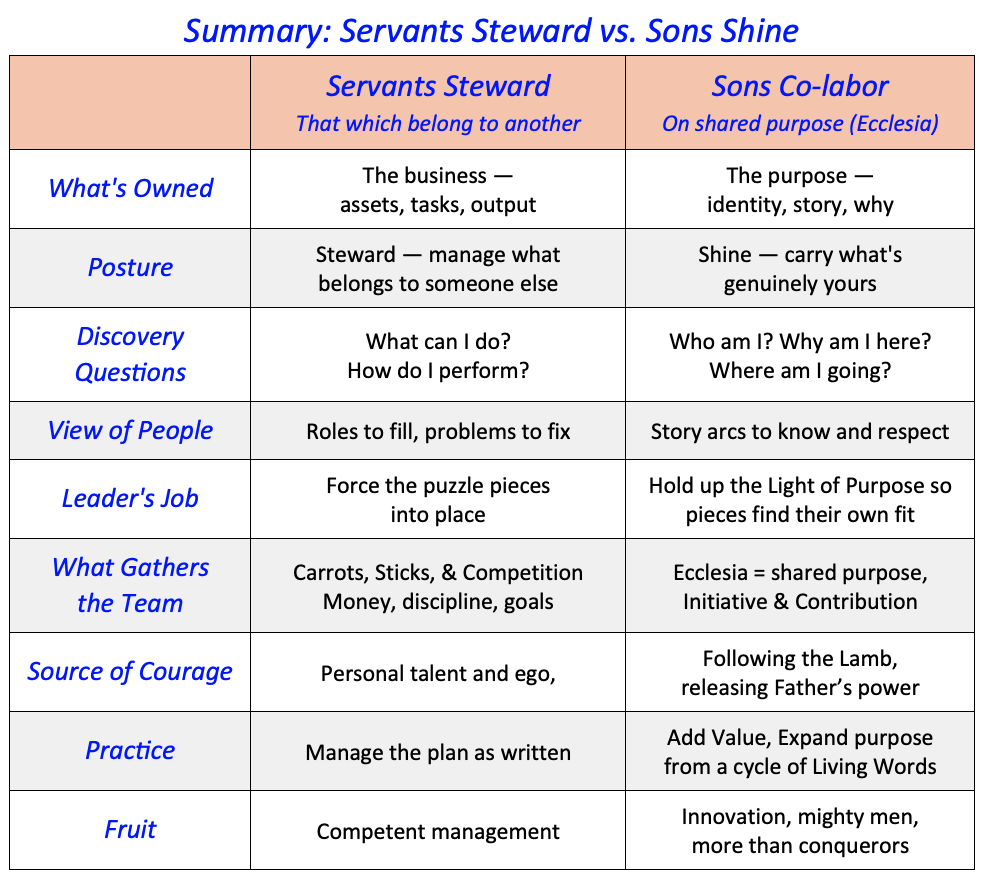
Co-ownership of a business is what servants steward.
Co-ownership of a purpose is what sons shine in.
Those are not the same invitation, and they don’t produce the same person. A servant who stewards a business well is genuinely valuable — but stewardship, on its own, caps out at competent management. A son who owns the purpose behind the business does something a steward structurally can’t: he starts to shine, because he’s no longer managing someone else’s asset. He’s carrying something that’s actually his. The level of commitment and creativity is totally different.
Two Sets of Questions Worth Asking in the Council
Discovering purpose — your own, a staff member’s, or a business’s — isn’t a personality assessment. It’s a Council conversation, and it tends to run through the same two sets of questions.
The first set is personal: Who am I? Why am I here? How do I make it happen? Where am I going?
The second set is purposeful: How does my purpose create value? How does it minister to people? How does it reflect God’s heart? How does it display Reformation?
Most businesses only ever ask the first set — and only about performance, not identity. The second set is what turns a job description into an actual reason to shine at it.
You Can’t Fix People — Start With Their Purpose
Everyone on a team is carrying a story arc worth knowing and respecting: Where does it go? Does it land in Father’s purpose? Does it land in the business’s purpose? Their ability to blossom depends on alignment — with their own purpose, with Father’s purpose, and with the business’s purpose — and on their ability to actually receive mentoring and maturity.
Here’s the leadership trap: don’t sign up to rescue people by fixing them. You can’t — that’s the Holy Spirit’s job — and they don’t want to be fixed anyway. They want to be found. The only sustainable posture is collaborating with what Father is already doing: what He’s already written in their hearts, and where the Lamb is already leading them. What is their purpose that ignites them?
The Puzzle Only Makes Sense With the Light On
I saw this picture: a 1000-piece puzzle, with the seven Spirits at the table helping put it together. The pieces are alive — some fit now, some don’t fit yet because they’re still changing, morphing to fit a future that hasn’t arrived. The puzzle is three-dimensional, plus time, plus Spirit. It’s way too complicated for me.
Then Holy Spirit turns on the Light of Purpose — and the pieces start finding their own place, moving themselves. That’s the actual job description for any leader: not to force the puzzle together, but to hold up Father’s purpose. It’s the light that gathers people under a banner. Once it’s lit, they pull together, help one another, and find they “fit” — not because a leader assembled them, but because Father’s purpose drew them out of their ego and into their own Kingdom purpose and contribution.
Ecclesia: Ownership Shared Is Power Released
Your heritage is symphony — the power of sons pulling together with Father. Ecclesia is simply shared purpose: two or three gathered in His name.
Mt 18:19-20 – if two of you agree on earth about anything that they may ask,
it shall be done for them by My Father who is in heaven.
For where two or three have gathered together in My name, I am there in their midst.
Gathering around a shared purpose releases Father’s power — not gathering around a shared paycheck. That’s the practical difference ownership-of-purpose makes: it’s what actually qualifies as Ecclesia inside a business, and Ecclesia is what Matthew 6:33’s promise is attached to — seek first, and all these things will be added.
Courage Is Owning Purpose Over Ego
Courage, in this framework, isn’t personal bravado. It’s gathering around Father’s purpose — following the Lamb instead of your own dream, releasing His power instead of just your own ego and talent. That’s the actual resource behind “mighty men”: not raw talent, but sons who’ve traded their dream for His and found it released more power than the original dream ever could.
Col 2:3 – Christ Himself, in whom are hidden all the treasures of wisdom and knowledge.
Have the Conversations
Owning purpose isn’t a one-time epiphany. It’s a practice, the same way a professional golfer practices: have the faith, then do the work. Three moves, run as a cycle:
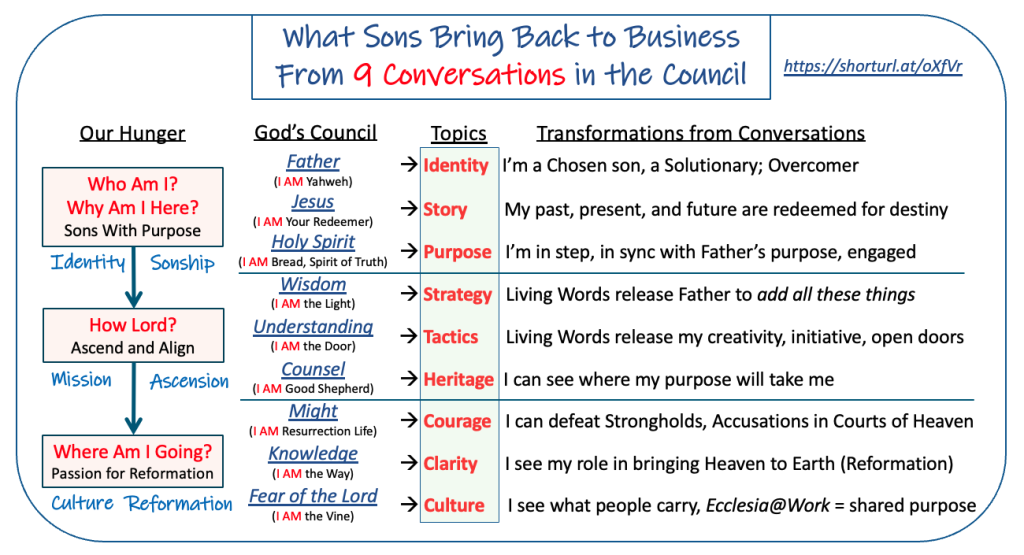
See the purpose — what and why (your Identity, Story, and Purpose)
Plan the approach — how (know your Strategy, Tactics, and Heritage)
Make mid-course corrections — learn to follow the Lamb (get the Courage, Clarity, and Culture)
Pro 3:14-16 – for she (Wisdom) is more profitable than silver and yields better returns than gold.
She is more precious than rubies; nothing you desire can compare with her.
Long life is in her right hand; in her left hand are riches and honor.
So — do you own the purpose, or are you stewarding someone else’s business?
- Servants can do the second one well.
- Only sons do the first (Own Father’s purpose resulting in creativity & Initiative).
Kingdom culture is people discovering what Father carries, seeing where their own purpose intersects it, and voluntarily gathering around that shared purpose… to implement it!
This blog was inspired by a Council Session you will enjoy – 2026-08-14 Council – Ownership
Conversations that Lead to Purpose
Father is leading Sons and Daughters into their purpose. He uses their relational connections in brothers and sisters at work to coach people into finding their purpose. Here two ways you can help them in conversations. Our formal coaching process is detailed in The Lead Your Tribe Playbook.
I use two roadmaps to intentionally include Father in 3-way conversations about purpose with people. I do this formally in coaching and get these answers in writing, or informally in conversations to draw people into “their” purpose. I’m intentionally creating space for Father, Jesus and the 7 Spirits to speak to us. The metric for success is, Did the person I spoke with hear Father themselves?
- The first is hearing what is being said in the Council, 9 Aspects or conversational topics.
- The second is how that person’s purpose translates into practice, a business in four quadrants.
Who am I?
-
-
- Why am I here?
- How to make it happen?
- Where am I going?
-
How does my purpose:
-
-
- Create Value?
- Minister to People?
- Reflect God’s Heart?
- Display Reformation?
-