Follow the Lamb, Not the Money
Two men. Both captives in a foreign empire. Both gifted to interpret dreams no one else could crack. Both elevated to the right hand of a pagan king because of it. And yet Joseph’s rise left an entire nation enslaved, while Daniel’s rise — as a slave himself — helped set people free. Same starting point, same gift, opposite fruit. The difference is worth sitting with, because it’s not really a story about Egypt and Babylon. It’s a story about what you’re actually following when you follow a good opportunity.
Joseph’s System
Joseph’s wisdom during the seven years of famine is rightly celebrated — he genuinely saved lives, including his own family’s. But look at what the rescue actually cost the people he saved. Genesis 47 walks through it in stages: first the Egyptians paid Joseph with money for grain, until the money ran out. Then they paid with their livestock, until the livestock ran out. Then they offered their land. And finally, with nothing left to trade, they offered themselves: “Buy us and our land for food, and we with our land will be servants to Pharaoh” (Gen 47:19). Joseph’s administration didn’t just survive the famine — it ended it with the entire population landless and indentured to the crown, a fifth of every harvest owed to Pharaoh from then on.
That’s the uncomfortable part. Joseph wasn’t a villain. He was brilliant, faithful, and genuinely used by God. But his gift got fully absorbed into Pharaoh’s system, and the fruit of that system was a nation permanently mortgaged to an empire. Good administration, applied without a different allegiance underneath it, still built Pharaoh’s kingdom — not God’s.
Daniel’s Integrity
Daniel started from a harder position than Joseph — a captive with no family influence, taken from a conquered nation, serving kings who’d destroyed his own. And yet he never let the empire absorb him the way it absorbed Joseph’s administration. He refused the king’s food rather than compromise on something small (Dan 1). He kept praying toward Jerusalem three times a day even after a law was signed specifically to trap him in it, penalty of death (Dan 6). He told Nebuchadnezzar the truth about his pride when flattery would have been safer and more lucrative (Dan 4). At no point did Daniel build a personal empire inside the empire — no land, no indentured servants, no fifth of anyone’s harvest.
And look at the fruit: two separate pagan kings, in two separate books, end up publicly decreeing that the God of Israel is the true God. Nebuchadnezzar: “I praise and exalt and glorify the King of heaven” (Dan 4:37). Darius: “he is the living God… His kingdom will never be destroyed” (Dan 6:26). Daniel was a slave his entire adult life. And his faithfulness set more people free — toward the true King — than Joseph’s brilliant administration ever did.
The Same Choice Today
This is where it stops being ancient history. People get talked into investments, business opportunities, and even ministry assignments constantly — and the pitch rarely sounds like greed. It sounds like generosity: this opportunity will finally let you give the way you’ve always wanted to. It sounds like calling: this uses exactly the gift God gave you, you have an anointing for it. It sounds like blessing: look how obviously favored this is — surely it’s God’s will. That packaging is precisely what makes it dangerous. Idolatry rarely announces itself. It shows up wearing exactly the language a sincere person would find hardest to say no to.
The test was never whether the opportunity is gifted, generous-sounding, or wrapped in spiritual language. Joseph’s system had all three going for it, and it still ended in bondage. The actual test is the one underneath: are you following the Lamb wherever He leads (Rev 14:4), or are you following the money and calling it faith because the money came dressed like an open door, an answer to prayer?
The offer is usually something that temps our dream for promotion and prosperity clothed in following “me” instead of following the Lamb. Father’s offer is built around something in His heart. It may be in my heart as well, but my heart alone isn’t the decision maker. The key that opens the door to Kingdom is sharing the purpose in Father’s heart.
Follow the Lamb, Not the Money
Joseph and Daniel weren’t opposites in gifting, character, or usefulness to God. They were opposites in what their gift ultimately served. One built a system that owned people. One stayed owned by nothing but his own devotion to Father, and it made kings kneel.
Before you say yes to the next opportunity that promises to finally fund your generosity, finally release your gift, finally prove God’s favor on your life — ask the only question that actually matters: if this succeeds exactly as promised, is it really Father’s leading, does it set people free, or does it just quietly own them? Does the promise of this dream fulfilled just own you?
Is it just ego click-bait from the devil to give you what you want or is it really following the Lamb.
Did God really lead Israel into Goshen?
Or was it following the Money?
The next question is, If I’m already in blessing (the money), am I willing to follow the Lamb and risk losing what I have. That’s Israel’s delima for 400 years in Goshen.
God did explicitly confirm the move? This isn’t ambiguous in the text. When Jacob is on his way down to Egypt and stops at Beersheba, God speaks to him directly in a night vision: “I am God, the God of your father… Do not be afraid to go down to Egypt, for I will make you into a great nation there. I will go down to Egypt with you, and I will surely bring you back again” (Gen 46:2-4). That’s not Jacob rationalizing a decision after the fact — it’s an unprompted theophany confirming the move before he crosses the border. And it wasn’t even new information: God had already told Abraham centuries earlier that his descendants would go down into a foreign land, be enslaved and afflicted for 400 years, and come out with great possessions (Gen 15:13-14). Goshen wasn’t a detour from the plan. It was the plan, spoken generations in advance.
But look at what actually drove the decision on the ground. The original trip to Egypt wasn’t a response to a divine call at all — it was Jacob’s sons going to buy grain because they were starving (Gen 42:1-2). The move to relocate permanently only came after Joseph revealed himself and dangled the offer: come down, and “I will give you the best of the land of Egypt, and you will eat the fat of the land” (Gen 45:18). Pharaoh doubles down on the same pitch (Gen 45:20). When Jacob’s family actually arrives, Joseph settles them in Goshen specifically because it’s the best grazing land in Egypt (Gen 47:6, 11) — and notably, because shepherds were “detestable to the Egyptians” (Gen 46:34), which conveniently kept Israel geographically and culturally separate, but also comfortably provided for. So: yes, God had already spoken it. And also: the actual, felt reason the family packed up and moved was provision, security, and the best real estate on offer during a famine. Both things are true in the same story.
Here’s where it connects to the Joseph pattern to Israel. The very system Joseph built to consolidate Egypt’s land and population under Pharaoh’s control is the same system, one Pharaoh-generation-who-didn’t-know-Joseph later, that turned around and enslaved his own descendants (Ex 1:8-14). Israel went to Goshen chasing “the best of the land” during a famine — reasonable, human, and not condemned anywhere in the text — and multiplied there for four centuries in what started as comfort and safety. Comfort was never the destination God actually had in mind; Canaan was. But comfort was compelling enough, generation after generation, that nobody left until they couldn’t leave anymore.
That’s the sharper version of the question worth asking, and it’s the same one underneath the Joseph/Daniel contrast: God can genuinely be in an opportunity, and the opportunity can still become the very thing that roots you somewhere you were supposed to pass through, not camp. Provision being real, and even prophesied, doesn’t automatically mean provision was the point. Goshen was good land. It was also, 400 years later, a slave camp. Both descriptions are accurate, and the first one is what made the second one possible — am I agile enough as a son to leave the best land in Egypt voluntarily to follow the Lamb. Does money move me?
Worth asking of any “obvious provision” today: Is this Canaan, or is this just very good Goshen?
Take the Next Step:
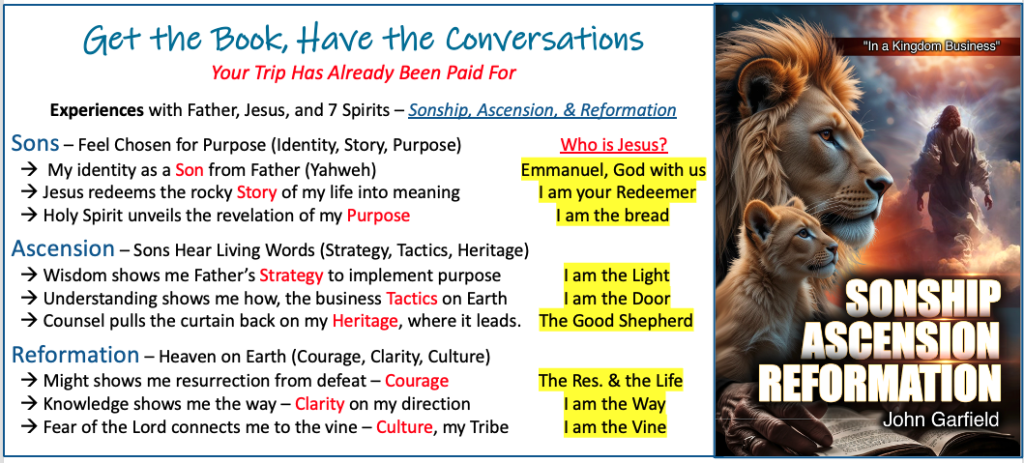
Progression to Sonship – Your Kingdom purpose and redemptive stories form the basis for your personal identity, purpose, value creation, and your business offer. Becoming your authentic self is the Father’s non-religious key to flow and fruit in business and life. We offer practical and prophetic coaching to help you get there, flowing with your Father (co-laboring) instead of fighting circumstances and resistance alone. Is this You?
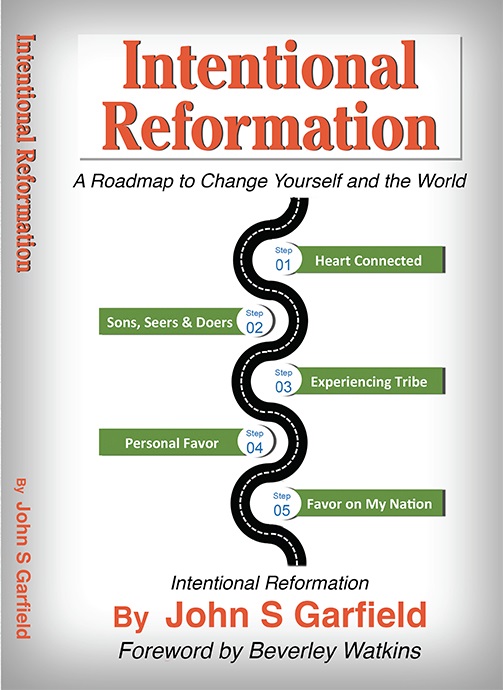
Read the book and Zoom with John for an overview of our process in Kingdom Business Coaching.