Speaking to the Heart
How Sons Hear from the Council and Mirror Father’s Words Back to People
Putting Heart in business via Sonship, Ascension, and Reformation
Foreword (Intro Video & Sharable PDF)
Decisions are made with the heart, not the head. Whether it was your last purchase of a house, car, clothing or selecting the spouse you fell in love with, your heart made the decision, and your brain made the justification. The head rationalizes what the heart has already decided.
Neuroscience bears this out too: research into emotional processing has consistently demonstrated that patients who lose access to the emotional centers of their brain become incapable of making decisions, even when full rational capacity is intact.
Hearts make decisions — but the implications depend entirely on the framework you bring to it. New thought philosophy hears “the heart decides” and concludes that the heart is simply the subconscious mind, a programmable mechanism that can be loaded with the right imagery, affirmations, and identity cues in order to produce desired outcomes. The practitioner becomes the programmer. Persuasion becomes a form of inner-game software installation. It produces inauthentic people disconnected from their own hearts. The burnout is tragic in the long run.
We’re taking a different position. The heart is not a subconscious mechanism — it is the place where Father’s Living Word lands and takes root. Proverbs 4:23 says, “Above all else, guard your heart, for everything you do flows from it.” The heart is the wellspring of a person’s life, the deep place where God deposits identity, story, and purpose before any of it surfaces in conscious awareness. When a person senses that something is “right for them,” it can be because the Father has already been speaking that direction to their heart — and they are hearing it. Learning to discern the difference between flesh and spirit is maturity, easy.
-
- The deepest and most enduring motivation is not our personal desires or dreams.
- It’s sharing the purpose in Father’s heart that is also written in our heart.
- It’s being integral with myself; God’s handiwork created in Christ to do His works in His power as sons and daughters of the King of kings.
Learning to Listen – The critical implication for sons is this: the most powerful thing you can do in any conversation is not to engineer the other person’s heart through technique, but to hear from the Father about what he is already saying to their heart — and then mirror it back to them. That is what Jesus modeled. He did not manipulate. He saw people. He named what was already in them. He called Nathanael before Philip found him. He told the woman at the well everything she had ever done. He looked at Simon and saw Peter. Sons who ascend to the Council and bring Living Words back to the earth are doing the same thing — not programming the heart but echoing what Holy Spirit is already speaking into it.
Sons do not engineer the heart. They hear from the Father about what he is already saying to someone’s heart — and mirror it back. People feel seen and loved. Our words confirm what they already hear from Holy Spirit.
Here’s how – Seven practical ways to put heart in your business that follow are a framework for doing exactly that — speaking to the heart from the Council, in the context of identity, story, and purpose, so that the person in front of you moves from confusion to clarity about who God made them to be and what he is inviting them into.
Summary – The Living Words you hear can be binned into Identity, Story, Purpose, Strategy, Tactics, Counsel, Courage, Clarity, and Culture “because” they come from Father, Jesus and the 7 Spirits (the Council). This is the inner game of sharing Living Words. And it flows directly from the Council framework in the graphic below: sons who ascend and align — who have had the nine conversations with Father, Jesus, and the Seven Spirits of God (Rev 1:4, 3:1, 4:5, 5:6) — bring back Living Words that speak to hearts. Those words, spoken into the hearts of the people, are not sales techniques. They are the work of Reformation — one person, one conversation, one council-informed Living Word at a time.
The heart does not need to be programmed. It needs to hear what the Father has already been saying. Sons who ascend carry that word. Their job is to be faithful enough to deliver it.
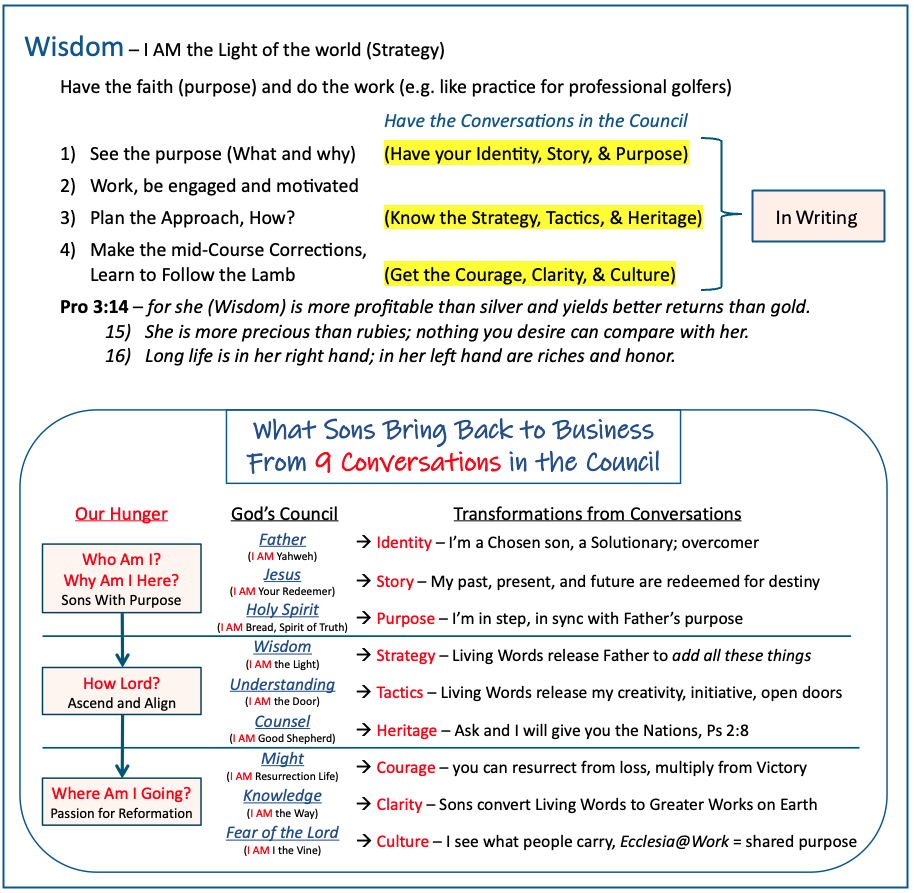
PS: It’s possible to hear required obedience flowing from conversations in the Council. It’s really co-laboring or sonship. Father’s purpose will actually enhance your creativity and initiative. He’s looking for sons who contribute, not servants who only do what they are told. Ingenuity is a huge asset that is only multiplied when we have clarity on Father’s purpose and our role. The ongoing conversations in the Council about course corrections are a saving grace that actually lead to more opportunity and fewer dead ends – it’s freedom and fun, especially in business!
7 Ways to Speak to Hearts – Each of these seven relational clues is expanded with examples; each is doing the same thing from a different angle: clearing the interference between a person and words Father has already been speaking to their heart about who they are, what he has redeemed in their story, and where he is taking them.
#1). Love: removes performance anxiety so our heart becomes available, transparent.
We’re all somewhat insecure and guarded until we know our conversation is with someone we can trust; someone who loves us and puts us first.
#2). Identity: removes incongruence by echoing the Father’s declaration over who we are.
It’s how we get connected to our own identity, authenticity.
People who see the DNA in our kingdom identity and point to it prophetically always catch our ear.
#3). Story: removes accusation by carrying Father’s redemptive perspective on our history.
We all have some trainwrecks in our past. Someone who can help us put those tragedies and mistakes in a redemptive framework is very healing and welcome. “All things work together for Good for those who love God and are called according to His purpose” (Rom 8:28).
#4). Purpose: removes abstraction by reporting what Father has already prepared for us.
No one is changed or even motivated by a convincing argument or a better theology. We all want the liberty to choose our prophetic purpose from Heaven. Who can help me get that purpose, in writing? …is someone I love and respect.
#5). Co-laboring: removes pressure by releasing the outcome back to the Father.
No one likes cold accountability, self-discipline without desire, or forced labor. We are all designed to co-labor with Father on our unique purpose, voluntarily!
#6). Silence: removes noise by waiting on the Lord rather than filling space with words.
No one likes to be preached at. Are those who lead us capable of listening to Father and sharing His words? Or are they just droning on with the script of what they want from us as servants at their disposal?
#7). Leading: removes hesitation by voicing what the Spirit has already deposited.
Charismatic leaders we’re willing to follow are those who can say what God is saying in a way that prophetically resonates. Good leaders give themselves permission to take the risk to do so. We can all tell the difference.
Addendum
7 Ways to Put God’s Heart in Your Business
#1: Hearts Speak the “Safe” Language of Love
The heart operates like a drawbridge. Under threat — real or perceived — it closes, and the head takes over in defensive mode. Under safety, it opens. This is not a soft idea. The body’s threat-detection system scans every new interaction for danger before any deeper engagement begins. If it senses pressure, judgment, or agenda, the bridge goes up. Nothing you say after that point reaches the heart.
For sons, loving people is not a technique — it is a byproduct of presence. When you have been in the Council and carry the Father’s perspective on the person in front of you, the way you look at them changes. You are not scanning for an opening or managing an outcome. You are genuinely curious about what God has put in them and listening (to them and God). That posture is disarming in a way that no conversational tactic can replicate, because people’s hearts can sense the difference between someone who sees them and someone who is working on them.
People’s hearts can sense the difference between someone who sees them
and someone who is working on them. It feels like love.
The most powerful safety signal is listening to understand rather than to respond. Most people in transactional settings are waiting for their opening. The heart can feel that. When a son listens from a place of genuine interest — unhurried, without an obvious agenda, asking questions he actually wants the answer to — the other person’s guard drops. They become available for a real conversation.
When you carry the Father’s perspective on a person, the way you look at them changes — and their heart registers it before you say a word.
Example — About 15 years ago I went with several other businessmen to Poland doing business conferences. We did breakout sessions for individuals and just asked them about their dream and shared what we could “see” both prophetically and practically. It was the first time anyone suggested God could see their dreams. That hadn’t happened with parents, teachers, managers, pastors – no one had ever tried to see their hearts before. It was fun, but what surprised me most is the way they loved us back. When you see what God wrote in someone’s heart and share your own heart, that’s a depth of relationship that lasts a lifetime.
Jn 13:34 – By this everyone will know that you are my disciples, if you love one another.
#2: Speak to Identity, Not Logic
People do not make decisions primarily on the basis of features, returns, or specifications. They make decisions based on who they believe they are and who they are becoming. When something aligns with their identity, the heart recognizes it as congruent and moves toward it. When it conflicts with their self-image, no amount of logic closes the gap.
New thought teaches that identity is a psychological construct — something to be reprogrammed through affirmation and visualization. The Sonship framework starts from a different premise: identity is assigned by the Father before birth (Jeremiah 1:5), written into a person’s scroll (Psalm 139:16), and has been waiting to be discovered rather than manufactured. When a son ascends to the Council and asks, “Father, who is this person?” — what comes back is not a sales profile. It is an echo of what God declared over them before they were born.
When you speak that identity back to someone, even in a natural, non-religious way, the heart recognizes it as true. You are not flattering them or programming them. You are holding up a mirror to something the Father has already spoken. The response is almost always the same: a quiet pause, a slight lean-in, and an expression that says, “how did you know that?” The son did not know it from observation. He heard it from the Father.
Identity is not a construct to be reprogrammed. It is a declaration by the Father, written before birth, waiting to be discovered — and echoed back.
Example — Justin is starting a crypto banking business and is negotiating with investors. It’s been a six-year process he has self-funded. Potential investors review the business plan, cash flow, and legal documents to make a good “intellectual” business decision. Recently Justin started share his own compelling origin story, purpose profile, and aspirations in what we call a brochure. It communicates his prophetic purpose to investor hearts and creates the space for them to resonate. It works perfectly for the people Justin wants to work with who share the same prophetic purpose. See Justin’s example for BankWyse and John’s example for Kingdom Business Coaching.
Lu 24:31 – Then their eyes were opened and they recognized him, and he disappeared from their sight.
32) They asked each other, “Were not our hearts burning within us while he talked with us on the road and opened the Scriptures to us?”
#3: Anchor to Their Redeemed Story
Every person is living inside a story they are telling themselves — about who they are, what they deserve, what is possible for them, and what they are afraid of. In most cases, that story is a mixture of real history and enemy accusation. The wounds are real. The narrative built around them is often a lie.
New thought coaching addresses this by trying to replace the negative story with a positive one through visualization and reframing. That is not what sons carry. Jesus is the redeemer of stories, not the editor of them. He does not coach people into a better self-narrative. He enters the actual history — the betrayal, the loss, the failure, the shame — and transforms its meaning from the inside out. Romans 8:28 is not a positive-thinking framework: it is a declaration that the God who governs history can make even the worst chapters serve the destiny he planned.
When a son enters someone’s story from the Council, he is not offering reframing techniques. He is carrying the Father’s perspective on what that story means — which is often the exact opposite of what the enemy has been saying about it. The prison sentence that broke Ferren’s trust in people was not wasted. The season of betrayal that left Tonya isolated was not an accident. These chapters were never the end of the story. A son who has been in the Council can speak to that with authority because he has heard what the Author of those stories says about them.
Jesus does not reframe stories. He redeems them. A son carries the Father’s perspective on what a person’s hardest chapters actually mean.
Example — Simon Sinek famously says, “People buy your why.” The reason that is a credible marketing tactic is because those same people see something of their own purpose when you share yours. They get a prophetic glimpse of their own destiny that resonates in their heart. Since our hearts make buying decisions they are choosing to take a step toward their destiny in the purchase. As salespeople, we can help other reach their purpose with our products, or we can selfishly manipulate them to improve our bottom line. The secret is that it’s not hard to discern the motive behind sales. People love the help and hate the manipulation.
Jer 1:5 – Before I formed you in the womb I knew you,
before you were born I set you apart;
0
#4: See Purpose from the Council
Information is processed by the thinking brain. Imagery — vivid, sensory, future-oriented pictures — is processed by the feeling centers that govern emotional decisions. When you describe a future state in prophetic, experiential terms, you are not making an argument It feels to them like a loving invitation to something they have already heard. You are creating an encounter. The heart responds to encounters and experiences, not arguments. Hearts also need to know “why” before they make decisions. Father isn’t afraid to connect our dots to our why. I have called you friends, for everything that I learned from my Father I have made known to you, Jn 15:15.
When you describe a future state in prophetic, experiential terms, you are not making an argument. It feels to them like a loving invitation to something they have already heard. Their purpose.
This is true in both new thought and Sonship — but the source is completely different. New thought uses imagery to activate the subconscious toward self-defined goals. Sonship uses vision to communicate what the Father has already prepared and placed in a person’s scroll. The difference is not technique; it is authority. A son who has been in the Council and seen the Father’s vision for a person can describe that future with a weight and specificity that no motivational framework can replicate — because it is not invented. It is reported.
When the vision for purpose lands, the heart does not respond by saying “that sounds great.” It responds by saying “that is mine.” There is a quality of recognition rather than aspiration. This is what prophetic words do at their best: they do not introduce something foreign into a person’s life. They name something that was always there, and the heart says yes before the head has had time to evaluate it.
Vision from the Council is not motivational imagery. It is a report of what the Father has already prepared — and the heart recognizes it before the head evaluates it.
Example — John shares a picture with Tonya from the Council: “I see your business becoming a place where people come for the travel and stay because of what happens to them in the process. Not just clients — your staff. I see your mid-level managers becoming people who are genuinely known and transparent, and that culture spreading beyond One Flight into whoever they touch next.” Tonya is quiet for a moment. Then: “I’ve seen exactly that. I’ve even heard one of the managers say it.” She was allowed to choose it. The Father painted to it first.
Deut 31:8 – The LORD himself goes before you and will be with you; he will never leave you nor forsake you. Do not be afraid; do not be discouraged.
#5: Co-Labor, Don’t Compel
Pressure is the death of a heart decision. When a person feels pushed, they move from openness to defense. Even if they eventually comply, it is the head that has capitulated — not the heart — and that produces short-lived commitment and eventual resistance. New thought sales training knows this and teaches “invitation over pressure” as a technique. The principle is correct; the foundation is still manipulation, just a softer version of it.
Sons co-labor. This is a fundamentally different posture. Co-laboring means following the Lamb — doing what the Father is doing, saying what the Father is saying, and then releasing the outcome. It means you are not trying to win a decision. You are participating in a work the Father is already doing in that person. If they are not ready, the Father is not done. If they are ready, the decision will feel obvious to them rather than pressured by you.
The language of co-laboring is exploratory and conditional: “What would change for you if…”, “When you imagine that being true…”, “What would feel right to you about…” The real question is “What is prophetically correct from God’s perspective and yours?” We can make suggestions, even put words in their mouth – as long as they are Father’s words for them, they will adopt your suggestion as their own. And often times forget to give you credit.
These questions do not push. They open. And they communicate something the heart registers immediately: the person speaking does not need anything from you. That absence of need is one of the most powerful trust signals that exists.
Sons do not need to win a decision. They participate in what the Father is already doing in the other person — and then release the outcome.
Example — Tonya does not close her manager on a culture change or a purpose conversation. She says: “You’ve told me you want to make people great. I believe you. What if we figured out together what that actually looks like for your team — not as a management principle, but as something they actually feel?” He has heard that invitation in Tonya’s language before. This time it has traction because the ground has been prepared. She is not pushing. She is simply holding the door open that the Father has already been opening in his heart.
Jn 5:19 – the Son can do nothing by himself;
he can do only what he sees his Father doing,
because whatever the Father does the Son also does.
#6: Wait on the Lord — Silence Is a Council Practice
In a world of relentless noise, silence is profoundly disarming. Most people in conversations are terrified of it and rush to fill it with more words. But that impulse pulls the other person back into their head, where they analyze and resist. Silence, by contrast, creates space for the heart to surface what it already knows.
For sons, silence in conversation is not merely a tactical pause. It is the practice of waiting on the Lord — remaining attentive in the Council even while a conversation is happening, listening for what the Father wants to say next rather than what you have prepared to say next. Isaiah 40:31 says those who “wait on the Lord” will renew their strength. That word for waiting (qavah) carries the sense of being in expectant, attentive service. It is not passive. It is the posture of a son who knows that the next move belongs to the Father and is willing to hold the silence until it comes.
There is also a trust signal embedded in a comfortable silence. A person who can be quiet is a person who is not desperate. Desperation is the enemy of trust. When you wait without anxiety, you communicate that the answer is already there — you are simply giving it room to arrive.
Silence in conversation is a Council practice. It is the posture of a son who knows the next move belongs to the Father — and is willing to wait for it.
Example — John has just spoken to Tonya about hinds’ feet on high places — that the Lord has her positioned in an exposed, difficult, but appointed place. He says it and then stops. Several seconds pass. Tonya is not being sold anything. She is processing something true in a place deeper than argument can reach. When she speaks, it is not to respond to John. It is to agree with what the Father has been saying to her heart all week. The silence held the space for that agreement to surface.
Isa 40:31 – but they who wait for the LORD shall renew their strength; they shall mount up with wings like eagles;
they shall run and not be weary; they shall walk and not faint.
#7: Lead With Prophetic Purpose
The heart often knows before the mind has given it permission. In most significant conversations, there is a moment — usually quiet, sometimes barely visible — when the person has already received what the Father has been saying to them but has not yet found the courage or the language to declare it. A son who recognizes that moment and names it is not manipulating. He is being prophetic. He is simply voicing what the Spirit has already done.
This is the pattern throughout Scripture. Jesus looked at Peter, who was still introducing himself, and said, “You will be called Cephas.” He did not wait for Peter to discover his identity over time. He named it in the moment of meeting. The Father’s word to Jeremiah was not a career suggestion: “Before I formed you in the womb I knew you; before you were born I set you apart.” Identity is declared before it is lived. Sons carry the authority to echo those declarations into the lives of people around them. The best leaders of people are the best followers of the Lamb. It’s how we know where to go and what to do.
The language is offered as an observation, never a conclusion: “I think part of you already knows this is true…”, “Something in you recognized that before I finished saying it…”, “This isn’t new to you, is it — you’ve been carrying this for a while.” If you are wrong, they will say so. If you are right — and when it comes from the Council, you usually are — their heart will nod, and the conversation will shift from negotiation to agreement.
Sons do not wait for people to discover their identity on their own. They carry the authority to echo what the Father is already saying — and the heart recognizes it as true.
Example — We help people fill out their purpose profile. At first it seems intellectual with questions about their dreams and desires, where they want their life to go. As phrases are evaluated to articulate their path, some resonate and some don’t. Quite often the leader can offer a phrase that is closer to God’s heart and their heart and they adopt it. That’s what leaders do… offer God’s purpose, strategy, and tactics to let people choose them because they fit (in their hearts) and work in their lives.
Jn 15:15 – I no longer call you servants, because a servant does not know his master’s business. Instead, I have called you friends, for everything that I learned from my Father I have made known to you.
16) You did not choose me, but I chose you and appointed you so that you might go and bear fruit—fruit that will last—and so that whatever you ask in my name the Father will give you.
Summary
Every one of these relational cues is doing the same thing from a different angle: clearing the interference between a person and the word the Father has already been speaking to their heart about who they are, what he has redeemed in their story, and where he is taking them.
#1). Love: removes performance anxiety so our heart becomes available, transparent.
#2). Identity: removes incongruence by echoing the Father’s declaration over who we are.
It’s how we get connected to our own identity, authenticity.
#3). Story: removes accusation by carrying Father’s redemptive perspective on our history.
#4). Purpose: removes abstraction by reporting what Father has already prepared for us.
#5). Co-laboring: removes pressure by releasing the outcome back to the Father.
#6). Silence: removes noise by waiting on the Lord rather than filling space with words.
#7). Leading: removes hesitation by voicing what the Spirit has already deposited.
The words you hear for others can be binned into Identity, Story, Purpose, Strategy, Tactics, Counsel, Courage, Clarity, and Culture “because” they come from Father, Jesus and the 7 Spirits (the Council). This is the inner game of Kingdom conversation. And it flows directly from the Council framework in the graphic above: sons who ascend and align — who have had the nine conversations with Father, Jesus, Holy Spirit, Wisdom, Understanding, Counsel, Might, Knowledge, and the Fear of the Lord — bring back Living Words about Identity, Story, Purpose, Strategy, Tactics, Heritage, Courage, Clarity, and Culture. Those words, spoken into the hearts of the people around them, are not sales techniques. They are the work of Reformation — one person, one conversation, one council-informed word at a time.
The heart does not need to be programmed. It needs to hear what the Father has already been saying. Sons who ascend carry that word. Their job is to be faithful enough to deliver it.