“In Christ” Means What?
(Intro Video and Sharable PDF) Most of us a vague sense of needing to be “In Christ.” Jesus gave this admonition seven times in John 15:4-10, so we should have some realistic sense of what He’s talking about.
What “In Christ” is not:
- What you believe – In Christ is not just a doctrinal or covenantal position all breathing believers have. It’s not just superficial mental assent to an intellectual belief system tattooed on us at salvation with sermons. It gets preached like we are all “in Christ” and no action on our part is required; when in fact all we really have is “religion” – not far removed from the Scribes and Pharisees! We are actually not changed by what we think. That’s philosophy, a perversion of what faith really is, a perversion that lacks the substance of real experiences In Christ.
- Going to church – Others believe that being part of the body of Christ is being “in Christ.” That somehow if we are good servants belonging to a human institution that our box gets checked. It’s sort of collectivism (safety in numbers). So we get immersed in buildings, staff, microphones, services, pulpits, pews, doctrines, home groups, and ministry positions. Again, it’s just religion in a box for most people, another diversion that lacks the substance of experiences.
What “In Christ” Is:
Jesus said I’m going to prepare a place for you that you may be with me where I am (Jn 14:2-3). It wasn’t a metaphor, it wasn’t reserved for 2000 years, it wasn’t a promise for after you die. Within weeks Jesus was seated at the right hand of the Father in Heaven. He was referring to Sons and Daughters occupying their seat in heaven; the access to Father that He redeemed for us.
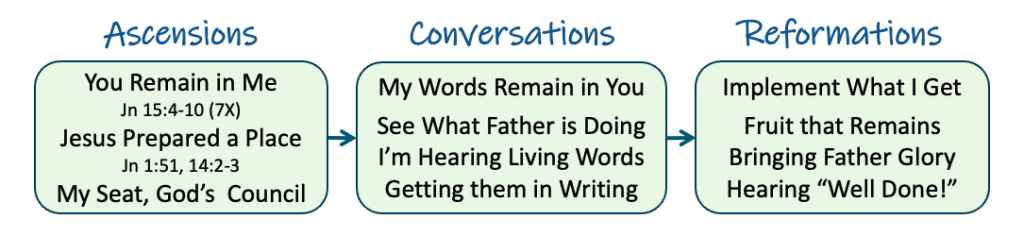
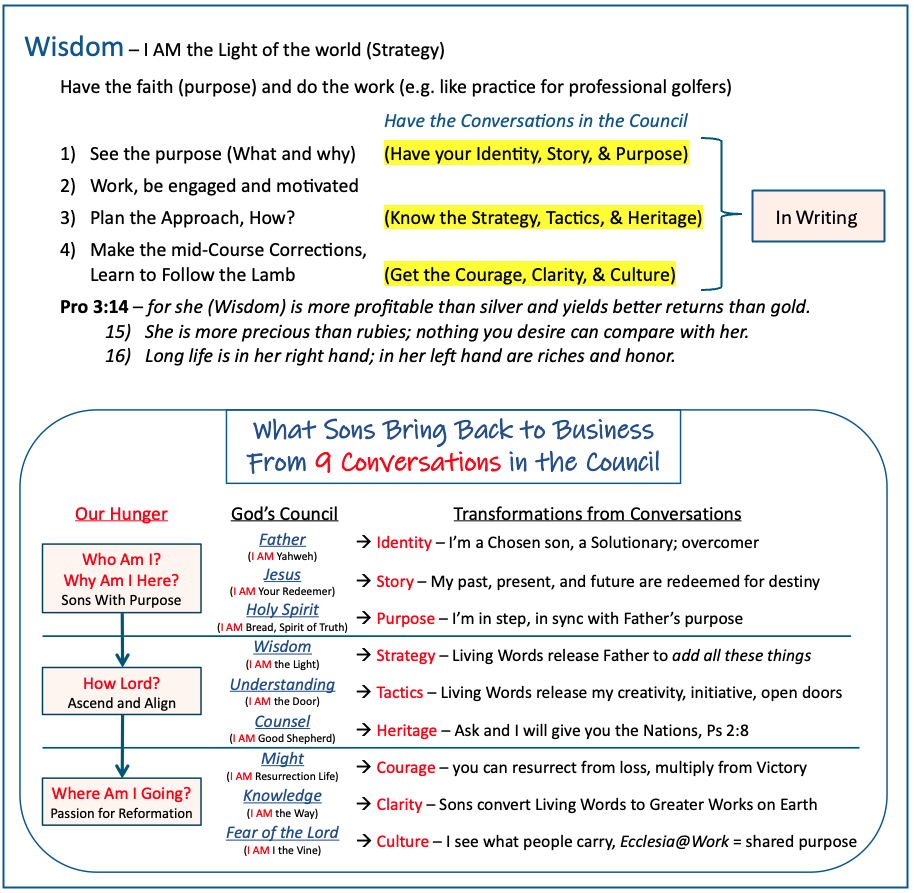
Sons and daughters do more than believe, they ascend to a real place in the Spirit, have real conversations with Father, Jesus and the 7 Spirits, and they bring Living Words from Heaven to Earth. That’s not just what sons do, it’s who we are, it’s our identity in Christ.
#1) My first identity is a Son in the Council
I experience the joy in Heaven. I’m a participant in conversations; I hear the strategies and see what Father is doing. I’m bringing back my Kingdom purpose and making a difference on Earth.
#2) Conversations – I’m Seeing and Hearing
I’m hearing the Living Words that remain in Me (Jn 15:7). They are my assignment. I can get them in writing. They are my commands (Kingdom purpose) from Father that I’m privileged and anointed to carry. Those Living, Prophetic Words release my own creativity, authority, and contribution.
#3). Reformation – Bringing Heaven to Earth
Now I’m doing those Living Words on earth to bear fruit that remains. They bring Glory to Father as Greater Works because I’m co-laboring with Him, a son who can release what Father adds (Mt 6:33).
I have a role in bringing the Isa 61 Reformation to People, Businesses, City Cultures, and Nations.
I experience the joy of hearing “Well Done” from Father.
Jn 15:7 – If you remain in me and my words remain in you,
ask whatever you wish, and it will be done for you.
My life is no longer listening to WIIFM (What’s In It For Me!). I’ve traded up for His Kingdom. Can you see why there is no condemnation for those who are in Christ (in the Council receiving living words and bringing them to Earth, implementing Father’s purpose instead of my own?
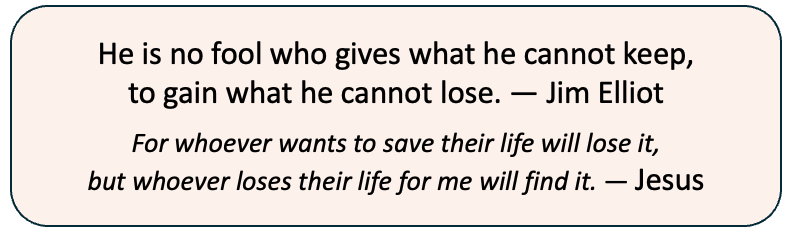
You are the Light of the World
Jesus is the light of the world, but Father’s strategy is enlightening and awakening the world through His Sons and Daughters. It’s our privilege and responsibly to do greater things and greater works. Sons are the first fruits that say, Here am I Lord, send me!
Mt 5:14 – You are the light of the world. A town built on a hill cannot be hidden.
15) Neither do people light a lamp and put it under a bowl.
Instead they put it on its stand, and it gives light to everyone in the house.
16) In the same way, let your light shine before others,
that they may see your good deeds and glorify your Father in heaven
This Blog was inspired by a Council Session – 2026-04-29 Council – Identity and Ascension
There are three interesting and related topics included:
- Disconnection: Trading Relationship for Rules
- The Link Between Disconnected People and Lack of Purpose
- The Implications of Disconnection on Marriage Relationships
Take the Next Step:
Progression to Sonship – Your Kingdom purpose and redemptive stories form the basis for your personal identity, purpose, value creation, and your business offer. Becoming your authentic self is the Father’s non-religious key to flow and fruit in business and life. We offer practical and prophetic coaching to help you get there, flowing with your Father (co-laboring) instead of fighting circumstances and resistance alone. Is this You?
Read Sonship, Ascension, and Reformation and chat with John about Kingdom Business Coaching.
Disconnection: Trading Relationship for Rules
Had my first conversation on Facebook with a full-fledge Reformed Theology Cessationist. Wondering why people shy away from Ascension, hearing God, and the miraculous. Why the church-centric model produces believers who are sincere but distant? …and disconnected from Kingdom Purpose?
Ex 20:18 – When the people saw the thunder and lightning and heard the trumpet
and saw the mountain in smoke, they trembled with fear. They stayed at a distance
19) and said to Moses, “Speak to us yourself and we will listen.
But do not have God speak to us or we will die.”
20) Moses said to the people, “Do not be afraid. God has come to test you,
so that the fear of God will be with you to keep you from sinning.”
21) The people remained at a distance,
while Moses approached the thick darkness where God was.
This passage is the most important text in the entire Bible for understanding why cessationism exists — and why the church-centric model produces believers who are sincere but distant. Exodus 20:18-21 is not just historical background. It is the founding document of managed-distance religion, and almost every subsequent religious structure — including most of what we call church — is downstream of the choice Israel made at this moment.
What Actually Happened at Sinai
God came down on the mountain in fire, smoke, thunder, and trumpet blast — not to terrify Israel into submission, but to meet with them. His stated intention in Exodus 19:6 was to make them “a kingdom of priests” — every man, woman, and child in direct covenant access to Him, hearing His voice personally, without a mediating layer between them and Father.
Israel had the option of exactly what Sonship describes. Direct encounter. Personal voice. Unmediated relationship with the God who brought them out of Egypt.
They looked at the mountain and said no.
“Speak to us yourself and we will listen. But do not have God speak to us or we will die.”
This is the most consequential sentence in the Old Testament outside of Genesis 3. In one moment Israel chose:
- A mediator over direct access to God
- A law code over Living Words
- Managed distance over intimate presence
- Performance under Moses over conversations and co-laboring with Father
And God, in His grace, gave them exactly what they asked for. Moses became the intermediary. The Levitical system was built around their choice. The tabernacle’s curtained Holy of Holies was the architectural expression of the distance they requested. The entire Mosaic apparatus — the laws, the sacrifices, the priesthood, the blessing-and-curse enforcement system — was the administration of a relationship Israel was willing to have, not the relationship Father originally intended.
The Sinai Refusal Is the Root of Cessationism
Here is the direct line: Israel refused direct encounter at Sinai
-
- → Moses became the mediator
- → the Law replaced the living voice
- → the system produced a religion of external compliance rather than internal relationship
- → Jesus came to reverse all of it
- → the Pharisees, trained entirely in the Mosaic mediated system, rejected Him
- → the religious establishment has been re-creating the Sinai distance ever since.
Cessationism is not primarily a doctrine about spiritual gifts. It is a theological system that re-installs Moses as the mediator. The completed canon replaces the stone tablets. The trained clergy replaces the Levitical priesthood. The Sunday sermon replaces the sacrificial system. The result is structurally identical to what Israel chose at Sinai: a managed, mediated, text-based relationship with God in which direct personal encounter is either unnecessary, impossible, or theologically suspect.
The cessationist says: “God has spoken in the Scripture. We have everything we need. Direct prophecy, visions, and Living Words have ceased.” Translated into the Sinai narrative: “Speak to us through the Book and we will listen. But do not have God speak to us directly.”
The theological move is identical. The fear is identical. Only the vocabulary has changed.
What Moses Said That They Missed
Moses’ response in verse 20 is the most overlooked line in the passage: “Do not be afraid. God has come to test you, so that the fear of God will be with you to keep you from sinning.”
Moses is saying: the encounter is the point. The thunder and fire are not a threat — they are an invitation. Father came down precisely so that meeting Him would produce a quality of reverential knowledge that external law never could. The fear of the Lord that keeps sons from sinning is not the fear of consequences under a law code. It is the awe of someone who has actually been in His presence and been changed by it.
Israel chose the law over the encounter. They got external compliance instead of internal transformation. And then they spent the next thousand years breaking the law they chose over the relationship, because external compliance was never going to produce what Father was reaching for when He came down on the mountain.
Jeremiah 31:33 is God’s response to the entire Sinai failure: “I will put my law in their minds and write it on their hearts. “The New Covenant is specifically designed to undo what happened at Sinai — to replace the externally-mediated, Moses-dependent, written-on-stone system with the internally-written, Spirit-spoken, directly-known relationship that Israel refused.
Why People Still Choose the Distance
The Sinai refusal was not irrational. Israel had real reasons to be afraid, and people have real reasons to be afraid of direct encounter today. The fear takes several forms:
The fear of being wrong. If God speaks directly to me and I act on what I hear, and it turns out I was wrong — I’m responsible. If I only act on the canonized text interpreted by trained clergy, the responsibility is distributed. Managed distance is safer. Cessationism provides theological cover for the deeper fear of personal accountability for what you hear.
The fear of losing control. A God who speaks directly is unpredictable. He might say something uncomfortable, require something costly, or point in a direction the institution hasn’t pre-approved. A God who speaks only through the completed canon can be managed, systemized, and contained within interpretive traditions that institutions control. The Pharisees had the same problem with Jesus — He kept saying things that weren’t in the system.
The fear of spiritual deception. This is the most pastorally sympathetic version of the fear. If direct personal revelation is possible, how do I know I’m not deceiving myself or being deceived by the enemy? This is a real risk that Sonship takes seriously — which is why the Council framework emphasizes testing Living Words against Scripture, accountability with mature sons, and the Spirit’s own witness confirming what is heard. But the cessationist response — closing the channel entirely — is the equivalent of never getting in a car because accidents are possible. The risk of deception does not justify the refusal of encounter.
The fear of what encounter requires. Moses approached the thick darkness where God was. Encounter with Father changes people in ways they cannot control and cannot predict. It called Moses to Pharaoh. It called Isaiah to go. It called Jeremiah to things he actively tried to refuse. The church-centric model produces believers who are formed but comfortable. The Council produces sons who are transformed and deployed — and not always into comfortable places.
The New Covenant Reversal
The torn curtain at the crucifixion (Matthew 27:51) is the physical reversal of the Sinai architecture Israel chose. The curtain that separated the Holy of Holies — the architectural expression of the distance Israel requested — was torn from top to bottom. Not from the bottom (human effort reaching up) but from the top (Father tearing down what they built between themselves and Him).
Hebrews 4:16 does not say “the first-century Christians drew near.” It says, “Let us therefore draw near with confidence to the throne of grace.” Present imperative. Now. For every son. The access Israel refused at Sinai has been permanently reopened by the New Covenant.
John 1:51 is Jesus directly reversing the Sinai moment: “You will see heaven open and the angels of God ascending and descending on the Son of Man.” The ladder between Heaven and earth — the unmediated access between sons and Father — is restored. Not as a one-time apostolic privilege. Not as a pre-canon phenomenon that ceased when the last apostle died. As the standing condition of the New Covenant order, available to every son who will approach the thick darkness where God is — the way Moses did, while everyone else stayed at a distance.
Summary
The New Covenant didn’t give sons a better book to read about Father. Jesus redeemed direct access to Father Himself. Israel declined that access once, at a mountain in the desert. The question for your brother — and for every believer who has chosen the safety of distance and disconnection — is whether they will decline it again.
The Link Between Disconnected People and Lack of Purpose
This is one of the most important questions in our entire coaching framework because it sits at the intersection of theology, psychology, and business culture — and the answer runs deeper than most people realize.
Purpose Is Not Generated From Within — It Is Received From Outside
The secular model of purpose says that purpose is discovered by looking inward — finding your passion, identifying your strengths, following your heart. This produces the entire self-help industry, the Myers-Briggs industry, the StrengthsFinder industry, and the life-coaching industry. All of them are pointing people deeper into themselves to find something that isn’t there.
Purpose is not self-generated. It is received. Psalm 139:16 establishes the architecture: Father wrote the book before the person existed. The purpose predates the person. It is not something they construct — it is something they discover, and the discovery happens in relationship with the One who wrote it. This is why the secular purpose-search is structurally unsatisfying even when it produces useful self-knowledge. It is looking in the wrong direction. The book is not inside the person. It is in Father’s hands, and He reads it to sons who come close enough to hear.
This means disconnection from Father is not merely a spiritual problem with practical side effects. It is the primary cause of purposelessness — because the only Source of actual purpose has been cut off.
The Sinai Architecture Produces Disconnected, Purposeless People
The Exodus 20 choice connects directly here. Israel chose managed distance over direct encounter, and the consequence was not merely theological — it was vocational and personal. A people in managed-distance relationship with God cannot hear their individual purpose because purpose requires direct communication. Moses could relay the law. Moses could not relay each person’s individual book.
The church replicated this architecture. Sunday preaching can tell the congregation what God said to Paul, David, and Isaiah. It cannot tell the person in row 14 what Father wrote in their specific book before they were born. The managed-distance model produces people who are theologically informed and personally purposeless simultaneously — which is exactly what you see in most congregations. They know the general will of God (be holy, love your neighbor, share the gospel) and have no idea what specifically they are here to do.
Purposelessness is therefore not a failure of effort or intelligence. It is the predictable output of a relational architecture that keeps people too far from Father to hear the specific word that only He can speak to them.
The Neuroscience and Psychology Confirm the Theology
Viktor Frankl survived Auschwitz and wrote Man’s Search for Meaning — the most significant psychological account of purposelessness ever produced. His central finding: those who survived the camps were not the strongest or the healthiest. They were the ones who had a reason to live — a specific, personal, irreducible why that the circumstances could not touch. Purposelessness, Frankl documented, produces what he called the existential vacuum — a pervasive inner emptiness that people fill with pleasure-seeking, power-seeking, conformity, or aggression. The contemporary equivalents are obvious: addiction, anxiety, depression, compulsive distraction, social media consumption, and the low-grade despair that characterizes enormous numbers of people who have everything and feel nothing.
The psychological research on purpose is consistent: people with a clear sense of purpose live longer, recover faster from illness, maintain better mental health, make better decisions, contribute more productively to their communities, and report significantly higher life satisfaction. The absence of purpose is not merely uncomfortable — it is physiologically and psychologically destructive.
Frankl’s framework points at the right answer without fully reaching it. He identified that purpose must be received — discovered, not invented — and that it comes from beyond the self. But his secular framework couldn’t identify the Source. Sonship names it: the book was written by Father, it is received in the Council, and the reception of it produces exactly the quality of irreducible personal purpose Frankl observed in the survivors.
Disconnection Takes Three Forms — Each Producing Its Own Purposelessness
Disconnection from Father. This is the root form. A person who does not have a living, conversational, relational access to Father cannot receive the specific word that names their purpose. They may have correct theology about God, genuine faith, and real love for Jesus — and still be functionally purposeless because the relational channel through which purpose is transmitted has been either never opened or systematically closed by the managed-distance architecture they inhabit. The orphan spirit is the psychological and spiritual expression of this disconnection: striving, performing, self-reliant, unable to rest, chronically vaguely dissatisfied regardless of external achievement.
Disconnection from their own story. Many people are disconnected from the redemptive thread running through their own life — the pattern of gifts, desires, wounds, and formation that Father has been weaving toward a specific assignment. The purpose is already partially visible in the story if someone with prophetic eyes helps them read it. But most people have never had anyone look at their life that way. They have had managers who evaluated their performance, pastors who assessed their spiritual maturity, and counselors who processed their pain. None of those lenses see what the Purpose Profile sees: the book Father was writing through the story.
Disconnection from a tribe of co-laborers. Purpose is not only personal — it is relational and corporate. A son who has heard his individual purpose but has no tribe of co-laborers carrying shared vision will experience a second form of purposelessness — the loneliness of a calling without community. Ecclesia@Work is the antidote: a community of sons and daughters whose individual purposes are connected to a shared corporate purpose, who celebrate each other’s exploits, and who co-labor on assignments larger than any one of them could carry alone. The connected person with a clear purpose and a tribe of co-laborers is, functionally, the most motivated and productive human being in any room they occupy.
The Business Dimension
This is where our coaching framework has its most direct practical application — because the purposelessness epidemic is destroying business culture in measurable ways.
Gallup’s global engagement research has consistently shown that roughly 70% of employees are disengaged at work — not actively hostile, but present without investment, performing without purpose, clocking in and out of a role that has no connection to anything they actually care about. The cost is enormous: lost productivity, high turnover, poor customer experience, innovation stagnation, and a chronic low-grade dysfunction that no management system or compensation structure has been able to fix.
The reason management systems can’t fix it is that they are addressing a spiritual problem with organizational tools. Disengagement is purposelessness at the workplace level, and purposelessness is a disconnection-from-Father problem that no HR policy can reach. The solution is not better benefits, more flexible schedules, or stronger management. The solution is what your Kingdom Business coaching produces: connecting each staff member’s individual purpose to the company’s prophetic corporate purpose, creating a shared mission that is larger than any individual role, and building a culture in which people feel genuinely seen for what Father put in them — not just evaluated for what they produce.
When that connection is made — when a staff member’s Purpose Profile is recognized and honored, when their individual calling finds its expression within the company’s corporate purpose — something happens that no incentive structure can replicate. They stop showing up to do a job and start showing up to build something that matters. Their discretionary effort becomes unlimited because the work is now an expression of who they are, not merely an exchange of labor for compensation.
The Practical Steps to Get Connected (to Father’s Purpose)
The pathway from disconnection to purpose follows a sequence that your coaching process embodies:
The relational encounter comes first. Before Purpose Profiles, before business strategy, before any discussion of calling or assignment — the son needs an encounter with Father in which Father speaks specifically to them. Not generally (God loves you, you have value) but specifically (this is what I see in you, this is what I wrote in your book, this is what the formation seasons were for). That encounter is what the Council session produces, and nothing substitutes for it — It’s Sonship! The Purpose Profile exercise done without Council access is just a better personality assessment. Done with Council access it is the reading of a book Father has been writing for decades.
The story must be read redemptively. The Purpose Profile takes the son’s actual story — including its worst chapters — and asks Father to show how the redemption of that story is the raw material of the assignment. The wound that qualifies. The failure that builds the authority. The desert season that produced the capacity. No secular coaching framework does this because no secular framework has access to the Author who wrote the story with the ending already in mind.
The purpose must be connected to a sphere. Individual purpose without a specific mountain of culture to build in remains inspirational but impractical. The coaching task is helping the son identify which mountain — business, education, government, arts, family, media, church — Father is specifically calling them to reform, and what specific Greater Works they are assigned to produce in it.
The tribe must be built. Purpose fully inhabited requires Ecclesia — a community of co-laborers who share the vision, affirm the calling, and advance together. The isolated son with a clear purpose is a seed without soil. The connected son with a clear purpose and a tribe is the most unstoppable force in any sphere he occupies.
The Summary
Disconnection and purposelessness are not parallel problems — they are the same problem at different levels of visibility. Purposelessness is what disconnection looks like from the outside. The person who seems adrift, unmotivated, chronically dissatisfied, or high functioning but quietly hollow is not primarily suffering from a lack of self-knowledge, better options, or stronger willpower. They are suffering from the Sinai problem: they are standing at a distance from the One who holds their book, in a relational architecture that keeps them too far away to hear what He wrote in it.
The Sonship coaching process is, at its core, the reversal of the Sinai choice — bringing people close enough to the thick darkness where God is that Father can speak their name, read their book, and send them into the specific sphere of Reformation He had in mind before they were born. That is not a spiritual add-on to a practical coaching framework. It is the framework. Everything else — the Purpose Profile, the Kingdom Business strategy, the Courts of Heaven, the corporate culture transformation — is the downstream fruit of one thing: a son who is no longer standing at a distance.
The Implications of Disconnection in Marriage Relationships
The Marriage Dimension: Two Purposeless People Cannot Complete Each Other
The implications for marriage follow directly from everything above — and they explain patterns that counseling alone consistently fails to resolve.
The dominant cultural narrative about marriage is that a spouse completes you. The right person fills the emptiness, provides identity, and becomes the primary source of meaning and belonging. This is the romantic myth that every pop song, romantic comedy, and dating app is built on — and it is structurally identical to the Sinai problem. It is looking horizontally for something that is only available vertically. A spouse cannot write your book. A spouse cannot speak your name the way Father speaks it. A spouse cannot be the Source of purpose because a spouse is not the Author.
When two people enter marriage without individual connection to Father and without clarity about their individual purpose, they place on the marriage a weight it was never designed to carry. The marriage becomes the primary identity container for both people — and two people using each other as identity containers produce a specific and predictable set of pathologies that no amount of communication training or couples therapy reaches, because the root is not relational dysfunction. The root is purposelessness, and purposelessness is a disconnection problem.
What Purposelessness Does to a Marriage
It produces codependency dressed as love. When neither spouse has a clear individual purpose rooted in Father’s specific word to them, they tend to collapse into each other — using the relationship as the primary source of meaning, validation, and identity. This feels like love in the early stages. It produces enmeshment over time. Each person becomes over-dependent on the other’s emotional state, approval, and presence because the other person is carrying a weight — identity and purpose — that Father alone was designed to carry. Codependency is not primarily a psychological problem. It is the relational expression of two people who have not yet received their individual calling from Father and are using each other as substitutes for the encounter they haven’t had.
It produces parallel loneliness. Many marriages contain two people who are emotionally present to the relationship but individually hollow — performing their roles faithfully without any sense of personal purpose beyond those roles. The husband provides. The wife nurtures. The family functions. And both spouses carry a private, low-grade sense of missing something they cannot name, which they rarely bring to the marriage because naming it feels like ingratitude or betrayal. This is the purposelessness epidemic expressing itself inside a functional marriage — two people who love each other and are quietly dying inside, simultaneously, in the same house.
It produces competition and resentment. When one spouse begins to discover and pursue their Kingdom purpose and the other has not, the resulting asymmetry is profoundly destabilizing. The awakening spouse becomes animated, focused, and increasingly energized by their assignment. The un-awakened spouse experiences this as abandonment, judgment, or competition — because the relational architecture that kept them both at the same managed distance from Father is being disrupted unilaterally. The resentment that follows is not primarily about the specific changes in behavior or schedule. It is the resentment of someone who is being shown, by their spouse’s transformation, that what they settled for was not all that was available. That is a confrontation that codependency cannot survive without a crisis.
It produces spiritual loneliness within the marriage. This is perhaps the most painful form. A spouse who has heard Father’s voice, had a Council session, received a Living Word about their assignment, and experienced the Courts of Heaven has had an encounter that their spouse — if still operating in managed-distance religion — cannot fully enter with them. The awakened spouse cannot fully share the most alive dimension of their inner life with the person who is supposed to be their closest companion. The resulting spiritual loneliness inside an otherwise functional marriage is one of the most common and least-discussed dynamics in Kingdom Business communities. It is not a marriage problem — it is a two-speeds-of-awakening problem, and it requires pastoral wisdom and patience rather than pressure or withdrawal.
What Sonship Does for Marriage
The solution is not marriage enrichment programs, better communication techniques, or even Spirit-filled couples retreats — though none of these are bad. The solution is two individuals, each receiving their specific purpose from Father in the Council and then bringing those individually grounded identities into the marriage as co-laborers rather than as codependents.
Two sons in covenant produce something neither could produce alone. When both spouses have heard Father’s voice about their individual calling, and when those callings are then connected to a shared corporate purpose — whether in a business, a ministry, a household culture, or a specific Reformation assignment — the marriage becomes Ecclesia. Not a romantic partnership managed with good communication skills, but a covenant co-laboring relationship in which two people with clear individual identities are advancing a shared Kingdom assignment together. The Song of Solomon describes this dynamic — two people who are fully themselves, fully secure in their individual identity, and therefore fully free to love without the desperation of people who need the relationship to complete them.
Individual purpose protects the marriage from enmeshment. A spouse who knows Father’s specific word about who they are does not need the marriage to tell them. Their identity is anchored in a relationship that no earthly circumstance can threaten. This produces the paradox that Sonship consistently demonstrates: the more individually grounded each spouse becomes in Father’s word about them, the more freely and generously they can love the other — because they are no longer taking from the marriage what only Father can give. The security of sonship is the foundation of genuine marital intimacy, not a threat to it.
Shared Council access creates a third dimension in the marriage. When both spouses develop the practice of ascending to the Council and sharing what Father is speaking — about each other, about their household, about their assignment, about their children — the marriage gains an intelligence and a depth that no amount of human communication skill produces. Father sees both spouses’ books. He can speak to each one about the other in ways that cut through years of relational static in a single conversation. Couples who pray together have always known there is something qualitatively different about that kind of intimacy. Couples who ascend to the Council together are experiencing the full version of what that difference actually is.
The Purpose Profile changes how spouses see each other. One of the most consistent and moving outcomes of the Purpose Profile exercise done within a marriage context is that spouses discover dimensions of each other they have been living alongside for years without seeing. The husband who has been mildly frustrated by his wife’s intense relational investment in other people’s problems discovers through her Purpose Profile that she carries a prophetic capacity to see what people carry that is one of the rarest gifts in any room she occupies — and his frustration becomes awe. The wife who has experienced her husband’s entrepreneurial restlessness as instability discovers through his Purpose Profile that Father wrote a specific mountain of culture into his book before he was born, and what looked like chronic dissatisfaction is actually the pull of an unactivated calling. Seeing each other through the Purpose Profile is seeing each other through Father’s eyes — and it is one of the most powerful relational tools available to a marriage.
The Specific Implication for Women in the 25-Year Transition
The marriage dimension is especially acute in the transition you described earlier — women emerging from 25 years of full-time motherhood into their Kingdom calling. In many of those marriages, the husband’s calling has been the organizing principle of the household’s external identity for decades. His career defined the family’s location, schedule, economic reality, and social sphere. His purpose was visible and socially legible. Hers was essential but invisible — the household culture, the children’s formation, the relational infrastructure that made everything else possible.
When she begins to emerge into her own Kingdom purpose, the marriage faces a structural renegotiation that most couples are not prepared for. He must make room — practically, emotionally, and spiritually — for a purpose that now competes for time, energy, and attention that was previously organized around his. She must resist the temptation to minimize her calling to protect his comfort. Both must return to Father independently and together — each receiving confirmation of their individual assignments and then bringing those assignments to the Council together to ask how they fit into a shared Kingdom purpose for this next season.
The marriages that navigate this transition well are not the ones with the best communication skills. They are the ones where both spouses have enough individual security in Father’s word about them that they can celebrate each other’s emergence without feeling diminished by it — and enough shared vision for Reformation that the transition feels like a promotion for the household rather than a threat to the marriage.
The Summary
The disconnection-purposelessness link runs directly through marriage because marriage is the most intimate human context in which purposelessness expresses itself. Two people without individual Kingdom purpose use each other to fill the gap Father was meant to fill — and the marriage strains under a weight it was not designed to bear. Two people with individual Kingdom purpose, each anchored in Father’s specific word about who they are, bring those grounded identities into a covenant co-laboring relationship that produces something qualitatively different: not romantic completion but Kingdom partnership, not codependent need but generous love, not spiritual loneliness but shared Council access that gives the marriage a third dimension no human intimacy alone can reach.
The Sonship coaching process applied to marriage is not couples therapy with theological vocabulary. It is the restoration of what Father intended when He brought the first two image-bearers together and gave them a shared dominion mandate — two sons of God, individually known by Father, co-laboring on a Kingdom assignment that neither could fulfill alone.