The Role of Sons in Judgement
How the Courts of Heaven Set Captives Free and Stop the Adversary
(Intro Video and sharable PDF) Most Christians have a vague awareness that spiritual warfare exists. Far fewer understand that the New Covenant gives sons and daughters of God a specific judicial role in it — not as bystanders watching God work, but as participants seated with the firstborn Son in the Courts of Heaven, authorized to prosecute the accuser’s claims, release decrees, and advance the Kingdom on earth. That judicial role has two directions: opening what needs to be opened, and closing what needs to be closed.
No Condemnation — But the Courtroom Is Still Open
The foundation is Romans 8:1: “There is therefore now no condemnation for those who are in Christ Jesus.” The Greekword katakrima means the final, condemning verdict of a court. For sons in union with the firstborn Son, that verdict has been permanently dismissed at the cross. The case against them is closed. God is not a judge in the New covenant, but he has delegated that responsibility to Jesus, the first-born son and to us as sons. Now we have a role in setting captives free in the Courts of Heaven.
Jn 5:22 – Moreover, the Father judges no one, but has entrusted all judgment to the Son,
24) Very truly I tell you, whoever hears my word and believes him who sent me
has eternal life and will not be judged but has crossed over from death to life.
No condemnation does not mean no courtroom. The accuser retains legal standing to bring accusations, and those accusations — if not answered — can restrict the freedom, fruitfulness, and authority of sons and those they are called to serve. The Courts of Heaven are where sons go not to re-litigate their justification (settled), but to have active accusations legally dismissed and to receive the decrees that change lives from the inside out.
The purpose is always Luke 4:18 — the Isaiah 61 anointing Jesus claimed as His own: to proclaim freedom for prisoners, to release the oppressed, to set captives free. Sons engage the Courts not to sentence God’s people but to liberate them from the sentences and accusations the enemy has already imposed. Sons are engaged is proclaiming the year of the Lord’s favor and the day of His vengeance.
The Judicial Inheritance of the Firstborn Son
The Father has permanently transferred the judicial function to the firstborn Son, has given all judgment to the Son, Jn 5:22. And because sons are co-heirs with Christ now (Rom. 8:17) — co-seated with Him in the heavenly places (Eph. 2:6) — that judicial inheritance flows through them as well. Jesus confirmed it in Matthew 19:28, promising that those who follow Him will sit on thrones judging alongside the Son of Man in 33 AD. These are not ceremonial seats. They are functional.
Jn 20:22 – And with that he breathed on them and said, “Receive the Holy Spirit.
23) If you forgive anyone’s sins, their sins are forgiven;
if you do not forgive them, they are not forgiven.”
On the evening of the resurrection, Jesus breathes on His disciples — the same gesture as Genesis 2:7, life breathed into Adam — and immediately confers judicial authority:
-
- Mercy – the power to forgive sin. This is not institutional clergy language. It is the judicial inheritance of the firstborn being transmitted to sons in the Spirit.
- Justice – The power to “not forgive” — to retain, to bind, to hold a legal claim in place — is an act of real judicial authority, available to sons who are moving in step with what the Spirit has discerned. Our Father loves Justice and hates wrongdoing (Isa 61:8).
The Two Directions of the Courts
The Courts of Heaven operate in both directions simultaneously, and sons need to understand both sides of the docket.The liberating side of mercy is more familiar:
-
- Opening doors no man can shut (Isa. 22:22) — releasing access, opportunity, and Kingdom purpose that no opposing power can close.
- Loosing what is loosed in Heaven (Mt. 16:19) — bringing Heaven’s decrees to earth through sons who carry the keys of the Kingdom from the Courts and Council of Heaven to Earth.
- Forgiving those who are forgiven in Heaven (Jn. 20:23) — dismissing accusations, releasing people into the freedom the cross already purchased.
But the same passages authorize Justice to oppose adversary’s when the Spirit directs:
-
- Closing doors no man can open — shutting down access and assignments of the adversary.
- Binding what is bound in Heaven (Mt. 16:19) — agreeing with Heaven’s legal determination to restrain what Father has already adjudicated.
- Not forgiving — retaining the legal standing of an accusation when its ground has not been renounced and there is no willingness for repentance and consequences are reaped.
The governing principle is non-negotiable: sons never exercise binding authority from personal opinion, grievance, offense, or self-interest. Jesus rebuked His Disciples for judging in the flesh (Lu 9:54-55). Sons bind only what is already bound in Heaven — agreeing with Jesus’ judicial determination via hearing Living Words, not initiating their own verdicts or decrees. But what sons can initiate is the court proceedings to get the verdicts and decrees and bring them to Earth.
When the Courts Move Against the Adversary: Peter and Paul
The New Testament gives us two clear examples of sons exercising the binding dimension with precision and Spirit-led authority. Sons are seated in Heavenly places exercising judgment now, not in the afterlife.
Peter confronts Ananias and Sapphira (Acts 5), who have lied to the Holy Spirit about the proceeds of a land sale. Peter does not seek their deaths. He speaks what the Spirit has already discerned — the judicial reality already adjudicated in the Courts — and the natural order conforms to it. Both die. The result is not terror but awe: “great fear seized the whole church” (Acts 5:11), and the atmosphere of Ecclesia was preserved for the signs and wonders that followed.
Paul exercises the same authority by proxy. In 1 Corinthians 5:5, he hands a man over to Satan “for the destruction of the flesh, so that his spirit may be saved.” The goal is explicitly remedial — restoration, not punishment. In 1 Timothy 1:20, Hymenaeus and Alexander are handed over to Satan “to be taught not to blaspheme.” Again: the binding is the severe mercy of removing a covenantal covering the individual has forfeited, creating the conditions in which repentance becomes possible. Paul makes the orientation explicit in 2 Corinthians 13:10 — the authority is given “for building up, not for tearing down.” The binding side is always the reluctant, secondary application of an authority whose primary direction is liberation.
The Holy Spirit Is the Judicial Guide
None of this is available to sons operating in their own judgment. We’ve all tasted religious, legalistic, condescending, self-righteous, judgmental people – they are universally abhorred. We are hesitant to consider being sons who could navigate righteous judgement based on Living Words because of those bad experiences. The “old” feels like religion, the “new” feels prophetic, powerful, and life-giving.
Our Guide – John 16:7–13 makes the operational mechanism clear. Jesus calls the Spirit the Paraclete — a courtroom term meaning one called alongside to assist in judicial proceedings. The Spirit convicts the world concerning sin, righteousness, and judgment (Jn. 16:8). He guides sons into all truth (Jn. 16:13) — Guide (hodegeo) means to lead along a road in real time, not to deposit a static body of knowledge. He takes what belongs to the Son and makes it known to sons (Jn. 16:14) — including the judicial inheritance of the firstborn, the Living Words that make sonship so powerful.
Demolishing Strongholds – This means sons function in the Courts as participants in the conversation, not as self-appointed judges. The difference is that now we have a lens for our role in spiritual warfare. The initiative sons possess is bringing the cases into the Courts of Heaven to obtain Justice and Mercy and get the verdicts and decrees. We’re no longer observant pacifists turning the other cheek in the face of captives struggling with sin and iniquity when redemption is available. Nor are we passive in the face of demonic activity, in our culture. We demolish deceptive strongholds undergirded by false arguments and pretentious people because sons have weapons in the Courts of Heaven (2Cor 10:3-5) and we know how to use them.
1Pet 4:17 – For it is time for judgment to begin with God’s household; and if it begins with us,
what will the outcome be for those who do not obey the gospel of God?
The Courts of Heaven are not a devotional technique or a prayer framework bolted onto conventional Christianity. Justice and Mercy is the operational expression of what Jesus promised His followers on the way to Jerusalem: thrones, authority, and a share in the judicial administration of the Kingdom He was about to establish. Sons who understand this — who enter the Courts as freed sons legally breaking the accuser’s claims on behalf of those who are still captive — carry something the world has not seen enough of: not religious performance, not self-righteous posturing, but the judicial authority of the firstborn Son, exercised in the Spirit, advancing the Kingdom one liberated life at a time.
Not Pacifists – Sons and daughters in the Kingdom are not turning the other cheek every time a despotic Mullah in Iran kills 42,000 of their own people and threatens the rest of the world with nuclear weapons. The Lord can lead us to pray in the Spirit and the in Courts to potentially take action, which Trump did. It’s not out of context for sonship! Sons are peaceful, but not pacifists. They execute Justice and Mercy on behalf of their Father’s Kingdom; they do what their Father is doing.
Businesspeople face corruption, legal challenges, and evil people on a fairly routine basis. Sons have the tools in the Courts and Council to respond proactively. Reformation depends on it! It’s the nature of spiritual warfare that none of us get to dodge. It’s starts with your presence in the Courts and the Council of Heaven, with Ascension.
This blog was inspired by a book review I did for Covenantless by Jonathan Welton. That review turned into a theological and inspirational basis for this blog, see 2026-04-24 Covenantless by Jonathan Welton.
Q & A
On Holy Spirit Guiding Us Into All Truth (Jn 16:9-15)
- Lord, How do I know what issues, or people, or adversaries to take on?
- You don’t know. Holy Spirit has to guide you.
- How do I know what decrees or verdicts to Release on Earth?
- You don’t know. Decrees come from the conversations, Living Words via the Courts and Council.
- How public should I be with what I get in the Courts and Council? Who I take?
- Intercession is largely private, and by proxy (the people you are praying for aren’t present). Father will tell you what to expose and when (and if).
On Access and Qualifications
- Do I need a special anointing or office to engage the Courts?
- Sonship and Ascension is the qualification. The co-seating of Eph. 2:6 and the co-heirship of Rom. 8:17 are for every son, not a priestly class. The Courts became accessible to sons at the resurrection (Jn 1:51, 20:22-23).
- What if I have unresolved accusations against myself? Can I still bring others’ cases?
- 1 Pet. 4:17 answers this — judgment begins in Father’s household of sons (us). Unaddressed accusations against yourself give the enemy legal standing to challenge your cases on behalf of others. Clean hands aren’t perfection; they’re transparency before Father about what He already knows.
On Binding and the Negative Side
- How do I know when to show mercy vs. when to bind? That feels like a dangerous line.
- It is a dangerous line — which is why sons never cross it alone. The Spirit convicts (Jn. 16:8); sons agree. If you’re uncertain, the default is always mercy. Binding is the reluctant, secondary application of authority. Paul wished he didn’t have to use it (2 Cor. 13:10).
- What happens if I try to bind something the Spirit hasn’t authorized?
- It simply won’t hold. You can’t bind what Heaven hasn’t bound — the Courts don’t respond to sons acting unilaterally. The more serious risk is that presumption opens legal ground for the accuser to bring a case against the son who overreached.
- Can I take someone to the Courts who has wronged me personally — a corrupt business partner, a false accuser, a government official?
- Yes, but the motive must be Justice and Reformation, not personal vindication. The son who enters the Courts offended is bringing the wrong plaintiff. Father can handle both if you’re willing to lay down the personal injury and bring the Kingdom case instead.
On Practical Engagement
- How often should I be engaging the Courts? Is this a daily practice?
- 1:51, ascending and descending is more like a posture than an appointment. Daily bread (Mt. 6:11) implies daily presence in the Council. The Courts of Heaven is for accusations as they are identified… and most of the accusations I deal with are against “me.”
- What does a Courts of Heaven session actually look like? Is there a process?
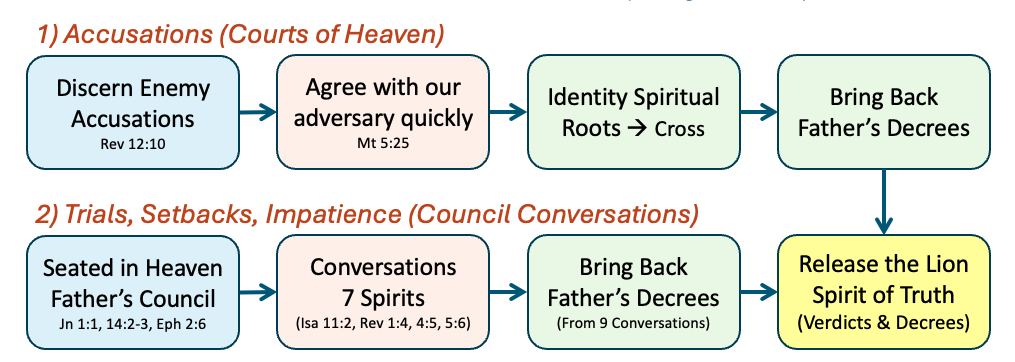
- There are entry points: worship, stillness, and presenting yourself before Father. You identify the accusation (what the enemy is using against you or the person you’re interceding for), agree with it and take it to the cross (Mt. 5:25), address generational or root issues, and receive the decree Father releases in place of the accusation. The Court & Council Tool Kitwalks through this practically, but going with a mentor a few times is a great help.
- What’s the difference between praying for someone and taking their case to the Courts?
- Prayer can be asking Father to act. The Courts are where sons act in agreement with what Father decrees in the Courts of Heaven. The Courts are more specific: there’s an accusation, a legal ground, redemption at the cross, and a decree. It’s setting captives free (Mercy) or releasing consequences (Justice), not merely petitionary.
On Reformation and the Wider Scope
- Can sons bring corporate cases — for a business, a city, a nation?
- Yes — and this is where Reformation lives. Daniel interceded for a nation (Dan. 9). The Courts address the spiritual principalities behind geopolitical situations (Dan. 10). The Trump/Iran example in the blog is exactly this: sons praying with judicial authority over a national-level adversary.
- Isn’t this just spiritual warfare with different vocabulary?
- The Courts of Heaven reframe spiritual warfare as a legal proceeding rather than a battle. The enemy isn’t primarily a force to overpower (He’s already defeated) — he’s an accuser in a courtroom (Rev. 12:10). That legal framing changes the posture from our combat to Jesus legal advocacy, which is more accurate, more sustainable, and more effective.
- What’s the relationship between the Courts and the Council? Are they the same thing?
- The Council is relational — sons ascending to have conversations with Father, Jesus, and the 7 Spirits ( 1:51, Rev. 4:1). The Courts are judicial — sons presenting cases, addressing accusations, and receiving decrees. They are distinct but connected by Ascension and Sonship. Living Words and decrees are received in the Council and the Courts because we are present in Heaven to hear them and implement them on Earth.
On The Results or Fruit in Business
- What fruit should I expect to see from engaging the Courts?
- The same fruit Acts 5 describes after Peter’s judicial act: an atmosphere of awe and reverence, followed by multiplication of signs and wonders (Acts 5:12-16). In business terms: open doors, favor, resolution of legal and relational blockages, and the release of Greater Works that weren’t accessible before the accusations were cleared.