Windfalls and Wealth Transfers
vs. What Father Actually Adds
(Intro Video) There’s a real dilemma in many conversations about faith and finances, and it rarely gets named directly: how do you tell the difference between credible faith for what Father will provide, and wishful thinking dressed up in Bible verses and glorified religious purpose? — to get what you want.
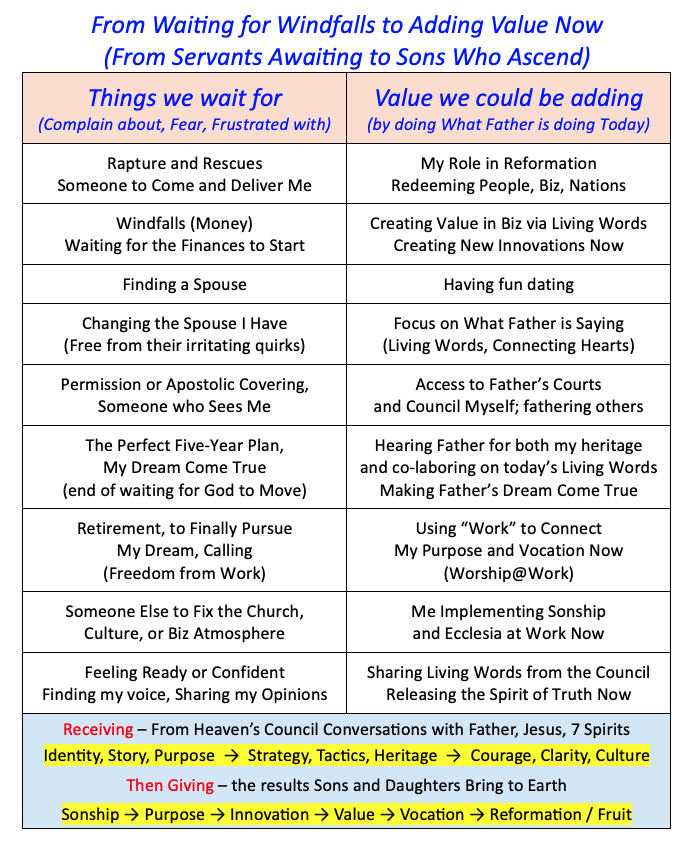
Two very different pictures of wealth circulate in Kingdom-business and charismatic circles. One says sons co-labor with Father’s purpose, create real innovation and value that genuinely blesses people, and profit follows as the fruit of that value — wealth built the way a tree builds fruit, slowly and from roots. The other says God can simply supply riches via grace and through no particular effort of your own — a windfall, a sudden gift dropped into your lap because Father loves you and He’s generous.
The second picture has real biblical texts attached to it — Isaac’s hundredfold harvest, Job’s restored fortune, Joseph multiplying grain for a nation, a coin found in a fish’s mouth. And yet it also has a smell to it that’s hard to shake — something closer to conspiracy-theory thinking than Kingdom life, a “free money” energy that feels carnal even when it’s wrapped in scripture. Both instincts are worth taking seriously. So which one is actually true?
What the “Windfall” Texts Actually Say
Look closely at each one, and none of them say what windfall theology wants them to say about getting “free money.”
Isaac (Gen 26:12-14) wasn’t rewarded for passivity. Before the hundredfold increase, Father gave him a specific word: stay in this land, don’t go down to Egypt (26:2-3) — during a famine, when leaving would have been the obvious move. Isaac knew Father’s purpose for that season and co-labored with it — he planted, he worked the land, he stayed exactly where he was told to stay. The multiplication was real, but it landed on top of actual planting, actual labor, and a son who was on the same page with what Father was doing.
Job is usually misquoted as “sevenfold” — it was double (Job 42:10, and the livestock counts in 42:12 confirm exactly 2x the original numbers). More importantly, notice the hinge: “after Job had prayed for his friends, the LORD restored his fortunes” (42:10). Restoration follows a specific act flowing from Job’s own heart aligning with Father’s — interceding for the very friends who’d wronged him. That’s not a reward for enduring suffering passively. It’s the fruit of a son whose heart had come fully into agreement with Father’s, forgiveness included.
Joseph isn’t a windfall story at all — it’s the clearest biblical picture of theory one. Wisdom, strategic administration, years of skilled labor, all flowing from a purpose Joseph had actually heard from Father (Gen 41:16, 25, 28), multiplied value that fed a nation. It belongs on the “create value” side of the ledger, not the “sudden gift” side.
The coin in the fish’s mouth (Mt 17:24-27) is the closest thing to a genuine windfall on the list — and worth looking at exactly what it was for. It wasn’t open-ended wealth. It was the precise amount needed for one named obligation (temple tax, for two people), released through a specific instruction Jesus gave Peter, and framed around a Kingdom principle Jesus states out loud before the money ever appears: sons are technically exempt, but pay it anyway so as not to needlessly offend. The miracle serves a defined purpose that existed before the provision did.
Solomon (1 Kings 3:5-14) makes the pattern explicit. When Father asked what to give him, Solomon didn’t ask for riches, long life, or victory over his enemies — he asked for an understanding heart to govern Father’s people well (3:9). Because he asked for wisdom to fulfill the purpose in front of him rather than wealth for its own sake, Father gave him both — wisdom, and riches and honor unmatched by any king of his day (3:11-13). It’s Mt 6:33 in narrative form, centuries before Jesus ever said it: seek the purpose, and you free Father to add all these things.
“Transfer of wealth from the wicked to the righteous” isn’t one text, but a deceptive slogan that borrows several — chiefly Proverbs 13:22’s line that “a sinner’s wealth is stored up for the righteous,” and Israel plundering Egypt of silver, gold, and clothing on the way out of slavery (Ex 12:35-36). Both get stripped of what actually makes them what they are. Proverbs 13:22 is wisdom literature describing a slow, general pattern across generations — unjust gain tends not to last, and diligence over time tends to outlast it — not a specific, on-demand promise of a sudden transfer event. And the plunder of Egypt wasn’t free money either: it followed a specific instruction Father gave in advance (Ex 3:21-22, 11:2), tied to a specific redemptive purpose — overdue wages after four centuries of forced, unpaid labor, released at the exact moment God was ending that slavery for good. It’s back pay, not a windfall. And it’s worth noticing what happened next: within about six weeks, that same silver and gold was melted down into a golden calf (Ex 32:2-4). Wealth that arrives ahead of a people’s actual formation into their purpose doesn’t stay wealth for long — it becomes raw material for the next idol, unless character and purpose have caught up to the provision. Solomon also engaged in idolatry because of his wealth and wives.
The Pattern Underneath
Every one of these examples shares the same shape, and it isn’t “effort vs. no effort or works vs. grace.” It’s this: knowing Father’s purpose came first, and provision followed, sized to that purpose. Isaac knew the purpose was to stay and be blessed in the land during famine (he also connected the dots between wells, irrigation, and 100-fold increase). Job’s heart aligned with Father’s purpose toward his friends. Joseph knew the purpose was to preserve a nation. Solomon knew the purpose was to govern well. Israel’s plunder of Egypt paid an overdue debt for a specific redemptive moment, not an appetite. Peter knew the purpose was one tax bill for two people, no more. None of them went looking for money and reached for a scripture to justify a wealthy lifestyle; they were co-laboring in purpose, not seeking wealth or influence. They knew what Father was doing, co-labored with it to create value, and the “all these things” got added on top — exactly the pattern Jesus names directly: “seek first His kingdom and His righteousness, and all these things will be added to you” (Mt 6:33).
That’s the actual theology worth building on, not “obey and you’ll get rich” and not “believe hard enough and money appears.” Seeking purpose first is a posture of knowing Father’s heart and purpose — through real Council conversations, not through wishful projection or spiritual entitlement — and co-laboring with what’s already in motion to create value. The addition is Father’s business. The seeking-first is our role as sons in the Council saying, Lord, What’s on your heart?
The Real Discernment Test
So the test isn’t sudden provision vs. gradual provision — both of those show up in genuine Kingdom wealth. The test is what came first, and what purpose does the money serve:
Did knowing Father’s purpose come before the desire for money, or after it? Genuine provision follows a purpose the son didn’t manufacture to justify wanting wealth. Counterfeit windfall thinking runs backward — the desire for money comes first, and Isaac, Job, Solomon, the fish coin, and the “transfer of wealth” proverbs get reached for afterward as proof texts for what was already wanted.
Is there a defined purpose, or is the money the whole point? Every genuine example above serves something specific and nameable. If you can’t name what it’s actually for beyond “financial freedom,” that’s worth noticing.
What happens to it once it arrives? Job’s restored wealth produced striking generosity — he gave his daughters an inheritance alongside their sons, unusual for the culture. Isaac’s produced peacemaking over the wells, not hoarding. Fruit that remains and blesses others is the tell of genuine Kingdom wealth tied to Purpose and Living Words; fruit that only funds a lifestyle upgrade and stops there is the counterfeit’s usual trajectory.
Does it survive mid-course corrections the Council? Genuine direction can be tested, examined, questioned. Windfall teaching tends to resist that kind of scrutiny — it wants urgency and certainty instead, often with a whiff of secrecy or exclusivity. That resistance to correction and lack of transparency is the same tell that shows up anywhere a soulish plan is dressed in spiritual language.
It’s Not About the Money
The best conspiracy-sounding windfall temptations are clothed in religious purpose to mask the carnal ambition behind the real motive. Sincere believers can deceive themselves via their own heart’s desires. Those desires can even be partially aligned with legitimate purpose.
Sons don’t chase windfalls or rabbits. They know Father’s purpose, they co-labor with what He’s already doing to create business value in a financially self-sustaining model with cash flow, and they let God handle the multiplication. They are never waiting for (or promising others) a windfall to do God’s purpose. They are co-laboring today on what their Father is doing today via Living Words.
Give People Their Ability to Produce Value
The nature of giving is giving value. Can you see why just giving money can feed entitlement and destroy lives and families and cultures? It suggests that the stronghold of getting something for nothing is true. It’s not! When we give value, it multiplies and returns to us. Creating value is what God can bless and scale and multiply and prosper. Measure comes from metron and refers to my responsibility or sphere of influence. It is my ministry; my ability to produce something of value.
Giving people something-for-nothing in a windfall can cause them to double-down on what produced their scarcity in the first place — lack of producing value for others. The sonship sequence is simple: See Father’s purpose, create the value from implementing it on Earth, and people will be blessed to buy it, and both you and the buyer will be blessed financially.
Give people the ability to valiantly produce from the script written in their heart (the way God does according to covenant, Deut 8:18). They will love you for it. You are the hero in this Kingdom story. God has made room for you to do exploits that make a difference. He’s already written the script for your involvement in the desires of your heart and in Living Words from the Council.
More on mentoring Value Creation in Sons in the next blog – Lord, Teach Me to Create Value
Take the Next Step:
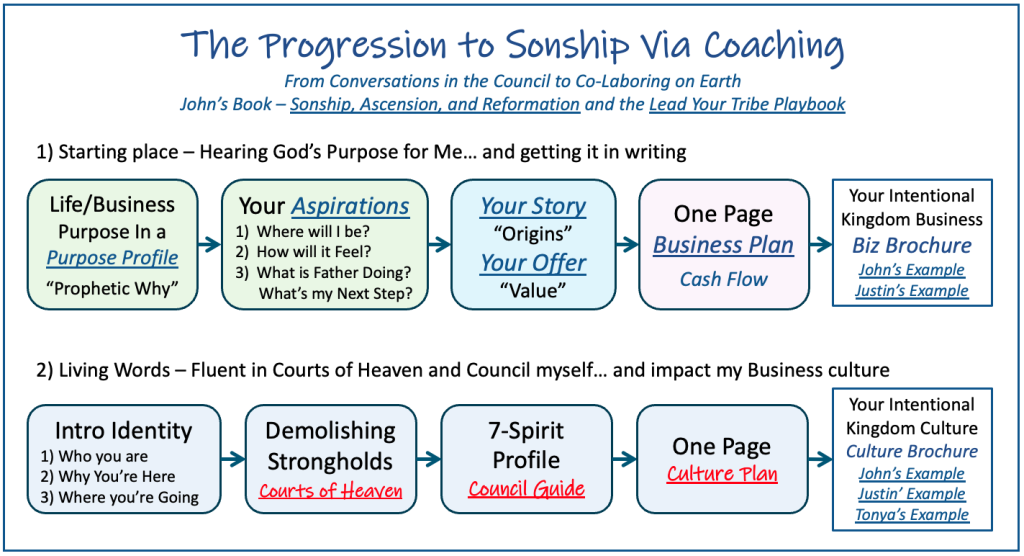
Progression to Sonship – Your Kingdom purpose and redemptive stories form the basis for your personal identity, purpose, value creation, and your business offer. Becoming your authentic self is the Father’s non-religious key to flow and fruit in business and life. We offer practical and prophetic coaching to help you get there, flowing with your Father (co-laboring) instead of fighting circumstances and resistance alone. Is this You?
Read the book and Zoom with John for an overview of our process in Kingdom Business Coaching.
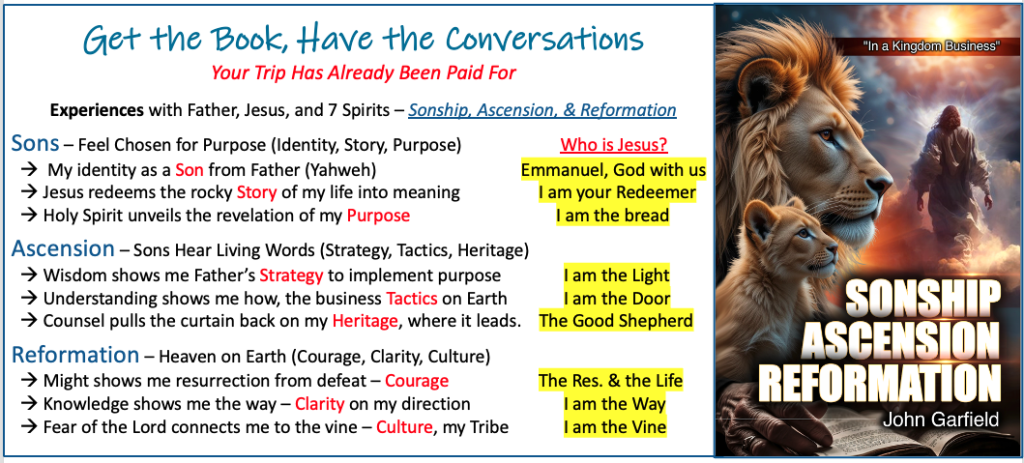
Click the graphic below for access to the live links (how-to details, templates and examples)