From Soulish to Son: How We Hire, Inspire, and Mentor
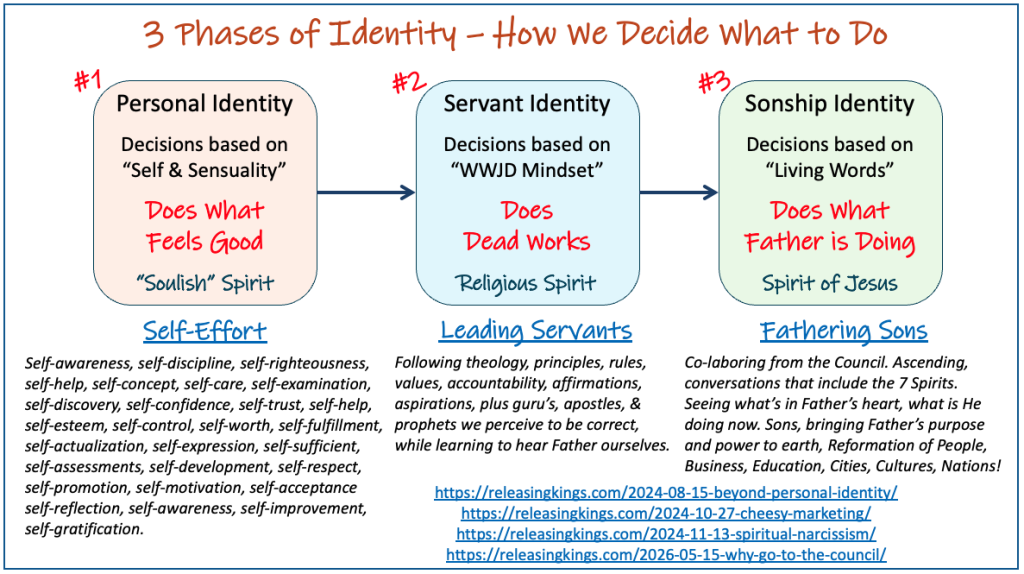
(Intro Video) Businesspeople can be soulish — self-centered, focused on their own strengths and their own ideas. It’s such a normal way to lead that most people never notice it as a category at all. It’s just called being ego-driven. This graphic is revealing because it names three distinct worldviews:
Notice the progression isn’t “bad person, good person.” It’s a maturing sequence — Personal Identity, deciding by what feels good; Servant Identity, deciding by what a mental checklist of rules and mentors says is correct; and Sonship Identity, deciding by what Father is actually doing right now. Most business leaders are orphans and servants living somewhere in the first two columns without ever being shown there’s a third option, Sonship, Ascension, and Reformation.
This Already Has Names
Watchman Nee wrote about this decades before “soulish” became common charismatic vocabulary — what he called soul power: a striving human energy that can look anointed while originating entirely from the self, not from God.
Jack Frost’s Spiritual Slavery to Spiritual Sonship runs the same axis under different language — an “orphan heart” operating from fear and performance, contrasted with a heart that’s actually received Father’s love and rest. If you haven’t read it, it’s close enough to this chart’s own framework that it’s worth putting next to it.
Secular psychology has its own version, useful for a business audience that won’t sit still for spiritual language: the Dark Triad — narcissism, Machiavellianism, and psychopathy — and books like Robert Hare and Paul Babiak’s Snakes in Suits, written specifically about corporate settings. Christopher Lasch’s The Culture of Narcissism (1979) diagnosed the whole self-focused American cultural moment before self-help and New Age vocabulary fully merged into one thing.
Immaturity, or Something Sharper?
Not every soulish leader is under a spirit of manipulation. Most are still moving from servant to son — they haven’t been shown a third column exists. That’s ordinary immaturity, and it corrects the ordinary way: teaching, encounter, being shown a better path.
The discernment tradition reserves sharper language — witchcraft, a Jezebel spirit (see John Paul Jackson’s Unmasking the Jezebel Spirit or Steve Sampson’s Confronting Jezebel) — for something narrower: control and manipulation exercised apart from God’s authority. The practical test isn’t how soulish someone looks. It’s what happens when they’re corrected. Immaturity yields. Manipulation tightens its grip and calls the tightening faith and perseverance. The difference is humility.
The Plan-Then-Pray Pattern
Here’s where the soulish pattern gets specifically religious, and specifically manipulative, without ever announcing itself that way: make the plan first, then ask God to bless it. Pray over it. Declare it. Decree it. Believe hard enough, long enough, and the plan becomes “faith” – It’s manipulating God.
Look at the second half of the same chart, under “Source of Power”:
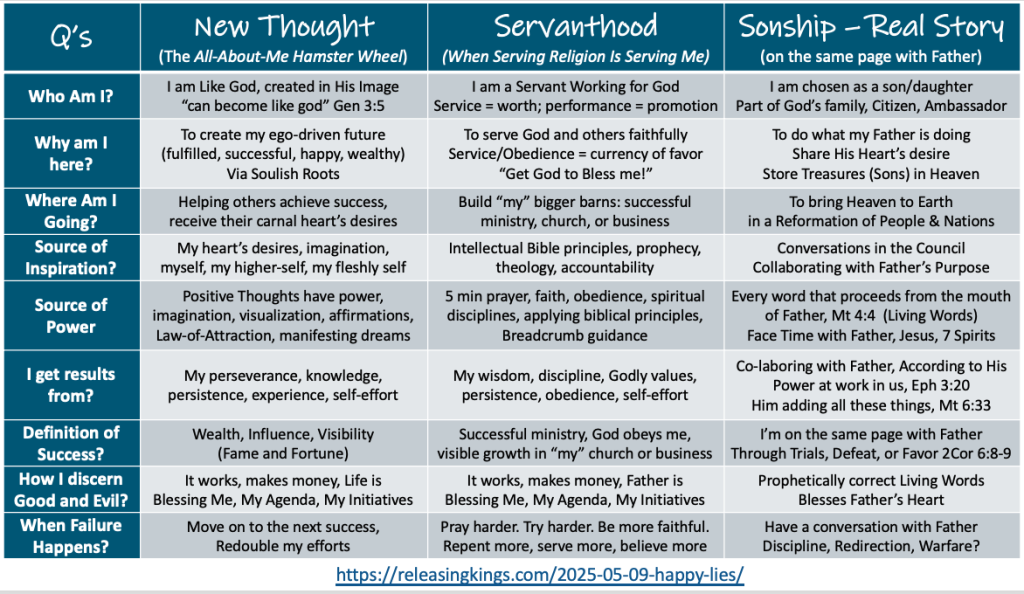
The Servanthood column’s honest description: “5 min prayer, faith, obedience, spiritual disciplines, applying biblical principles, breadcrumb guidance.” Five minutes is the tell. That’s not a conversation — it’s a formality, a spiritual rubber stamp applied to a decision that was already made in the previous forty-five minutes of strategic planning. Pray about it, then do what you were always going to do. Call the outcome “providence” if it works, and “a test of faith” if it doesn’t.
That’s the plan-then-pray pattern, and it’s worth naming for what it actually is: an attempt to get God to cooperate with my agenda, rather than a genuine ask for His. It’s the same posture Simon the Sorcerer had in Acts 8, trying to purchase spiritual power to serve his own ends — not overtly evil, maybe even sincere, but fundamentally transactional. Prayer becomes leverage instead of conversational sonship.
Prov 19:21 – Many are the plans in a person’s heart, but it is the LORD’s purpose that prevails.
Sonship reverses the order entirely: the Council conversation happens before the plan, not after it. “Conversations in the Council and collaborating with Father’s Purpose” isn’t a nicer way of saying the same thing as “breadcrumb guidance” — it’s a completely different transaction. One asks God to sign off on a decision. The other invites Father into a Council Conversation about a course correction.
A Cultural Norm, Not an Anomaly
This isn’t rare. It’s close to the default operating system across New Age, New Thought, and mainstream business culture alike — just wearing different vocabulary in each room. New Thought gives soulish self-focus explicit metaphysical permission (manifesting, the Law of Attraction, “you are your own god” — which is precisely why Genesis 3:5 sits under the New Thought column of this chart). Business culture gives it secular permission through an entire vocabulary of self-actualization, personal branding, and self-promotion, treated as virtues to cultivate rather than a starting point to mature beyond. In recent years the two have substantially merged — “abundance mindset” and “manifesting” now show up in mainstream entrepreneurship content without anyone blinking.
Five Moves From Soulish to Sonship
Servants feel blessed when their ideas turn into money. Sons feel chosen because Father actually speaks to them in the Council and leads them to create value and bless people, fruit that remains.
This isn’t a switch you flip once. Sonship is a lifestyle — Present in the Council, hearing Living Words, then co-laboring with Father, daily. Five concrete moves, worth starting this week rather than admiring from a distance.
#1). Flip the order. — Stop asking “what can I do?” as the first question. Ask “what is Father doing?” before a single plan gets drafted. The test isn’t whether you pray about your plans — it’s whether the Council conversation happens before the plan exists, or after it’s already decided.
#2). Get there before the day fills up. — Meet Father, Jesus, and the 7 Spirits in the Council while the slate is still clean, not squeezed into the five minutes before a meeting. “In the morning, LORD, You will hear my voice” (Ps 5:3). His mercies are new every morning (Lam 3:22) — which means yesterday’s direction was never meant to be recycled indefinitely.
#3). Write down what you actually hear. — A Living Word that only exists as a feeling fades by lunchtime. Writing it down is how you find out whether it was actually alive or just noise that felt urgent — the pen either confirms it, or the thought doesn’t survive contact with the page. What’s written can be tested, implemented, and revisited; what’s only felt gets quietly reinterpreted to fit whatever you’d already decided.
#4). Lay the plan down daily. — Whoever wants to save their life will lose it; whoever loses their life for His sake will find it (Mt 16:24-25). That’s not a one-time death of ambition — it’s a daily willingness to hold the plan loosely enough that it can actually be corrected. Spiritual agility means trading yesterday’s plan for today’s Living Word, not defending yesterday’s plan out of habit.
#5). Test the fruit, discern the feeling. — A soulish plan can feel just as confident, just as “led,” as a genuine Living Word — confidence isn’t the tell. The tell is what happens under correction. Immaturity yields when confronted; manipulation tightens its grip and calls the tightening faith. If a “word” can’t survive being questioned in the Council, it probably didn’t come from there.
Prov 3:5-6 – Trust in the LORD with all your heart and lean not on your own understanding;
in all your ways submit to Him, and He will make your paths straight.
None of this requires waiting for a retreat or a crisis to start. It requires the next plan on your desk to go to the Council before it goes to the calendar.
The Refreshing Contrast (Experiencing the Culture)
Sonship is a genuinely different air to breathe. Living Words are actually present, not assumed. The focus sits on what God is doing, and through whom, rather than on what I’ve decided to do and am now asking Father to underwrite. It’s reverent. It’s respectful — of Father, and of the actual people He’s already at work in. Set next to that, the plan-then-pray version of professional ambition doesn’t look dangerous so much as it looks small and, frankly, a little loathsome once you’ve seen the difference up close: dressed in spiritual language, but still just our soulish self running the meeting dressed in a religious pretense.
Business creativity isn’t chasing intellectual rabbits in a brainstorming process to make more money. Real innovation comes after we’re clear on Father’s purpose and see what He’s doing (Jn 5:19); it’s an umbrella for the strategies and tactics that are being discussed in the Council with Wisdom and Understanding (two of the seven Spirits sons access in Council). The result is fruit that remains because Father is co-laboring with us to add all these things (Mt 6:33).
The question worth asking before the next plan gets made: did I go to the Council first, or am I about to spend five minutes asking Father to bless something I’ve already decided? Are there Living Words present in my business culture? Do we intentionally make room for Council conversations? Is God allowed to speak, or is He our lap dog dispensed to do our bidding?
How Do We Hire and Disciple Sons?
There are three practical stages people go through from servant to son. Here’s what this looks like concretely in our own hiring and leadership. We intentionally try to help people articulate and navigate their own progression in Kingdom maturity. Our worldview is that our business is a platform for 1) creating marketable value from a Reformational purpose, and 2) for mentoring and releasing sons and daughters on our staff into all the purpose God has for them.
#1). Share our Prophetic Purpose – Can you hear and share our corporate prophetic purpose? Does it resonate?
#2). Clarity on your own Purpose – Do you have your own personal prophetic purpose? Is it in writing? Do you have Court and Council sessions to walk it out?
#3). Living Words from Conversations – Can you contribute Living Words about your contribution in our shared purpose? Are you comfortable with a transparent weekly update on what Father is saying about your own creativity and contribution in the context of Father’s purpose from the Council?
Hiring, in this model, is just the first Council conversation of many — not a transaction, but an invitation into a purpose that Father is still writing. Conversations and direction are new every day. As sons and daughters, we’re keeping in step with Holy Spirit (Gal 5:25), doing what Father is doing (Jn 5:19), and moving with the cloud (Num 9:17-19) — Spiritual Agility to follow the Lamb (Rev 14:4).
Why? – We value resumes, experience, and recommendations for people who can do great things. But even more we value what God can do through that son or daughter. That entails co-laboring in Father’s purpose and in our anointing, fluency in the Courts of Heaven and Father’s Council.
This blog was inspired by a Council Session – 2026-08-24 Council – From Soulish to Son
Take the Next Step:
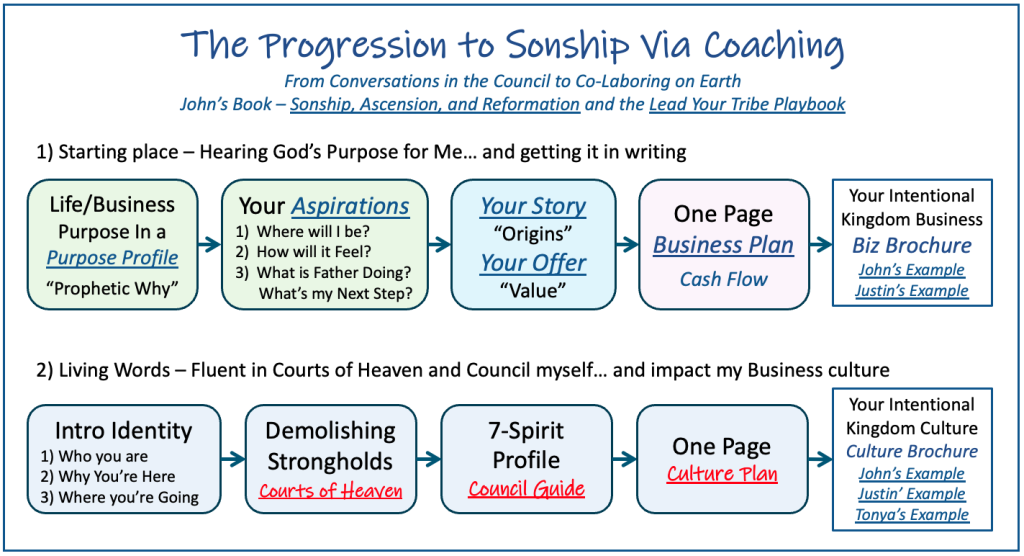
Progression to Sonship – Your Kingdom purpose and redemptive stories form the basis for your personal identity, purpose, value creation, and your business offer. Becoming your authentic self is the Father’s non-religious key to flow and fruit in business and life. We offer practical and prophetic coaching to help you get there, flowing with your Father (co-laboring) instead of fighting circumstances and resistance alone. Is this You?
Read the book and Zoom with John for an overview of our process in Kingdom Business Coaching.
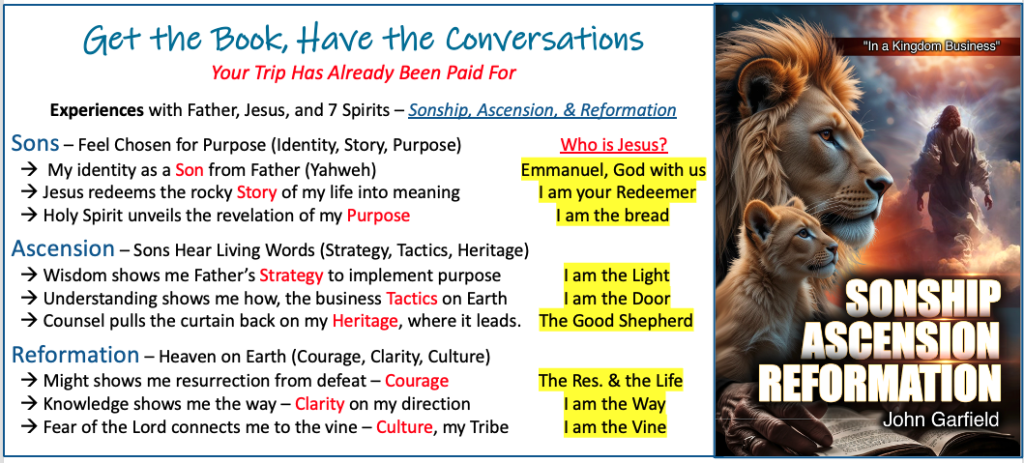
Click the graphic below for access to the live links (how-to details, templates and examples)