When Identity Become Your Prison
(Intro Video and Shareable PDF)The identity you build around your own desires becomes the prison that keeps you from hearing what Father actually says about who you are — and the three mechanisms of that prison are not spiritual problems; they are cognitive ones, listed below, that operate with or without God’s permission. They actually become the religious fortress that protects us from face-to-face conversations with Father in the Council.
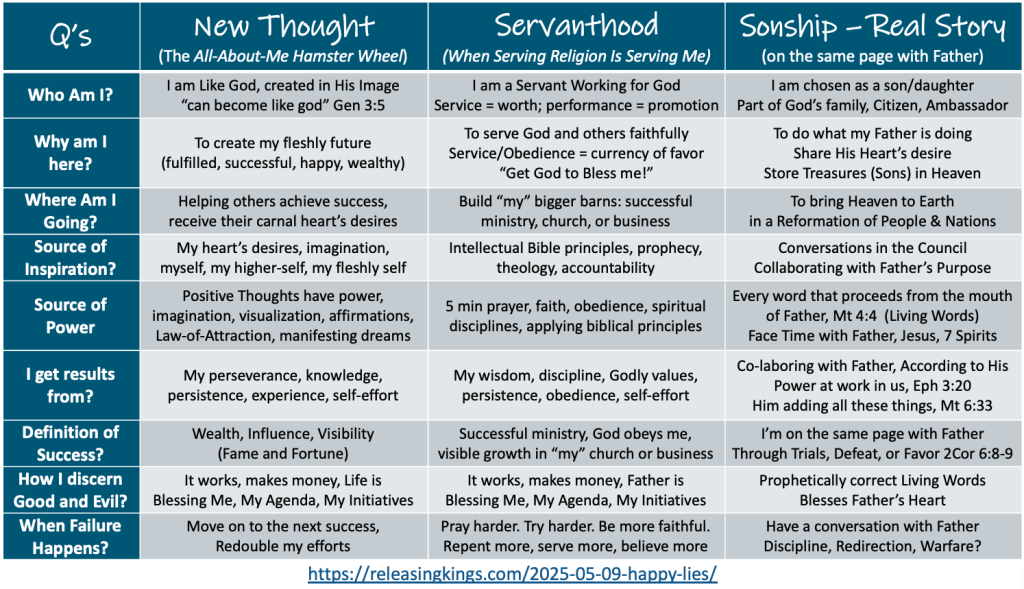
This is the ego at work: a self-constructed identity that must be built, defended, and validated because it didn’t originate with Father. New Thought is what happens when that construction project gets baptized — a nineteenth-century philosophy, still alive in self-help culture, marketing, leadership, and business coaching, teaching that your own mind and desires are the source of who you are and that your dreams and desires are God’s will — the perfect religious disguise. Sonship is the alternative: an identity spoken by Father before you built anything, which is why it never has to be defended.
#1). Identity Protective Cognition: Your brain defends your self-concept as a physical threat
When a belief gets woven into who you are — your theology, your business vision, your calling — your brain stops treating it like an idea and starts treating it like your life. Challenges trigger fight-or-flight, not evaluation. This is why “my business is God’s will” is so dangerous: correction from Father stops feeling like guidance and starts feeling like an attack. The prison is not external. It is neurological — and entirely self-constructed.
#2). Cognitive Dissonance: New info that threatens identity gets rejected, not evaluated
When the Council, a prophetic word, or plain circumstances contradict a deeply held self-narrative, the brain doesn’t update the narrative — it discredits the source. This is why people most invested in New Thought identity frameworks are also most resistant to sonship: “your identity comes from Father, not your desires” isn’t just theologically challenging, it’s cognitively threatening. Rather than argue the content, they discredit the messenger. Cognitive dissonance is how the happy lie protects itself.
#3). In-Group Loyalty Bias: The tribe reinforces the prison like a sectarian cult
Every identity-based community — Word of Faith, prosperity gospel, New Thought business coaching — develops an in-group whose approval validates the identity and whose rejection enforces it. Anything that threatens the narrative gets treated as coming from the enemy or the unanointed. This is why the prophetic voice most needed is most excluded. The Council breaks this pattern — it is a conversation with Father that bypasses the in-group entirely.
“My identity is in Christ” is a placeholder, not a prison break
The phrase “my identity is in Christ” has become a Christian in-group signal — it sounds like the alternative to New Thought identity, but it functions as the same prison at a different address unless it has specific content. A person who says “my identity is in Christ” but has never ascended to the Council and heard Father speak into their specific name, wiring, and assignment has simply fortified one self-generated ego narrative with religion undergirded by a theological narrative. The prison walls are still built from self-reference — now with Scripture verses to reinforce the concrete. We end up led by our ego-identity rather than hearing Father’s voice and following the Lamb.
My identity gives me permission to do what I’m supposed to do because of who I am, “and” whatever I want to do because I can — exactly the formula for presumption.
Practical sonship identity is radically different
It requires ascending to the Council, hearing Father speak something specific into your identity that you did not generate, and then deciding — as a son, not as a consumer — to co-labor with what Father initiated. That sequence breaks the cognitive prison because the identity is no longer self-constructed. It came from outside. It was received, not built. And because it wasn’t built by self, it cannot be defended by self. It simply is — and when Father says something that updates it, the son can receive the update without an existential crisis.
For example, when pastors say they are “called to the Ministry.”
They are perfectly willing to destroy their finances and family before adjusting their ego-led identity.
And here is the deeper freedom: a son’s identity is never a constant or a constraint, because sons follow the Lamb wherever He goes. Following Jesus is full of mid-course corrections. The whole point of taking up the cross and following Jesus is not the acquisition of a better identity — it is the daily surrender of the one you have to put Father’s Kingdom Purpose first (Mt 6:33). Dying to self is not a one-time theological event. It is the ongoing posture of a son who holds his own narrative loosely enough that Father can rewrite it at any stage of the journey.
The New Thought identity is an ego prison precisely because it cannot be surrendered — it must be protected, defended, worshipped and continuously validated. The son’s identity, received from Father in the Council, can be laid down at any moment because it was never his to begin with. He doesn’t follow Father because it confirms who he is. He follows because Father is going somewhere worth going — and wherever that leads, the son is free to go, because no destination threatens what Father has already spoken over him.
Identity Deaths and Resurrections
Minds don’t change when facts are presented — they change when the cost of protecting the narrative exceeds the cost of releasing it (a financial or relational trainwreck). Spiritually, this translates: the New Thought identity doesn’t break under argument or revelation (our ego identity is our deafness). It breaks when the fruit of the self-constructed narrative becomes undeniable — when the business fails, when the relationships fracture, when the Identity projection that was “God’s will” produces consequences that can’t be spiritualized away. Father in His mercy often allows (or leads us into) exactly these death and resurrection scenarios – the unpleasant discipline of Heb 12.
The prodigal son didn’t change his identity narrative because someone reasoned with him. He “came to himself” when the cost of the lie exceeded the cost of return. The Council is what he returned to — not a principle, but a Father who was already running toward him.
Sonship identity is the only identity that cannot become a prison
A self-constructed identity must be defended because it can be threatened. Father’s identity for you cannot be threatened — it was established before the foundation of the world, it was redeemed by Jesus’ specific work on your history, and it is renewed daily in the Council through living words that update rather than cement old mental concepts of identity. A son whose identity is continuously formed in conversation with Father doesn’t need to protect it, because Father is its source and guardian. The cognitive prison dissolves not through deconstruction but through encounter — when Father speaks your name and what He says is more real than what you built.
Summary – New Thought Identity is a Prison
(Intro Video) New Thought gives you permission to build your identity around your ego-driven desires and call it faith, or that God is speaking to you through the desires of your heart. The three cognitive mechanisms — identity protective cognition, cognitive dissonance, and in-group loyalty bias — then lock that identity in place and make it nearly impervious to correction.
The prison is real, sophisticated, and largely invisible to the person inside it. The exit is not argument, therapy, coaching, or better theology. It is a specific encounter in the Council where Father speaks into your identity something you could not have generated yourself — and the decision, as a son, to receive it and co-labor with Father “wherever” that goes.
Sons have a new song to sing:
Rev 14:3 – And they sang a new song before the throne and before the four living creatures and the elders.
No one could learn the song except the 144,000 who had been redeemed from the earth.
4) These are those who did not defile themselves with women, for they remained virgins. *
They follow the Lamb wherever he goes.
They were purchased from among mankind and offered as firstfruits to God and the Lamb.
5) No lie was found in their mouths; they are blameless.
(*) The key to understanding these verses is this reference to the Fallen sons in Gen 6. God’s original Council of Sons endured a fall described in Gen 6 and Enoch 6. Jesus redeemed that fall just like Adam and Eve. Just like choosing salvation, we can now choose to repopulate Father’s Council as sons and follow the Lamb wherever he goes. That Jesus redeemed our access to the Council (Jn 1:51) and that we have a seat in Heaven (Eph 2:6) doesn’t imply all is done. We still have to decide, ascend, converse, and bring Living Words and Greater Works to Earth.
Why? Sons are the new overseers whom Father is using to bring Heaven to Earth (Reformation).
We are called to be distributors (Titus 1:7) of Father’s blessing.
Cutting Room Floor
What is New Thought?
New Thought is a nineteenth-century American philosophy built on a single premise: the human mind, properly directed, can shape reality. Thoughts have power. Words create outcomes. The self is the center of the story, and God — or the universe, or the higher self — exists as a force to be harnessed for personal health, happiness, and prosperity. “God obeys us.”
As Dougherty documents, New Thought is not new, and it is not obviously false — which is precisely what makes it dangerous. It is almost true. It borrows Christian language, quotes Scripture selectively, and wraps Genesis 3:5 (“you will be like God”) in the vocabulary of faith, purpose, and blessing. The result is a counterfeit gospel that puts self at the center instead of Christ — promising freedom while delivering bondage to self-generated desire.
New Thought is the common ancestor of the self-help movement, the Law of Attraction, positive confession theology, prosperity preaching, progressive Christianity’s self-discovery narrative, and the entire motivational business culture from Napoleon Hill to Tony Robbins. Most people who carry it have never heard the term. They absorbed it through sales training, church, self-help books, and coaching culture — invisible because it has been so thoroughly normalized.
In Dougherty’s summary: “New Thought isn’t about rejecting God outright. It’s about twisting what He said — putting yourself in the center of the story instead of Christ.”
Discerning Ego From New Thought vs Identity From Father
This connects directly to the orphan-to-son paradigm, so this layout is the way that framework distinguishes it — not just as a generic self-help contrast, but as two entirely different sources of a person’s sense of self.
Ego: identity built from the outside in
Ego is a self constructed under pressure — it forms as a coping structure, assembling itself out of performance, comparison, and defense. Its core features:
- Earned, not given. It has to be built and then continually maintained — through achievement, approval, control, or image management.
- Fragile by nature. Because it’s self-constructed, it’s always vulnerable to threat — criticism, failure, or being outshone by someone else. Hence defensiveness, need for validation, competitiveness.
- Orphan-postured. In the orphan-to-son diagnostic, the ego is essentially the orphan’s substitute for identity — a self built by a soul that doesn’t yet know it’s securely fathered, so it has to prove worth, provide for itself, protect itself.
- Externally referenced. Its value comes from outside — status, results, others’ opinions — so it’s always shifting with circumstance.
Identity from God: a given, not a construction
The identity God gives is not built — it’s received and revealed, rooted in sonship rather than performance:
- Declared, not earned. It rests on a Father’s pronouncement (the pattern is Jesus at the Jordan — “This is my Son, in whom I am well pleased” — spoken before any ministry or miracle). Value precedes performance rather than resulting from it.
- Stable under pressure. Because it isn’t self-constructed, it isn’t self-defending. A son doesn’t need to win every conversation or protect an image, because nothing about his worth is actually on the line.
- Relationally sourced. It comes from ongoing communion — the kind of Council-conversation, Father-Son-Spirit access your framework centers — not from isolated self-assertion.
- Free to co-labor rather than perform. Since nothing needs to be proven, action flows from rest and relationship instead of striving. This is the difference between a servant working for approval and a son working from already-possessed sonship.
The practical hinge
The most useful diagnostic line: ego asks “What do I need to do or prove to be someone?” Identity-in-sonship asks “Given who I already am, what am I free to do?” One is anxious and self-referential; the other is secure and other-oriented — which is exactly why it can actually engage culture (the seven mountains) instead of just defending territory.