From Christian Business to Kingdom Business:
Why Good Values Aren’t Enough
(Intro video and Sharable PDF)
Christian Business — operates according to Christian ethics and values. Honest, generous, fair, and people-oriented. God is honored by how the business behaves according to scriptural principles. The owner is a servant trying to do business the right way, God’s way. The ceiling is the code of moral and behavioral excellence.
Kingdom Business — operates from Father’s personal assignment. The business itself is a vehicle for Reformation — a specific sphere of influence on a specific mountain of culture where a son is doing what Father is doing. Strategy comes from the Council in the form of Living Prophetic Words that resonate with Father’s authority, not just the dead letters of human recipes for success. The culture carries Heaven’s atmosphere. Profit is a tool for advancing an assignment, not just a reward for faithful service. The owner is a son co-laboring with Father on a unique mission Father initiated and whose creativity, innovation, and initiative flow from that co-laboring rather than from self-reliance.
But the deeper distinction is what a Kingdom business does with its people. A Christian business develops employees. A Kingdom business fathers sons — intentionally discipling the staff to ascend to the Courts and Council themselves, hear Father’s voice for their own assignments, bring living words back into their work, and release Father’s power and creativity from within their specific role. The business becomes an Ecclesia at work — people gathered around Kingdom purpose who are each individually connected to the source, each carrying Heaven’s intelligence into their sphere, each co-laboring with Father rather than merely serving the organization’s goals.
This is what makes a Kingdom business categorically different from even the best Christian business. The Christian business values excellence and integrity in its employees. The Kingdom business produces sons who are creative within the context of Father’s purpose — innovating, pioneering, and releasing breakthrough not from human ingenuity alone but from direct access to the One who holds the strategies. The culture of sons with access to the Courts of Heaven who can take accusations to the cross, demolish strongholds, and advance Father’s purpose through spiritual opposition rather than around it.
- The difference in one sentence: a Christian business asks how should we behave?
- A Kingdom business asks what Father is building, co-labors with Him to build it, and fathers the sons and daughters to engage with it in the same Council conversations.
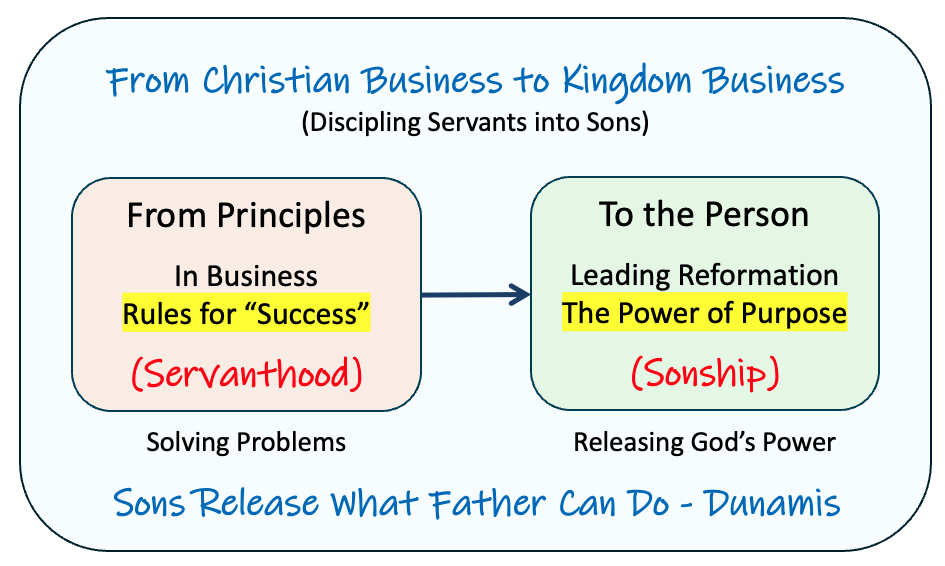
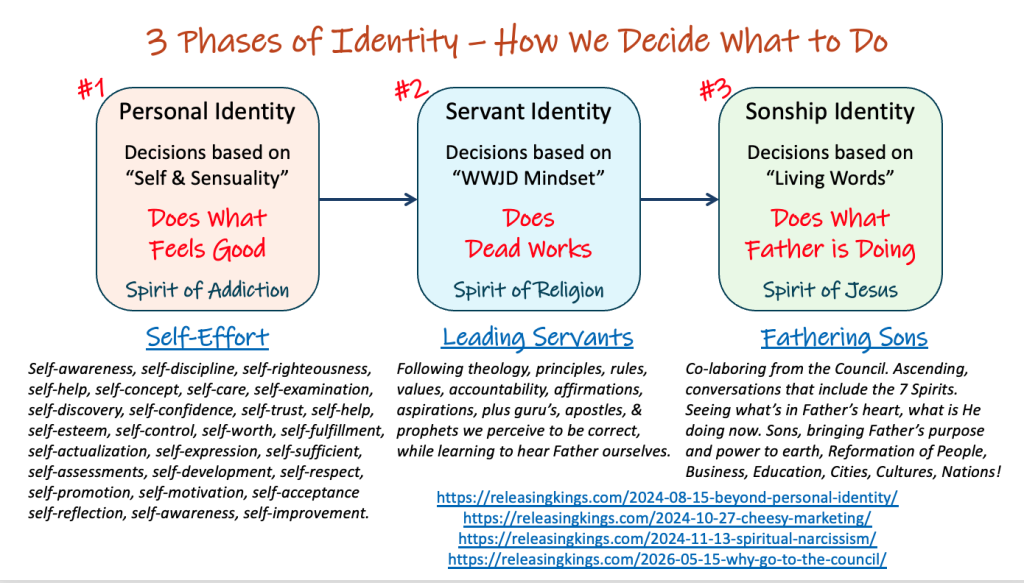
The reason a business can shift from Christian to Kingdom is because the leadership and staff are shifting from orphans apart from God, to servants in a religious context, to Sons occupying their seat in the Courts and Council so they can bring Heaven to Earth.
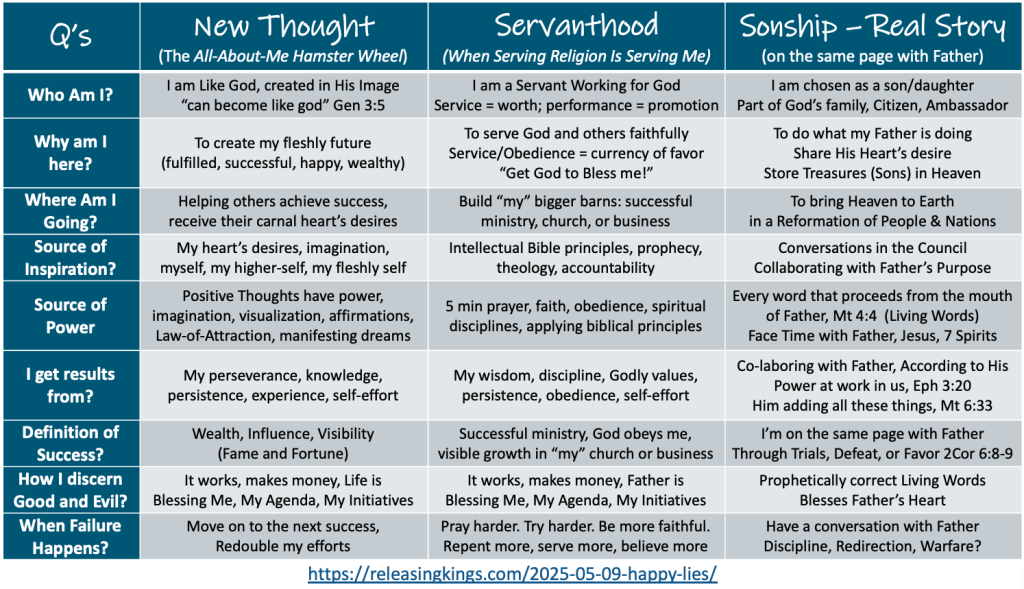
Appendix – Background on New Thought
Melissa Dougherty wrote Happy Lies and exposed the historic roots of the New Thought movement. These are the key historic figures that promulgated New Thought. Also the key people in the Business, Marketing, and Christian community that have held the same New Thought philosophy.
Secular / Historic Founders of New Thought
Emanuel Swedenborg (1688–1772) — the deepest root. Swedish mystic who taught that the material world reflects spiritual reality and humans can access divine truth directly through inner illumination. Seeded the entire tradition.
Phineas Quimby (1802–1866) — the originator. Taught that disease is caused by false belief and that the mind, properly directed, can heal the body. Every subsequent figure traces back to him.
Ralph Waldo Emerson (1803–1882) — gave New Thought philosophical respectability through Transcendentalism. Taught that God is an impersonal universal force accessible through intuition, not revelation.
Mary Baker Eddy (1821–1910) — founded Christian Science, the first major institutionalization of New Thought in Christian language. Matter is illusion; sickness and sin are errors of mortal mind.
Emma Curtis Hopkins (1849–1925) — the “teacher of teachers.” Trained virtually all the movement’s second-generation leaders including the Fillmores (Unity Church) after breaking with Eddy.
William Walker Atkinson (1862–1932) — popularized the Law of Attraction decades before The Secret, teaching that thought vibrations attract corresponding realities.
Business, Marketing, and Self-Help Transmitters
This is where New Thought left the church and colonized the boardroom — and why it is virtually impossible to go through any American business or sales training without absorbing it.
Andrew Carnegie (1835–1919) — his Gospel of Wealth aligned material prosperity with moral virtue, establishing the spiritual legitimacy of accumulation that New Thought then provided the mechanism for.
Napoleon Hill (1883–1970) — Think and Grow Rich is the single most important transmission of New Thought into business culture. Hill claimed to have interviewed Andrew Carnegie and distilled the secret of success: thoughts create reality, visualize wealth, desire becomes destiny. Hill was a documented fraud and cult member — but his book is still passed around in real estate, sales, and entrepreneurial circles like sacred text. Every Law of Attraction teacher since points back to Hill as the source.
Dale Carnegie (1888–1955) — How to Win Friends and Influence People. While more relational than metaphysical, Carnegie transmitted New Thought’s core premise that changing your internal state changes external outcomes. He is formally listed among New Thought authors and teachers and his work seeded the entire corporate training industry.
Wallace Wattles (1860–1911) — The Science of Getting Rich, the direct source Rhonda Byrne used for The Secret. Taught that thinking in a “certain way” aligns you with the formless substance of the universe and produces wealth.
Earl Nightingale (1921–1989) — co-founder of Nightingale-Conant, the dominant distributor of self-help audio. His recording The Strangest Secret — “you become what you think about” — sold over a million copies and established the business audio genre. Pure New Thought in business dress.
Og Mandino (1923–1996) — The Greatest Salesman in the World. Blended New Thought with quasi-Christian language in a business and sales framework that became standard sales training material.
Jim Rohn (1930–2009) — Tony Robbins’ mentor and one of the most influential figures in business motivation. His personal development philosophy — that success is the result of disciplined thinking and inner transformation — is the sophisticated business version of New Thought without the metaphysical language.
Tony Robbins (1960–) — the current dominant figure. Neuro-linguistic programming, visualization, peak state management, and manifesting outcomes through internal state control. Formally identified as a New Thought teacher. His business and leadership seminars have reached millions.
Stephen Covey (1932–2012) — The 7 Habits of Highly Effective People. More principled and less metaphysical than most, but Covey is formally listed among New Thought teachers. His framework that internal character produces external results, and that you can script your own life through principle-centered thinking, carries the New Thought DNA while using language acceptable to Christians and secularists alike.
Wayne Dyer (1940–2015) — bridge between self-help and spirituality. Your Erroneous Zones to The Power of Intention— increasingly explicit New Thought theology dressed in therapeutic and spiritual language, marketed heavily to the Christian adjacent audience.
Deepak Chopra (1946–) — merged New Thought with Eastern mysticism and quantum physics language. Enormously influential in the corporate wellness and leadership development space.
Louise Hay (1926–2017) — You Can Heal Your Life. Thoughts cause disease; affirmations heal. Hay House became the dominant publisher of New Thought content globally, publishing Dyer, Chopra, Doreen Virtue, and hundreds of others.
Jack Canfield — Chicken Soup for the Soul and The Success Principles. Explicitly teaches Law of Attraction as a business success framework. Trained under New Thought teachers and now trains business coaches globally.
Rhonda Byrne (2006) — The Secret mainstreamed the Law of Attraction globally, explicitly crediting Wattles and Hill. Produced the cultural moment that made New Thought impossible to ignore.
Esther Hicks / Abraham — the most explicitly occult end of the business New Thought spectrum. Channeled teachings on Law of Attraction marketed directly to business and entrepreneurial audiences. Featured in the original cut of The Secret.
Christian Community Figures
Norman Vincent Peale (1898–1993) — The Power of Positive Thinking. The primary bridge between New Thought and mainstream Protestant Christianity. Directly studied under New Thought figures and openly drew on the tradition while using Christian language.
E.W. Kenyon (1867–1948) — attended a New Thought metaphysical college before developing “positive confession” theology. The missing link between Quimby and the entire Word of Faith movement.
Kenneth Hagin (1917–2003) — father of Word of Faith. Directly borrowed from Kenyon. Faith is a force; words create reality; believers speak things into existence.
Kenneth Copeland — extended Hagin’s framework. Christians are “little gods” with creative power in their words. God operates by spiritual laws believers can activate.
Robert Schuller (1926–2015) — “possibility thinking.” Sin reframed as negative self-image; salvation reframed as self-actualization.
Joel Osteen — the mass-market current version. Your Best Life Now is Peale updated for Instagram. God’s primary purpose is helping you fulfill your potential.
Joyce Meyer — named explicitly by Dougherty. Thoughts shape reality; negative thinking blocks God’s blessing.
T.D. Jakes — prosperity and self-actualization teaching with Word of Faith elements across a broader theological range.
Marianne Williamson — A Course in Miracles teacher. Explicitly blends New Thought with Christian language across both church and secular spaces.
Progressive Christianity broadly (Rob Bell et al.) — the second infiltration stream. Replaces sin and redemption with self-discovery and authenticity. Different theology from Word of Faith, identical anthropology: the self is the authority, feelings are the guide, God is the resource.
The through-line across all three streams
The philosophical seeds sown by Swedenborg, Emerson, and Quimby flowered into New Thought promoted by Kenneth Hagin, Robert Schuller, and Joyce Meyer — but the business stream is the least examined and most pervasive. A Christian leader who would never read Hagin has almost certainly absorbed Hill through sales training, Covey through leadership development, Robbins through a business seminar, and Carnegie through management courses. The pipeline from the metaphysical roots into corporate America is so complete that New Thought is the default operating system of American business culture — invisible because it has been so thoroughly normalized. The wrapper across all three streams is always the same: God (or the universe, or the force, or your higher self) exists primarily to serve your desire for success, health, wealth, and fulfillment. Genesis 3:5 in a suit.
- I learn techniques — affirmations, visualization, declarations, prayer formulas — to get God to serve my agenda.
- God exists to bless me and fulfill my dreams (He’s a Genie in a bottle that I know how to rub).
- For Christians, Bible principles and verses are how I rub the bottle to get what I want. This is the most common pattern in Christian business circles — and the hardest to see from the inside.
- Faith is a technique for adjusting my belief system, so God is obligated to produce the outcome I want.
- I can adjust my Identity — declare who I am, speak my authority, align my mindset — to unlock the outcomes I’m pursuing. Sonship becomes a technique rather than a relationship.
- My business vision is God’s will because I conceived it and I believe it — therefore He is obligated to bless it.
- The measure of my faith and favor is my revenue, my growth, and my results. If business is struggling, I must be doing something spiritually wrong. If it’s thriving, God must be pleased.
- I coach others to believe bigger, think higher, and speak more boldly — so they can get more of what they want from God.
- I am the center of the story God is telling — my purpose, my calling, my destiny, my breakthrough. Father exists to complete my story rather than me existing to participate in His.
Sonship is not a better technique for getting what you want from God — it is a relationship with Father in which what you want progressively becomes what He wants, because you have been in Council conversations enough to hear and share His heart and volunteer to co-labor with His Purpose.