Why People Believe Lies
And What Actually Sets Them Free
(Intro Video) There is a question most leaders and parents avoid because the honest answer is uncomfortable: why people believe and choose lies over truth when truth is plainly available? Why did I do it?
It’s not primarily an intelligence problem. Most of us caught in a false narrative are not stupid. We already have good (usually hidden) reason for our beliefs. It is not even primarily an information problem. The internet has made data infinitely accessible. The problem is deeper, in the heart — and until we discern roots in the heart correctly, our attempts to rescue people from the consequences of believing lies will fall on deaf ears.
There are good buys on story lies (ever since the garden) because lies are a shortcut to what I want. And reality, without a Father who redeems it, has consequences that are often unbearable in the end.
Jer 5:31 – The prophets prophesy lies, the priests rule by their own authority,
and my people love it this way.
The anatomy of a comfortable lie
Every lie people embrace offers something truth is perceived to take away. Safety. Belonging. Identity. Meaning. When a person’s sense of self is built on a narrative — political, medical, financial, theological — and that narrative turns out to be false, the collapse is not just intellectual. It is existential. To admit the lie is to lose the ground under their feet.
This is why the cabal’s most powerful tool is not the lie itself. There is no sense in which the narrative story is required to be true. What is tangible is the community built around the lie. The lie becomes a tribe. To question the narrative is to risk excommunication — from the people, the identity, the belonging that the narrative provides. Most people will choose belonging over truth every time. The math is simple: truth is abstract, loneliness and lack of purpose is immediate.
The counteroffer isn’t cold, hard religious truth. It’s an invitation from a person, the Spirit of Truth. There is a tribe that Father calls his sons and daughters and Jesus calls His brothers and sisters (Heb 2:10-11). Believers buy the Kingdom, not just an intellectual story about the kingdom. Ecclesia is real! Father has real and unique purpose for each of His Sons and Daughters, YOU!
Why the servant mentality makes it worse
Here is the root that most analyses miss: the cabal is not selling ideas to free thinkers. It is selling identity to servants — people already trained to receive their sense of self from an external authority.
A servant’s identity is not intrinsic. It is assigned. Their value is determined by performance, compliance, and the approval of whoever holds authority over them. That is the designed output of an educational system, a media culture, and even a church culture that instructed people rather than fathered them. The mechanism is identical to what they experienced in school, in the workplace, in the pew: comply with the approved narrative, belong to the group, receive the validation.
This is why servants with prior allegiance experience truth as a threat rather than a liberation. A son can follow truth wherever it leads because his identity doesn’t depend on the outcome. A servant cannot afford that risk. Questioning the approved story means questioning the authority structure that defines them — and by extension, their own value and tribal belonging. It is not cognitive stubbornness. It is survival instinct.
The orphan condition is the precondition for manufactured consent. Edward Bernays understood this intuitively — not in Kingdom language, but in operational terms. Servants without a secure self are perpetually anxious, perpetually seeking approval, perpetually susceptible to anyone who offers them a coherent story about who they are and what they should fear. The cabal’s entire playbook runs on this: manufacture anxiety, offer the narrative story that resolves it, extract compliance in exchange for the relief. It works because servants have been trained since childhood to trade their autonomy and spiritual heritage for belonging, Esau’s bowl of lentil soup!
The church compounded this by teaching servanthood as the highest virtue without the corresponding foundation of sonship. The result was Christians who were humble, compliant, and completely unable to discern manipulation — because they had no interior reference point. They knew what to do. They did not know who they were.
Why information doesn’t fix it
The instinct of reformers, educators, and truth-tellers is to produce better information. More data. Stronger arguments. Cleaner evidence. If people just knew the truth, they would choose it.
They won’t. Not if their identity is still tethered to the false narrative of their tribe.
Paul understood this. He did not write to the Corinthians primarily about their bad doctrine. He wrote about their orphan condition — the fact that they had ten thousand instructors and not enough fathers. Instructors transfer information to minds. Fathers speak living words into identity. The difference is not academic, it’s heart. You cannot argue someone into a new identity. You can only father them into one with love and living words that resonate in their heart.
This is the precise gap the cabal exploits. A person without a father — without a secure identity rooted in who Father says they are — will attach to any narrative that offers them a self. Cultural Marxism, victimhood, ideology, institutional loyalty: all function as identity prosthetics for orphans. They are not primarily about truth. They are about belonging – Answering, “Why am I here.” Network marketing is an example of tribe: the product doesn’t have to offer measurable value, the marketing doesn’t have to be true, but the leaders have to model wealth and allure; integrity is optional!
Truth alone cannot compete with belonging. Sonship can.
Fathers rescuing people from consequences
Father does not primarily send better arguments into the world. He sends sons and daughters who see hearts — people with an identity so secure they can afford to share the truth in love, absorb the pushback, and stay in relationship with the person still caught in the lie.
This is what fathering looks like in practice. Not debate. Not exposure for its own sake. The son or daughter who sits with someone in a false narrative and asks: what are you afraid to lose if this isn’t true? That question does more than a thousand articles. Because it goes after the real issue — the identity beneath the belief.
The Council is where sons get equipped for this work. When Father speaks into your Identity, Story, Purpose, Courage, and Clarity, you stop needing the world’s validation to feel secure. People who don’t need validation cannot be manipulated by its withdrawal. You can hold truth and relationship simultaneously — which is the only posture from which anyone ever actually changes their mind.
This is why Father’s Reformation strategy runs through relationship and not information campaigns. He is not primarily releasing better content. He is releasing sons and daughters into every mountain of culture who carry His heart — His willingness to stay in the room, ask the uncomfortable question, and father people out of the narratives that are destroying them.
What this means practically
Rescue from consequences requires two things operating simultaneously.
The first is exposure — naming the lie clearly, showing its costs, refusing to soft-pedal the damage. Compassion that conceals truth is not compassion. It is abandonment dressed as kindness.
The second is identity before information; purpose before logic. Before a person can let go of a false narrative, they need somewhere else to stand. Someone who will still know them when the story changes. A Father who sees their identity and purpose when the community built around the lie has walked away.
Sons who have heard that voice in the Council can lead the way — living words that change hearts, with minds and wills aligning after hearts grasp the deeper purpose in Father’s heart.
That is how people get rescued — not from the outside by better arguments, but from the inside by fathers who have been in the presence of the One whose truth is always good news, even when it costs something to receive it.
This blog was inspired by A Council Session you will enjoy: 2026-07-01 Why People Love Deception
Take the Next Step:
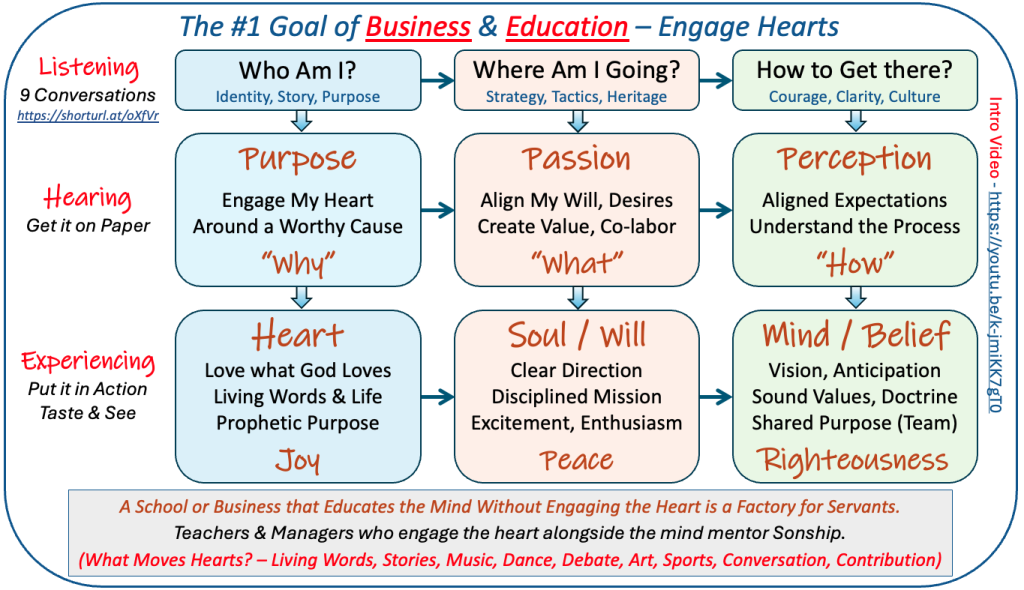
Progression to Sonship – Your Kingdom purpose and redemptive stories form the basis for your personal identity, purpose, value creation, and your business offer. Becoming your authentic self is the Father’s non-religious key to flow and fruit in business and life. We offer practical and prophetic coaching to help you get there, flowing with your Father (co-laboring) instead of fighting circumstances and resistance alone. Is this You?
Read the book and Zoom with John for an overview of our process in Kingdom Business Coaching.
Explainer Video – https://youtu.be/k-jmiKK7gT0
Appendix – Why Servants are Susceptible
The servant mentality is actually the root of the vulnerability to deception, not just a contributing factor. Here’s how the connection runs:
Servants are defined by the system they serve. A servant’s identity is not intrinsic — it is assigned. Their value is determined by performance, compliance, and the approval of whoever holds authority over them. That is not an accident of personality. It is the designed output of an educational system, a media culture, and in many cases a church culture that instructed people rather than fathered them. The result is a population whose deepest question — who am I? — has never been answered from the inside. It remains perpetually open, perpetually available to whoever offers the most compelling answer.
This is why the cabal’s narrative machine is so effective. It is not selling ideas to free thinkers. It is selling identity to servants — people already trained to receive their sense of self from an external authority. The mechanism is identical to what they experienced in school, in church, in the workplace: comply with the approved narrative, belong to the group, receive the validation. The content changes. The structure never does.
Servants cannot afford skepticism. A son can question a narrative because his identity doesn’t depend on the outcome of the question. He already knows who he is. He can follow truth wherever it leads without existential risk. A servant cannot. For a servant, questioning the approved story means questioning the authority structure that defines them — and by extension, questioning their own value and belonging. This is why servant-minded people experience truth as a threatrather than a liberation. It is not cognitive stubbornness. It is survival instinct.
The orphan condition is the precondition for manufactured consent. Edward Bernays understood this intuitively — not in Kingdom language, but in operational terms. Servants without a secure self are perpetually anxious, perpetually seeking approval, perpetually susceptible to anyone who offers them a coherent story about who they are and what they should fear. The cabal’s entire playbook runs on this: manufacture anxiety, offer the narrative that resolves it, extract compliance in exchange for the relief. It works because servant-conditioned people have been trained since childhood to trade their autonomy for belonging.
The church compounded this by teaching servanthood as the highest virtue without the corresponding foundation of sonship. Serve first, identity later — or never. The result was Christians who were humble, compliant, and completely unable to discern manipulation because they had no interior reference point. They knew what to do. They did not know who they were.
The exit from this vulnerability is not critical thinking — it’s sonship. Critical thinking is a mind-level tool. The servant mentality is a heart-level condition. You cannot think your way out of an identity deficit. What breaks the pattern is a son or daughter who comes alongside the servant and does what Father does in the Council — speaks living words into identity, story, and purpose until the person has a self that doesn’t need the system’s permission to exist.
When someone knows who they are from the inside — when Father has named them, when their story has been redeemed, when their purpose is clear — the lie loses its functional appeal. It no longer offers anything they need. The tribe built around the narrative cannot match what they already have. That is the only exit that actually holds.
The path to set captives free from deception is identity before information, purpose before logic. But the deeper point is that the servant mentality has to be named as the precondition — because until a person sees that they have been trained to receive identity from outside rather than from Father, they will keep shopping for better narratives rather than finding the one that was always theirs.