Educating Seers and Doers
How Schools Can Move from Degrees to Discipleship
(Intro video and Sharable PDF) This blog is the “how-to” follow-up for Education That Awakens (Read first for context).
- It has a great attachment on the History of American Education (Prussian roots)
- And another attachment on why academic excellence isn’t enough to be entrepreneurial
Most Christian schools have added a few Bible classes to the Prussian model and called it Kingdom education. It isn’t. The structure — age-graded cohorts, standardized tests, compliance metrics, GPA rankings — is identical to the system designed in 1843 to produce obedient factory workers, soldiers, and servants. Adding Scripture memory to that framework doesn’t reform it. It baptizes it.
The result is graduates who know the right answers but don’t know their own hearts, can’t hear Father’s voice, and enter the workforce as disengaged as everyone else. Gallup’s 80% disengagement number doesn’t spare Christian school alumni. The orphan spirit graduates with honors.
The question worth asking is not “How do we add more Christian content?” It’s “How do we change what education is actually doing via the heart?”
What the Research Already Tells Us
Harvard Business Review Press published research surveying over 25,000 entrepreneurs globally and found that academic intelligence — the kind measured by GPA — ranked last among the predictors of entrepreneurial success. Heart (passion and sacrificial love for a purpose), Guts (willingness to initiate, endure, and evolve), and even Luck (the cultivated openness of humble, curious people) all ranked higher than Book Smarts. See Heart, Smarts, Guts, and Luck (2012) by Anthony Tjan.
An NYU study of thousands of college seniors found a direct inverse relationship: the higher the GPA, the lower the student’s orientation toward innovation and creative work. A Modern Management Review study found only 6% of top students wanted to start businesses, compared to 19% of average students.
Sir Ken Robinson put it plainly: the education system doesn’t accidentally suppress creativity and leadership — it was designed to. Students who excel in it are finely conditioned to succeed in an artificial environment that has no analog in the real world of business, culture-building, or Reformation.
Christian schools know this and say little about it. The accreditation system, the college prep mandate, and parental expectations keep the compliance machine running with a cross on the wall.
Two Classrooms — One Missing
There are only two classrooms. One is in the head. The other is in the heart.
The head classroom delivers information — beliefs, values, principles, theories — to be memorized and reproduced on demand. It produces students who can tell you what they believe but whose hearts haven’t been touched by it. The mind changes beliefs like it changes socks. That’s the problem. Whatever lives in the head doesn’t govern behavior. Whatever lives in the heart does.
The heart classroom delivers engagement. The most productive learning period in human life — the first two years — produces more cognitive development than any other comparable window, with no curriculum, no grades, and no classroom. The brain doubles in size through relationship, imitation, and encounter alone. Everything the education system insists is necessary for learning, the human brain demonstrably doesn’t need when the heart is fully engaged.
The heart classroom is what every great coach already knows. You don’t produce an elite athlete by teaching them physics or the rulebook; you put them in the game. They fail, they adjust, they watch better players, they practice under pressure until the skill lives in the heart rather than the head. No coach has ever produced a champion through lectures alone — because what needs to change isn’t what the athlete knows, but what they’re trained and motivated to do under game conditions. The same principle governs every domain of real competence, including schools. Engage hearts, and heads will follow.
The shift Christian education needs isn’t more devotional content. It’s an entirely different classroom — one where the primary question isn’t just, “What does the student know?” but also, “What engages the student? What heart encounters transformed them? And what can they do now?”
The Education Process for Seers and Doers
A school that produces sons rather than servants has to answer three questions for every student:
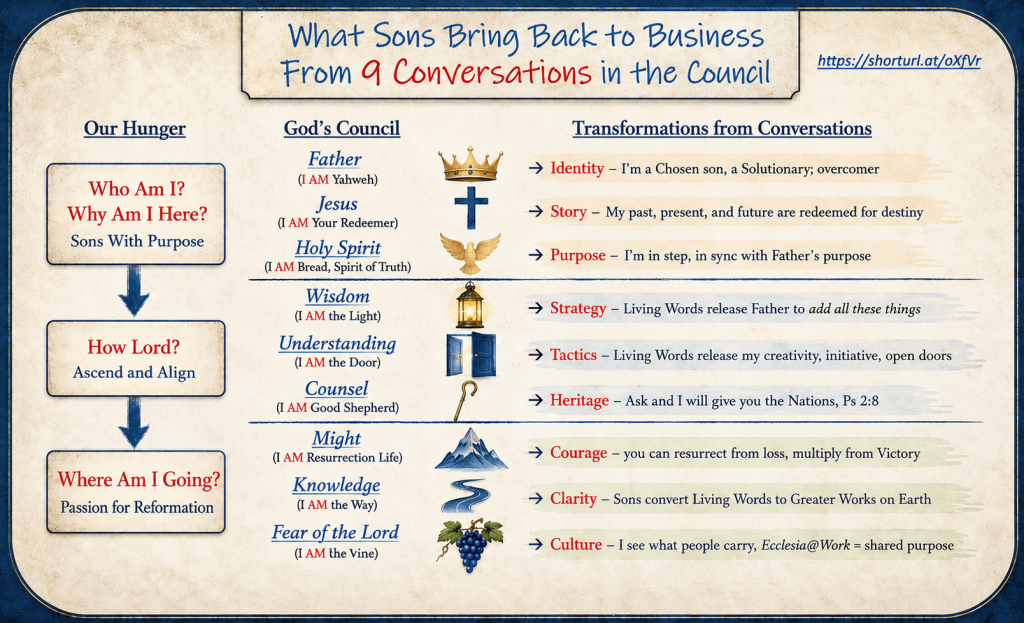
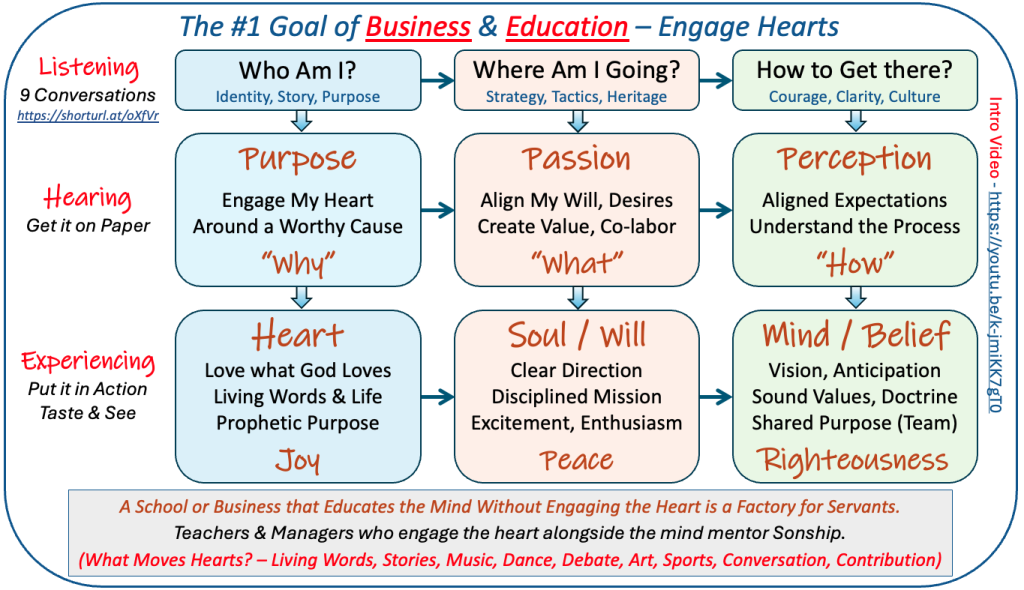
Who am I? — Identity, Story, Purpose. Every student carries a purpose Father wrote in their heart before they were born. Awakening that identity is the first job of every educator. This is a seer function — looking past performance and history to name what Father placed there. When a student feels seen for what they carry rather than ranked for what they scored, something unlocks.
We experienced this directly doing Christian business workshops in Ukraine and Poland — people from communist backgrounds who had never once been asked about their dreams. When we helped them prophetically navigate what Father put in them coupled with their own heart’s desires, they felt Father’s love in a brand-new way. They loved us back. The workshops came alive.
Why am I here? — Strategy, Tactics, Heritage. Once identity is awakened, purpose needs traction. The nine conversations of the Council give students a framework for hearing Father’s strategy for their specific metron — the particular sphere of culture they’re being sent to reform. This is where seers become doers. Living Words received in the Council convert into Greater Works on the earth.
Where am I going? — Courage, Clarity, Culture. Reformation requires the spirit of Caleb and Joshua — sons who can see the bright future for sound prophetic reasons, not just optimistic ones. This is faith based on Living Words, not wishful thinking. The student who carries this doesn’t need to be managed toward graduation requirements. They need to be connected with their hearts and sent into their dream.
What Graduation Actually Requires
The graduation metric for a discipleship-centered school isn’t just a GPA or a diploma. It’s Council fluency — the demonstrated ability to:
-
- Hear Father directly (not just through teachers or pastors)
- Bring accusations to the Courts and receive decrees
- Articulate their identity, purpose, and reformation assignment
- Point to fruit: something changed in their metron because they showed up
These are not mystical achievements. They are the natural outputs of a student who has been fathered rather than managed, encountered rather than instructed, and celebrated and sent rather than graduated.
The nine conversations of the Council — Father (identity), Jesus (story), Holy Spirit (purpose), Wisdom (strategy), Understanding (tactics), Counsel (heritage), Might (courage), Knowledge (clarity), Fear of the Lord (culture) — are a natural centerpiece of the curriculum. When a student can have those conversations in writing and show the fruit they produced, education has accomplished something that no degree program ever has: it has graduated a son. (See our Roadmap to Sonship)
The Practical Shift
A Christian school doesn’t have to abandon academics to make this shift. It has to reorder the priorities:
First: Create encounter before instruction. Before teaching the content, create the conditions for students to hear Father’s why related to the content. What does He say about this subject? How does it connect to what He wrote in their heart? How does it engage their heart?
Second: Father the prophetic “why” in every student. Make it a regular practice to see and name what each student carries — not their academic performance but their Kingdom purpose. When students feel seen, they engage.
Third: Supplement compliance metrics with engagement metrics. Can they hear God themselves? Can they articulate what Father is doing in their sphere? What is Father doing that ignites their heart? What are they inspired to do? Can they point to fruit? These are the questions that matter.
Fourth: Make Council fluency a graduation goal. Not a test about the Council — actual demonstrated ability to ascend, receive Living Words, and produce fruit with them.
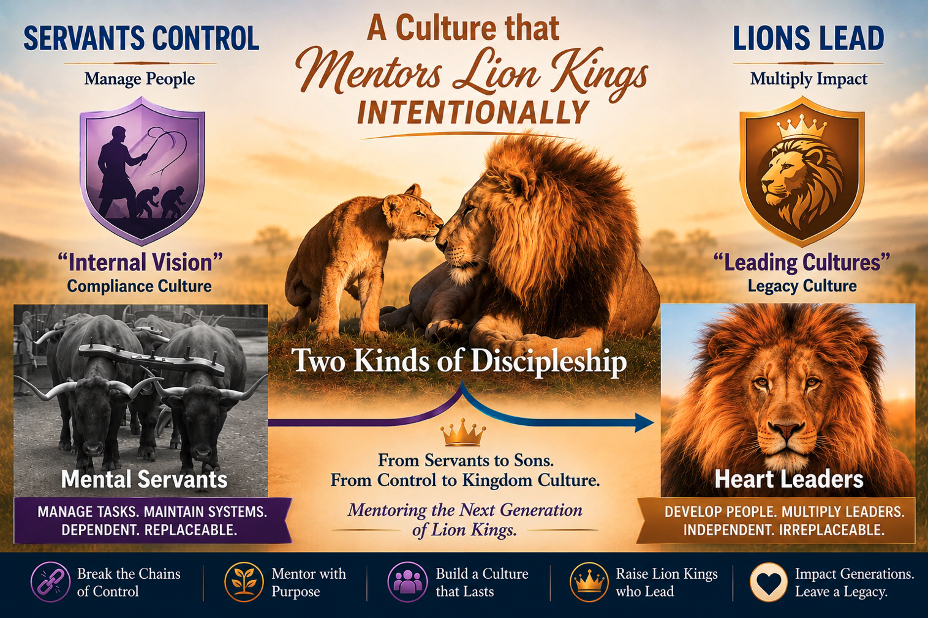
The world is graduating millions of educated but disengaged servants every year. The education mountain’s Reformation contribution is to produce something different: sons and daughters who hear God, know their metron, and build something with Living Words that changes the culture around them; a direction that thrills their heart and releases the hero God wired into their story.
That’s the degree worth having.
1Jn 2:27 – As for you, the anointing you received from him remains in you,
and you do not need anyone to teach you.
But as his anointing teaches you about all things… remain in him.
John 15:15 – I no longer call you servants… I have called you friends,
for everything that I learned from my Father I have made known to you.
This blog was inspired by a council session – 2026-06-16 Council – The Metric for Sonship
Appendix 1 – Practical Steps for Educators
- Use the same coaching approach in the upper grades that we use for businesspeople. See The Roadmap to Sonship
Two Examples
- Mike Whim’s Kolbe Assessment’s for Career Direction
- Help the students interface with business opportunities in their field of interest:
- Students give presentations to businesses
- Business giving presentations to students about the nature of their work
- Help the students interface with business opportunities in their field of interest:
- Create opportunities for site visits and interviews
Network summer or part-time employment opportunities
- Use David Nycz’s Classroom lesson plans for junior high.
(David was Teach of the Year in Oregon, see his web EducationViaHeart.com.-
- Allow student to pick biographies that interest them
- Create book reports around heart motivations
- Address the students own heart motivations where they overlap with their heroes.
-
- There are dozens more, but you get the idea.
(The real juice is in unlocking the creativity in teachers via the vision for Sonship in students)
Appendix 2 – Take Your Next Step:
Progression to Sonship – Your Kingdom purpose and redemptive stories form the basis for your personal identity, purpose, value creation, and your business offer. Becoming your authentic self is the Father’s non-religious key to flow and fruit in business and life. We offer practical and prophetic coaching to help you get there, flowing with your Father (co-laboring) instead of fighting circumstances and resistance alone. Is this You?
Read the book and Zoom with John for an overview of our process in Kingdom Business Coaching.
Explainer Video – https://youtu.be/k-jmiKK7gT0
0
0
Appendix 3 – Objections from the Education Mountain
And How to Answer Them | ReleasingKings.com
Starting With What Actually Works
Before addressing the objections, it’s worth naming what actually moves traditional educators — because leading with theology rarely does.
The most effective entry point is the Gallup data and the HBR entrepreneurship research. When a principal sees that 80% of their graduates are disengaged in the workforce within five years — and that GPA is the least predictive factor of their entrepreneurial success — the academic-only model loses its assumed superiority. The discriminator is, “Do students want to Learn, engage? Are they curious, creative, innovative?” The Kingdom framework then presents itself not as replacing academics but as adding the dimension that produces what academics can’t – a motive in Kingdom purpose.
The Ukraine/Poland story is relevant. People who had never once been asked about their dreams, who lit up when they were seen prophetically — that’s not a theological argument. That’s a human one. Teachers respond to it because they became teachers to do exactly that, they have an anointing for it.
Lead with the research and the human story. The theology follows naturally once the heart is open.
“The orphan spirit graduates with honors from the current system.
That’s not an accusation — it’s a diagnosis worth sitting with.”
Objections That Sound Theological But Are Really Institutional
Objection 1: “We can’t teach students to hear from God directly — that opens the door to spiritual deception.”
Wisdom to Consider: This sounds like discernment but functions as clergy-laity hierarchy protection. The unspoken logic: direct access to God requires an authority structure to validate it, and we are that structure. The answer isn’t argument — it’s demonstration. When a teacher has their own Council session and receives a specific, accurate Living Word, the deception argument weakens on contact with experience. Build the verification process into the curriculum: journaled, tested, submitted to community. 1 John 4:1 says test the spirits — that’s an instruction to verify, not a prohibition on hearing.
Objection 2: “This isn’t education — it’s church. We have a curriculum to deliver.”
Wisdom to Consider: The sacred/secular divide runs deep in Christian schools. The response: this isn’t replacing curriculum — it’s adding the motivational engine that makes curriculum stick. Research shows content retention is dramatically higher when tied to personal meaning and intrinsic motivation. The nine conversations don’t replace math or history; they give the student a reason to engage with them. Frame it as spiritually practical enhancement, not theological displacement.
Objection 3: “Parents are paying for their kids to get into college, not to have spiritual experiences.”
Wisdom to Consider: This is the most pragmatic and honest objection — and the principal is right that they answer to tuition-paying parents. Reframe the ROI conversation. Show the Gallup data: 80% of graduates are disengaged within five years. Show the HBR research: GPA is the least predictive factor of entrepreneurial success. Heart, Guts, and Luck outrank Book Smarts. The question for parents becomes: do you want a college-admitted graduate or a flourishing adult who knows their purpose? Most parents, when they understand the outcomes, pick flourishing. The real point is that you can have both academics and purpose; they complement one another when students get into their vocation.
Objections That Are Genuinely Theological
Objection 4: “The gifts of the Spirit aren’t for everyone. Some students aren’t even believers.”
Wisdom to Consider: Set the theological debate aside and lead with the human development case. Every student has a heart with desires and design. Every student benefits from being asked what they love and what they were made for. Council fluency in its fullest form is for sons — but the practice of asking identity questions, honoring what people carry, and connecting purpose to vocation is accessible to everyone. Start there. The theology catches up when the fruit is visible.
Objection 5: “We already do discipleship — we have Bible class, chapel, and a Christian worldview curriculum.”
Wisdom to Consider: This is sincere but reflects the head/heart confusion at the core of the problem. The most effective response is a question: “What percentage of your graduates are still walking with God and engaged in their purpose five years after graduation?” If the answer is uncomfortable, follow up: “What would change if the metric was Council fluency rather than just curriculum completion?” Don’t attack what they’ve built — invite them to evaluate it against outcomes and see the synergism in doing both.
Objection 6: “Preterism is a fringe theology. We can’t teach that here.”
Wisdom to Consider: Don’t lead with preterism. Lead with the mission question: what are we producing? A student who believes they’re waiting for extraction makes fundamentally different vocational choices than a student who believes they’re here to reform culture. You don’t need to name the eschatology to ask that question. Let the fruit of the two orientations make the case. When sons start producing reformation outcomes, the eschatology conversation becomes easier. Dispensationalism is an angel on a pinhead; not a hill worth dying on.
Objections That Are Genuinely Practical
Objection 7: “I wouldn’t know how to do this. No one trained me this way.”
Wisdom to Consider: This is the most sympathetic objection and deserves a direct practical response rather than a vision speech. You cannot impart what you haven’t received. The practical path: start with a small cohort of interested teachers, walk them through the nine conversations, let them experience Council fluency themselves, then build the student-facing process from that foundation. David Nycz’s EducationViaHeart.com provides classroom-ready lesson plans. The Roadmap to Sonship provides the coaching architecture. Staff formation precedes student formation. See Appendix 2.
Objection 8: “How do we grade it? How do we show parents and accreditors that this is working?”
Wisdom to Consider: Build a parallel engagement metric alongside existing academic metrics rather than replacing them. The seven heart engagement metrics — Does the student love what Father loves? Are they hearing Living Words? Can they celebrate fruit? Can others confirm their growth? — are observable and documentable. Student portfolios of Council sessions, purpose statements, and fruit reports create a meaningful record. Frame it to accreditors as character formation documentation, which most accreditation frameworks already require.
Objection 9: “What about students who aren’t Christians, or whose parents aren’t on board?”
Wisdom to Consider: The identity, purpose, and engagement work doesn’t require a student to be a Christian to benefit from it. Asking a student what they love, what they were made for, and what they want to build is universally valuable. The prophetic and Council-specific elements can be offered as the faith-based framework available to those who want it, without imposing it on those who don’t. Most parents — regardless of faith background — respond positively when their child comes home knowing what they’re passionate about and why it matters.
Objection 10: “We tried something experiential before and it became emotionally chaotic.”
Wisdom to Consider: This hesitation is protective, not just reactionary, and deserves respect. The distinguishing feature of the Council framework is its structure: journaled conversations, tested words, written Living Words submitted to community verification, Courts processes that address the legal rather than the emotional dimension. This is not a revival meeting — it is a disciplined, documented, relational process. Show the methodology before inviting participation. The journal is the accountability mechanism.
What’s Hardest to Overcome — Ranked
Not all objections are equally deep. Here’s an honest assessment of where the real resistance lives:
#1). The accreditation and college-prep stranglehold — structural, not attitudinal. Any reform must work inside this constraint of maintaining academic standards.
#2). The teacher’s own unformed heart — a teacher who has never had a Council conversation cannot impart one. Staff formation must precede student formation. Kingdom is an all-volunteer army. Work with Teachers and Students who are ready and willing.
#3). The parent’s ROI expectation — tuition-paying parents define success as college admission. The conversation has to shift to life outcomes in the context of Father’s individual purpose.
#4). Cessationism and fear of deception — theological frameworks take decades to shift. Demonstrations of fruit are more effective than arguments.
#5). The measurement gap — without credible engagement metrics, the Council fluency approach looks like soft anecdote versus hard data. However it’s not hard for parents and teachers to see the difference between motivated by purpose and disengaged from boredom. God can make a difference.