How You Were Trained Not to Pray
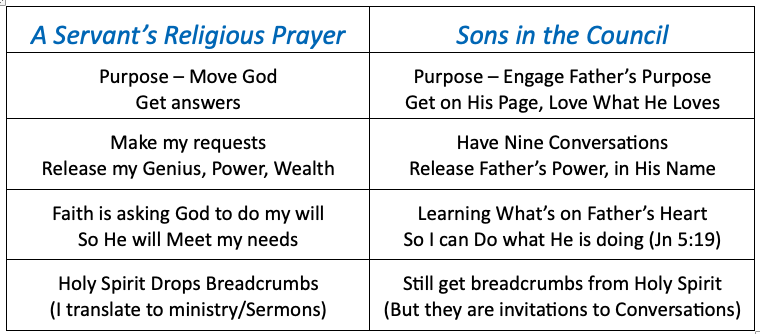
(Intro Video) The prayer life most Christians have is not a failure of discipline. It is a failure of framework. “Many believers are essentially prayerless” sounds provocative but the data supports it. Studies consistently show the average Christian prays less than five minutes a day — mostly grace at meals and corporate prayer at church services. It only takes five minutes to rehash my wish list every day. The servant model of prayer is largely responsible, because it trains people to stop praying.
Here’s the mechanism: when the petition model doesn’t produce results, it generates either theological crisis (“why doesn’t God answer?”) or quiet abandonment. Over time, prayer becomes a religious obligation rather than a living practice — and obligations get minimized. The servant prayer model produces the same disengagement curve that Gallup documents in the workforce. Same root cause: a transactional relationship that doesn’t engage the heart.
The church has produced a generation of people who believe in prayer but don’t practice it — because what they were handed was a servant’s model in a world that is waiting for sons. God is not a Geni in a bottle we can rub to get three wishes. The servant/son transition has huge ramifications on prayer. The servant mindset is a formula for independence from God; all my spare time and money is mine to do what I want — Sunday Christians.
The Problem with Breadcrumbs
Servants who do hear from God experience what might be called breadcrumbs — a verse that surfaces unexpectedly, an impression during worship, a quiet sense of direction about a decision, a name that comes to mind while praying for someone.
These are real. The Holy Spirit does drop them. And the servant’s response is entirely predictable: pick up the breadcrumb, translate it through his existing academic, mental framework, and produce a sermon topic, a ministry decision, or a personal encouragement.
The breadcrumb becomes the destination. But it was never meant to be the destination. It was an invitation. The Holy Spirit drops a word, a question, an image — not to deliver the full communication in a flash impression, but to open a doorway, curiosity for a conversation. Did you notice that? Come find out what it’s about. The breadcrumb is the beginning of a conversation, not the end of one.
The servant picks up the breadcrumb and runs with his interpretation. The son follows the breadcrumb into the Council and comes out with a Living Word — specific identity, specific strategy, specific assignment, specific authority.
The difference in output is enormous. The servant’s breadcrumb produces a sermon. The son’s conversation produces a reformation initiative. What the church has called hearing from God is largely the collection of breadcrumbs that were meant to be invitations to something much larger.
Nine Conversations in The Council, Not a 5 Minute Shopping List
What makes the Council framework practically different from prayer as most people understand it is the structure of what’s available in the conversation.
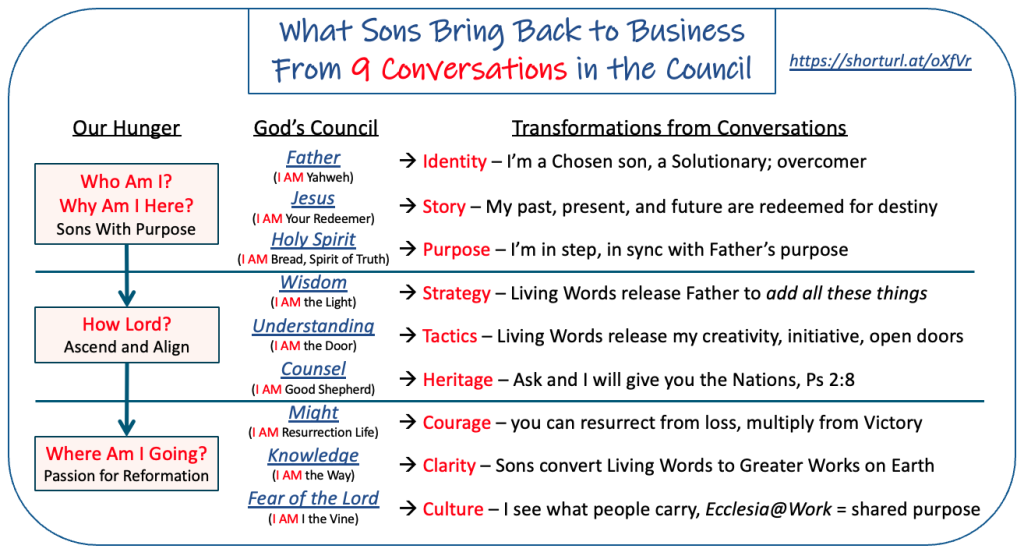
The Council is not an undifferentiated experience of God’s presence. It is a specific assembly — Father, Jesus, Holy Spirit, and the seven Spirits of Isaiah 11:2 — each with specific content to bring to the son who comes with ears to hear.
Nine conversations. Nine specific returns.
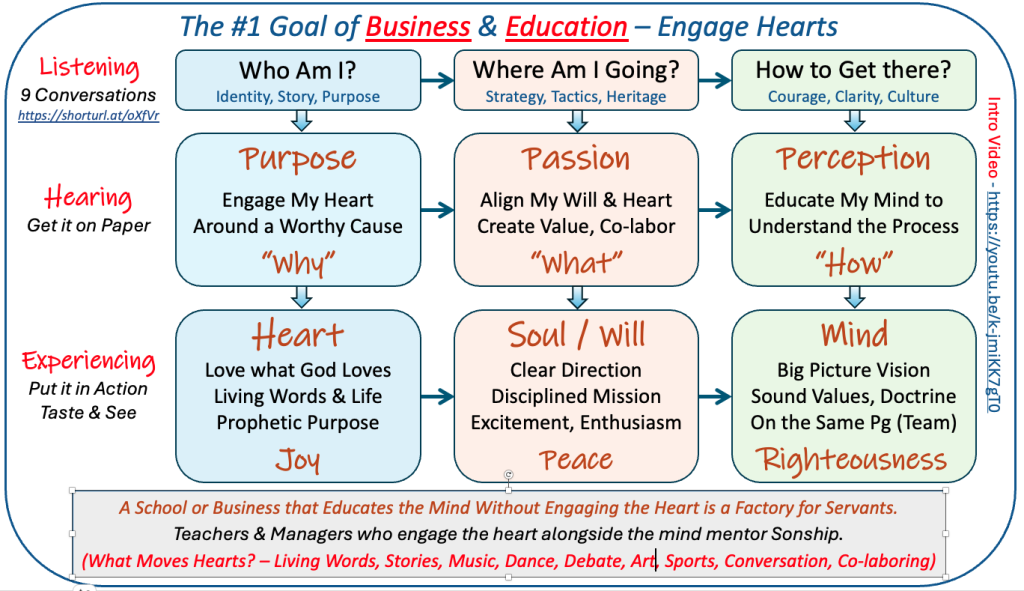
Father speaks to identity: Who am I? The son who sits with Father long enough stops performing for approval and starts receiving the identity that was always there — chosen, loved, named, sent.
Jesus speaks to story: My past, present, and future are redeemed for destiny. The accusations that history has written on the heart get brought to the Courts — and Jesus, as Redeemer, addresses what the enemy has used to define the son’s limitations.
Holy Spirit speaks to purpose: I am in step and in sync with Father’s purpose. The son who converses with the Spirit of Truth stops guessing at his calling and starts receiving specific alignment with what Father is doing in the earth.
Wisdom speaks to strategy: Living Words release Father to add all these things (Mt 6:33). What and Why become clear — not as a plan the son developed and brought to God for blessing, but as a Living Word that came from heaven and lands with weight.
Understanding speaks to tactics: Living Words release creativity, initiative, and open doors. The how becomes visible — not through the son’s ingenuity alone, but through insight that produces results exceeding natural capacity.
Counsel speaks to heritage: Ask of Me, and I will give you the nations for your inheritance (Ps 2:8). The son begins to see the scope of his assignment — connected to something Father is doing in cities and nations, not just in his personal life.
Might speaks to courage: You can resurrect from loss and multiply from victory. The son who converses with Might stops being defined by defeat and starts operating from confidence in what Father has already said about the outcome.
Knowledge speaks to clarity: Sons convert Living Words to Greater Works on Earth. The specific connection between the heavenly conversation and the earthly action becomes plain — this is how the word becomes a business, the decree becomes a building.
Fear of the Lord speaks to culture: I see what people carry — Ecclesia at Work is shared purpose. The son begins to see others not as resources or problems but as purpose-carriers whose treasure, when named and released, multiplies the Reformation around them.
These are not nine topics to cover in a quiet time. They are nine relational conversations that develop over time, deepen with practice, and produce an increasingly specific picture of what Father is doing and how the son fits into it.
We use this graphic as our roadmap to the Conversations
When the Council Is Silent
Here is where the Council framework addresses something the petition model never could.
When the servant prays and hears nothing, the conclusion is usually theological: God is testing me, or I lack faith, or He has His reasons. The silence becomes something to endure.
When the son goes to the Council and the conversation feels blocked, the framework has a different diagnostic: go to the Courts of Heaven. An accusation or a stronghold may be creating legal ground that is limiting access. The silence is not God’s absence — it is a signal that something needs to be addressed judicially before the conversation can flow.
This is not a peripheral add-on to prayer. It is the missing dimension that explains the most common and most discouraging prayer experience in the church — the sense that heaven is closed and God is far.
The Courts of Heaven exist precisely to address that closure. The son brings the accusation to Jesus, finds the legal ground the enemy is standing on, applies the cross, and comes out with a decree. The Council conversation then opens. The Living Word flows.
The servant has no framework for this. He can only endure the silence or question his faith. The son has keys to open & shut (Isa 22:22), bind & loose (Mt 16:19), ask whatever (Jn 15:16)
The Authority in Jesus’ Name
The servant-to-son transition in prayer is a move from breadcrumbs and presumption to facetime in the Council. Instead of asking God to meet our needs, we’re getting clarity on His heart’s desires so that we can co-labor with Him. Sons experience sharing Father’s purpose in the desires of our own hearts — After all, what other agenda competes with that?
Sons can ask whatsoever and see amazing results because we see what Father is doing and do it with Him. We’re not in the space of trying to convince Him to let us be God and have our way.
When we get on Father’s page it actually releases our confidence, creativity, initiative, and authority. Prayer becomes a compelling adventure in following the Lamb.
The Practical Bottom Line
The prayer life most Christians have is not a failure of discipline. It is a failure of framework.
Give someone a petition model and tell them to spend more time in it, and you will produce more of the same: occasional answers, frequent silence, gradual withdrawal. The model cannot produce what it doesn’t contain.
Give someone the Council framework — nine specific conversations, Living Words in writing, breadcrumbs as invitations, Courts when it’s blocked — and the practice becomes compelling rather than obligatory. Sons don’t abandon their relationship with Father because the relationship is producing something real: identity, purpose, strategy, courage, clarity, and fruit that confirms the Living Words were genuine.
The church has produced a generation of people who believe in prayer but don’t practice it — because what they were handed was a servant’s model in a world that is waiting for sons.
Servants make requests. Sons have conversations.
Change the model and everything changes.
Jn 5:19 – The Son can do nothing of Himself, but only what He sees the Father doing;
for whatever the Father does, these things the Son also does in like manner.
Jn 15:5 – I am the vine; you are the branches.
If you remain in me and I in you, you will bear much fruit;
apart from me you can do nothing.
This blog was inspired by a Council session you will enjoy reading:
Take the Next Step:
Progression to Sonship – Your Kingdom purpose and redemptive stories form the basis for your personal identity, purpose, value creation, and your business offer. Becoming your authentic self is the Father’s non-religious key to flow and fruit in business and life. We offer practical and prophetic coaching to help you get there, flowing with your Father (co-laboring) instead of fighting circumstances and resistance alone. Is this You?
Read the book and Zoom with John for an overview of our process in Kingdom Business Coaching.
Explainer Video – https://youtu.be/k-jmiKK7gT0