From the Law to Life and Living Words:
The Real Reason Willpower and Rules Don’t Break Addiction
(Intro Video) We’re all prone to addiction for a simple, structural reason: before we’ve heard Living Words, we run on the Law — the letter that kills. Not just the Ten Commandments kind of law, but the whole category it represents: rules, principles, verses, philosophies, doctrines, worldviews, opinions, the latest propaganda — anything that fences in behavior from the outside in, without ever touching the heart. The logic of the Law that we can apply it intellectually without hearing Father’s voice.
And here’s the part that trips people up — freedom doesn’t come from a better version of that same thing. Not a stricter set of rules. Not a smarter self-help framework to make self-discipline and self-righteousness work. Not even a new circle of people watching to make sure you comply. Accountability is still the Law wearing a religious face.
The Servant’s Bargain
Under the Law, the deal is always the same. Sacrifice, doing what I don’t want to do, buys me legal standing under the rules. I keep the rules, perform to the required level, stay inside the fence. And because good deeds never actually change my heart, it always needs a release valve. Periodically, I take a vacation from the sacrifice and just do what I want. We call it falling off the wagon.
This is why religion, AA, and self-help all tend to produce the same life cycles around the same mountain, even though they look completely different on the surface. Each one ministers the Law — a recipe to follow so a servant can, eventually, get to do what they actually want. AA’s genius is that it’s honest about the mechanism: keep showing up, keep working the steps, one day at a time. But “one day at a time” is still sacrifice-logic (Self-righteousness – see how much I sacrifice?). It’s a low bar precisely because it has to be sustainable for people running on willpower — fun, transitory, something you can do and never actually arrive anywhere. It saves lives for a season. It just can’t free a heart, because that was never the tool it was built to be.
A heart governed from the outside doesn’t get transformed; it gets divided, and the divided part eventually demands its own hearing — through a relapse, a binge, an affair, a blowup. Repentance is never just, “I quit, see what a good boy I am?” the second half is, “I turned toward a new purpose that frees my heart.”
Paul explains why the Law can never finish the job:
Heb 10:5 – Sacrifice and offering you did not desire…
6) with burnt offerings and sin offerings you were not pleased.
7) Then I said, ‘Here I am—it is written about me in the scroll—
I have come to do your will, my God.
The letter kills; the Spirit gives life (2 Cor 3:6). That’s not a slogan — it’s a diagnosis. Sacrifice divides a person against themselves: the part that complies and the part that’s waiting for the vacation. Dualism divides our identity so that we have to wear a fig leaf to hide the miss-behavior (plastic, inauthentic personalities). Lying to ourselves and others is a central theme in addiction and spiritual immaturity. We’re spiritual teenagers chafing against the rules, trying to find our identity. As long as the heir is underage he’s no different from a slave (Gal 4:1) — trying to obey the household rules but not yet living as a son who actually knows Father’s heart.
The Other Door: Sonship
Sonship is a different mechanism entirely. It isn’t a nicer rule (grace) or a stronger discipline (church). It’s hearing from God — directly, personally — in the Courts and Council, and finding that we can share the desires of His heart. Once that’s happened, I’m not sacrificing anymore. I’m co-laboring with Father, doing what I actually want to do, because what I want has been remade by what I’ve heard. I find out God’s purpose is also a purpose he wrote in my heart; I love doing what my Father is doing (I was designed for it!). It’s a jailbreak from the sacrificial system of the Law. That’s what “free from the Law” means in practice, not just in theology.
Jesus put the test plainly: anyone who chooses to do the will of God will find out whether the teaching comes from God (Jn 7:17). Willingness precedes clarity, not the other way around. And once someone has actually heard, condemnation loses its grip — there is now therefore no condemnation (Rom 8:1) — because the accusations that used to drive the sacrifice-and-vacation addiction cycle have nowhere left to attach. Sons take accusations to the Courts of Heaven instead of trying to hide them with fig leaves. Their hearts are freed, not fenced in.
This is the difference between sacrifice and co-laboring. Sacrifice is doing what I don’t want to do. Co-laboring is connecting my heart to the Father’s because I’ve heard His voice — His purpose becomes the joy set before me. The fruit isn’t manufactured by my will; it’s grown by the water of Living Words. I planted, Apollos watered, but God gave the increase (1 Cor 3:6). You can’t produce fruit by trying harder. You can only bear fruit by staying connected to the vine.
Nine Conversations, Grow Nine Fruits
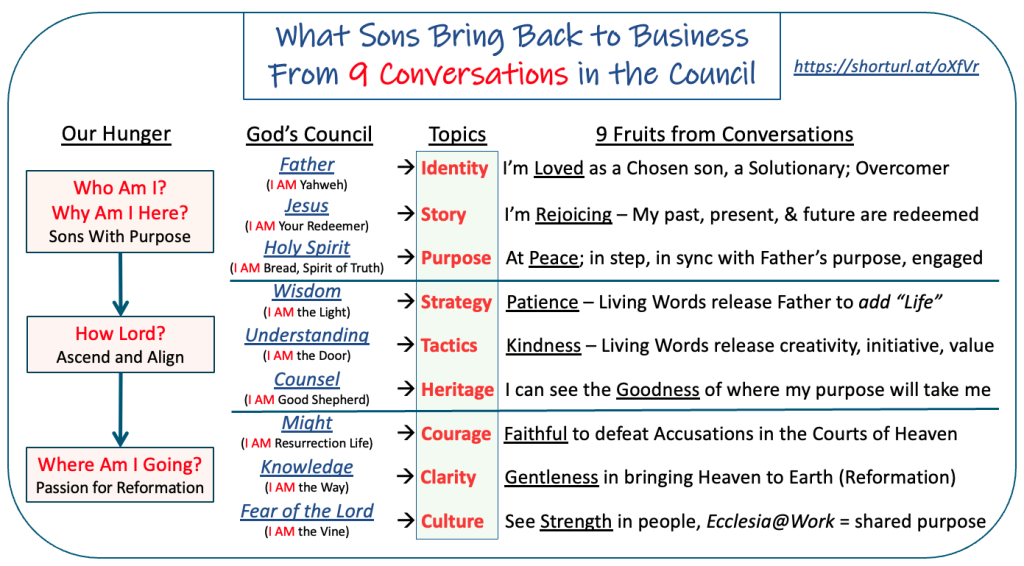
Here’s what makes this more than a nice reframe. The Council isn’t one conversation — it’s nine, each with its own voice and its own gift to a son who shows up for the conversation:
Father — Identity: I am loved and chosen, not performing for acceptance.
Jesus — Story: my past is being redeemed into a pattern for good, not hidden in shame.
Holy Spirit — Purpose: I have the confidence to carry what Father actually gave me to carry.
Wisdom — Strategy: I’m invited into Daniel’s excellence and anointing, not managed by minimum standards of behavior.
Understanding — Tactics: I stop staring at my own failures in the rear-view mirror and look at what Father is doing.
Counsel — Heritage: I’m set free from the letter that kills and connected, competently, to the Spirit that gives life.
Might — Courage: accusations don’t get to stand; the slate stays clean.
Knowledge — Clarity: it follows willingness — saying what Father is saying, doing what Father is doing.
Fear of the Lord — Culture: belonging to an Ecclesia built on shared purpose, not shared compliance.
God (and business professionals) are not really looking at how great we are (resumes). He is searching for people who bear His fruit; looking for what He can do through His sons, His greater works. People with ears to hear; the spiritual agility to follow the Lamb wherever, Rev 14:4.
Nine conversations, and nine fruits of the Spirit (Gal 5:22-23) that show up naturally on the other side of them — not as a checklist to hit, but as what a heart does when it’s actually been heard and has actually heard back. That’s the whole difference between fruit and performance: performance has to be maintained; fruit just grows, because the branch is connected to the vine, the Living Words.
What This Actually Means
Addiction is just the loudest, most visible version of a much quieter, much more common problem: an heir living like a slave, managing behavior on earth instead of hearing Father’s voice in Heaven.
The workaholic keeping impossible standards, the legalist white-knuckling their way through a moral checklist, the “successful” self-discipline that never once asked what Father actually wants — all of it is the same servant bargain wearing different clothes. Sacrifice, then a vacation. Rules, then relief. Compliance, then collapse.
It not just workaholics, it’s Alcoholics, Shopaholics, Foodaholics, Melancholics, Vitriolics, and Apostolics.
It’s all of us under the Law.
The way out was never a better rule. It’s a conversation, nine of them. It is for freedom that Christ has set us free (Gal 5:1), not for a new, more sustainable version of the yoke, but out from under it entirely. The Council conversations heal our broken story and unveil Living purpose from Living Words that put us on a new path to freedom and fun. Sons do something with the Living Words they hear; it’s purpose in business; a direction from Heaven put in action on Earth.
This blog was inspired by two Council sessions you will enjoy: