Lead Your Tribe into Sonship
(Intro Video) When people experience Sonship, Ascension, and Reformation, they naturally want to share it with their friends and get in on the thrill of setting captives free. There is a Spirit of Truth in sons and daughters who reproduce. Here is how it happens.
0
Dying to Live: How Sons Reproduce
Jesus said it plainly: Unless a kernel of wheat falls to the ground and dies, it remains only a single seed. But if it dies, it produces many seeds (Jn 12:24). The seed doesn’t produce by performing better; it reproduces when the shell is broken.
That’s the deal on the table. Not the death of purpose, but the death of self-sufficiency — my own wisdom, my own strength, my own power, my own ministry — in exchange for what Father is saying and doing. The alabaster box broken open. The sweet aroma of sonship fills the room only after self-sufficiency is surrendered, and the fragrance of brokenness invites us in.
This is not a hard sell once you understand what’s being offered. You trade a closed heart for an open Heaven. You trade intellectual strongholds for Living Words. You trade the exhaustion of self-effort for the flow of God’s favor and what He can add. Paul called it strength made perfect in weakness (2 Cor 12:9) — and then said he boasted in it. That’s not religious language. That’s someone who found out what was on the other side of surrender… co-laboring. Paul was well-educated and well-spoken, yet he learned to rely on the Spirit of Truth to speak to hearts instead of heads.
0
Other-Worldly Weapons to Defeat Strongholds
There’s a reason many people never find their purpose. It’s not that God hasn’t written it in their hearts — He has. It’s that something else got there first.
Vain imaginations. Religious opinions. The steady logic of human reasoning. Fleshly ambition dressed up as vision and goals. These aren’t just distractions; they are strongholds. They occupy the space where Father’s voice was meant to live, and they are loud enough, plausible enough, and familiar enough that most people never question the prison they create.
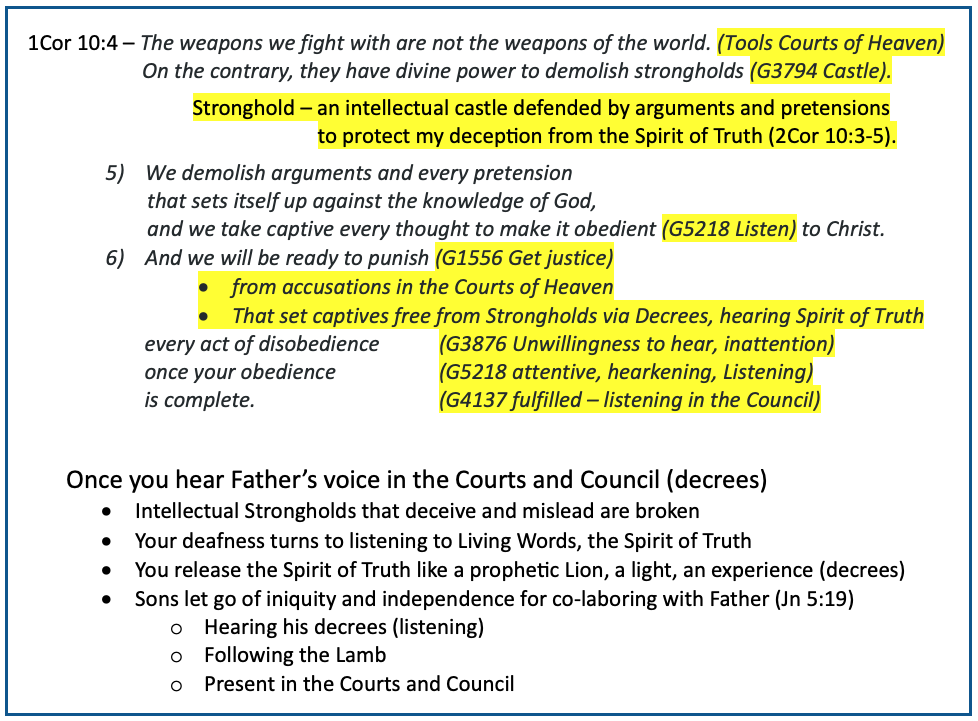
Stronghold (Ochuroma) – an intellectual castle defended by arguments and pretensions to protect a self-serving deception from the Spirit of Truth (2Cor 10:4-5). See cutting room floor at the end for examples.
Paul called them out directly — we have weapons that are not of this world, and we use them to demolish strongholds: arguments and every pretension that sets itself up against the knowledge of God (2Cor 10:4-5). Arguments. Pretensions. Not just bad theology, but the whole system of obstinate self-reliance that feels like wisdom and looks like discipline but quietly keeps our heart in a box; an inauthentic, pretentious, defensive, intellectual castle — a prison.
The cure, it turns out, is death.
0
What Ignites a Heart
Here’s where most ministry and most coaching get it wrong. The focus lands on “my” gifts, calling, and the revelation I want to communicate. The session, the seminar, the post, the conversation becomes about what’s igniting me rather than what Father is saying to them.
Letting your agenda die will resurrect your impact via listening to God’s heart and their heart. Stop asking, When can I make my point? Start asking, What is Father saying about their purpose? Not your prophecy. Not your intellectual framework for a solution. What is Father writing in their heart, and how is Jesus calling it to life?
The disciples on the road to Emmaus didn’t need a lecture. They needed someone to relate to them; Did not our hearts burn within us? (Lk 24:32). That fire (kaio in Greek, means to light and set ablaze) is the confirmation that Father’s Living Words have landed. It’s not manufactured; it’s experienced. Sons don’t create or impose purpose or conclusions on people; they release Living Words that ignite and engage what Father already placed there. The result is a disciple connected with their own heart, Father’s son or daughter connected with His heart.
0
Strongholds Don’t Argue with the Spirit of Truth — They Collapse
Here’s what sons are not invited to do: police others with intellectual opinions. Accuse others of violating our standards. The weapons of our warfare aren’t debate skills, better theology, or more Bible verses from the spirit of religion. They’re decrees — Living Words that carry the Spirit of Truth to quicken what is dead (Jn 6:63).
A stronghold is stubborn against human pressure. It’s built to withstand arguments, guilt, and confrontation. But it was never built to withstand Father’s voice spoken by a son who can release the Spirit of Truth in prophetic decrees, instead of trying to win a debate.
- When a decree comes through you rather than from you,
- When it sounds like it’s from Father rather than from your opinion — something shifts.
It resonates. It quickens. It burns. The captive hears something they’ve been longing for, and the box they’ve been living in suddenly has a door. They are hearing their own Father.
Truth is the Lion. It’s alive! It confronts and convicts — and then heals, illuminates purpose, and shows a path forward. It’s the light that makes a way when there doesn’t seem to be one.
0
The Way Out Is Through Purpose
This matters practically. People aren’t just spiritually captive — they’re often stuck financially, vocationally, or relationally. The stronghold blocking their initiative isn’t laziness; it’s a belief system that can’t see a way forward. What sets them free isn’t more information; it’s Father speaking directly to the purpose in their heart and showing them a financially viable and practical path to inherit that purpose. Our new son or daughter has the experience of following the Lamb themselves, ascending to their seat in Heaven.
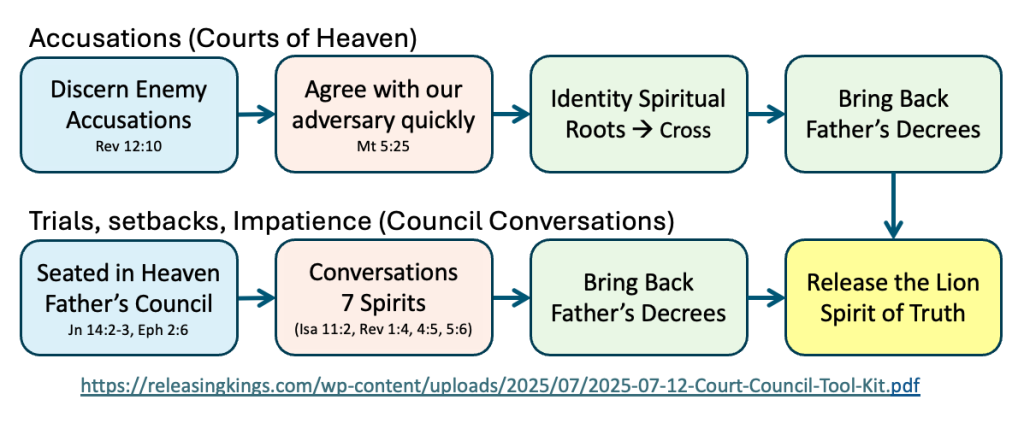
God’s Council – Sons carry those Living Words from conversations in the Council. They hear what Father, Jesus, and the Seven Spirits are saying about this person’s unique story, and they bring it back as decrees that give life to what was dry and direction to what was aimless.
Courts of Heaven – If there are accusations, sons take those to the Courts of Heaven for Jesus’ legal advocacy and Father’s decrees.
Intellectual strongholds can’t stop the Spirit and the Love from penetrating hearts. That’s the culture worth building, an Ecclesia of sons and daughters reproducing the same joy in their circle of friends and co-workers. Not one organized around gifted teachers or microphone ministries, but around the sound of sons and daughters hearing Father and releasing the Spirit of Truth into the hearts of people who were made to carry it all along.
Disciples become sons when they hear Father’s voice for themselves. When that happens, they will love you for helping them connect with their own heart and with their own Father.
The seed dies. The field multiplies. The captives go free.
This blog was inspired by several Council sessions:
- 2026-03-16 Council – Dying to Live
- 2026-03-18 Council – Defeating Strongholds in the Courts
- 2026-03-20 Council – Listening to Heaven
More explanation of the graphic below in the Courts and Council Toolkit
Take the Next Step:
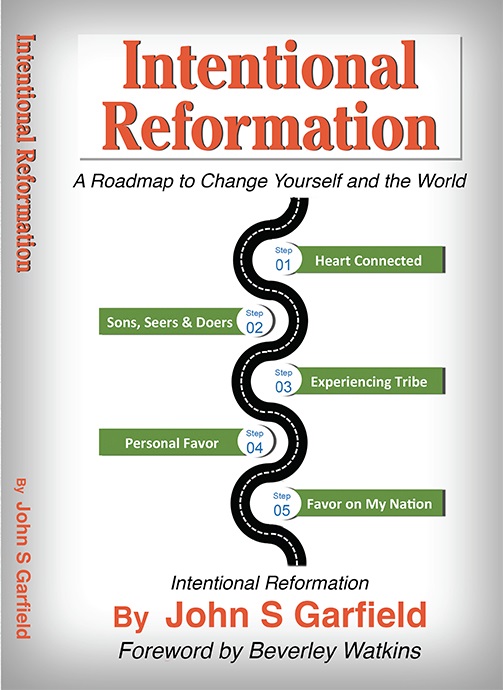
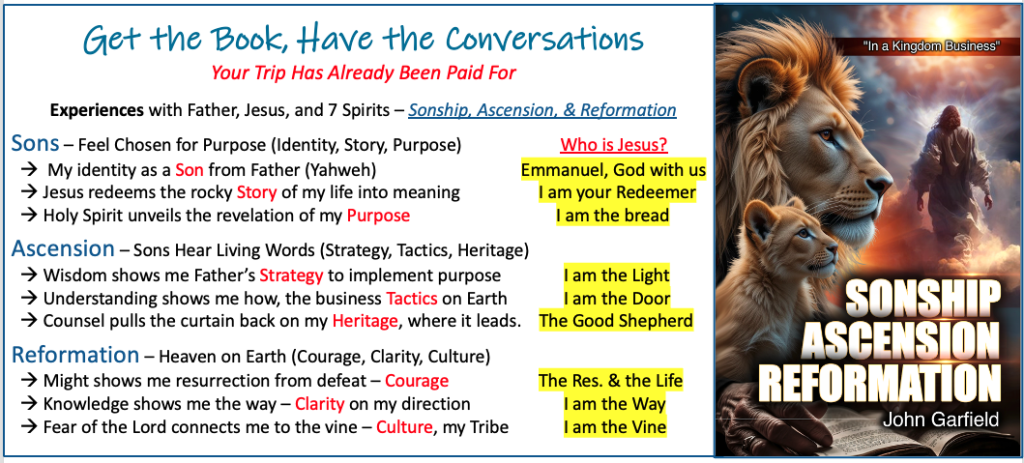
Progression to Sonship – Your Kingdom purpose and redemptive stories form the basis for your personal identity, purpose, value creation, and your business offer. Becoming your authentic self is the Father’s non-religious key to flow and fruit in business and life. We offer practical and prophetic coaching to help you get there, flowing with your Father (co-laboring) instead of fighting circumstances and resistance alone.
Read the book and chat with John about Kingdom Business Coaching.
o
Cutting Room Floor – Examples of Strongholds
Caution – Exposing the logical flaws in these 13 typical strongholds (below) is not an invitation to defeat them in debate. Captives are set free in Courts and in the Spirit. The Spirit of Truth is a velvet covered brick, the velvet is love, the Spirit is Jesus. Sons and daughters have an anointing to lovingly recognize strongholds hidden in hearts and defeat them in the Courts of Heaven to set the captives free to connect with their Identity, Story, and Purpose. The real solution to strongholds is the Courts of Heaven in the following sequence:
Accusation – this is the deception. What are we hiding from God in our castle (Stronghold).
Roots – Why do I protect it; Hide it? Defend it? (Take the accusations and roots to the cross)
Cross – Consequences of my deception/protection are taken to the cross
Decrees – I’m capturing Father’s decrees and bringing them from Heaven to Earth and into my life. I depend on the power of God for change, not my discipline or self-sufficiency.
The Learning Curve – it is risky to translate Living Words from Heaven to confront strongholds and set captives free. Go to the Courts of Heaven by proxy for others first. Gain the Courage in Heaven first via intercession and bring Life to earth second when your discernment is mature and your confidence is in Christ.
#1). The Sacred/Secular Divide
-
- Deception: God works exclusively through the church; business, politics, and the marketplace are spiritually inferior or spiritually neutral at best.
- Why we protect it: It justifies keeping one foot in “ministry” while hedging against full commitment to a secular career. It gives religious identity a privileged status.
- Consequences: Sons and daughters abandon the seven mountains of culture to default paganism. Wholehearted Kingdom engagement in business, law, medicine, and government is stunted. The marketplace is surrendered rather than redeemed.
#2). Christian Zionism / Dispensationalism
-
- Deception: Ethnic Israel retains a separate, parallel covenant with God. The modern state of Israel is the prophetic fulfillment of divine land promises. God’s end-times program runs through a geopolitical nation, not through sons in Christ.
- Why we protect it: Israel is God’s chosen people, we will be raptured off the scene and won’t be responsible for anything. Gentiles have no purpose or responsibility in life or the Kingdom – Whew!.
- Consequences: Wars and rumors of war are endorsed rather than opposed, because conflict advances “the timeline.” There is no place for Sonship, Ascension, and Reformation; no reason to ascend to the Courts and Council; no sons or daughters. Sons are locked out of their full inheritance in Abraham (Gal 3:29) by a system that re-ethnicizes what the cross made universal. This withholds the gospel from Jewish people by treating them as already included.
#3). Cessationism
-
- Deception: The gifts of the Spirit — prophecy, healing, tongues, words of knowledge — ceased with the apostolic age. The canon closed the supernatural.
- Why we protect it: It manages the risk of emotionalism, manipulation, and false prophecy. It also protects a purely academic approach to faith where the theologian, not the Spirit, is the final authority.
- Consequences: Sons are cut off from the very weapons Paul describes in 2 Cor 10 — the divine power needed to demolish strongholds. The Courts of Heaven and Council conversations become nonsensical categories. Christianity is reduced to historical study and moral improvement. There are no Living Words or decrees. Your seat in heaven (Eph 2:6) and the place Jesus prepared for you (Jn 14:2-3) are just metaphors.
#4). Poverty Theology / Anti-Prosperity
-
- Deception: Money is spiritually dangerous; pursuing financial success reflects worldliness and lack of trust in God. True spirituality is demonstrated by material sacrifice.
- Why we protect it: It provides a virtuous explanation for financial failure. It also offers moral superiority over those who are prosperous. It feels humble and Christ-like.
- Consequences: Kingdom Business is abandoned. Sons reject the financial metron God designed for them. Cash flow is metric for greed and unbelief. Wealth is ceded to the world rather than stewarded for reformation. Generosity is stunted by a theology that sanctifies scarcity.
#5). Institutional Church Loyalty
-
- Deception: Spiritual authority, accountability, and legitimate ministry are only valid when organized through a local church structure with ordained clergy.
- Why we protect it: It provides belonging, identity, and covering. Leaving or questioning it threatens relationships, spiritual status, and in many cases, livelihood.
- Consequences: Sons remain in spiritual adolescence, dependent on institutional permission to function. The Ecclesia — sons sharing Father’s purpose — is replaced by a Sunday attendance model. Sons who are entrepreneurs, artists, and cultural leaders are perpetually treated as second-tier members rather than frontline reformers.
#6). Performance-Based Identity
-
- Deception: God’s favor, voice, and purpose are tied to spiritual performance — prayer frequency, fasting, ministry output, moral consistency.
- Why we protect it: It gives the flesh a framework it can manage and measure. It also provides a defense mechanism: if I’m failing to hear God, it must be because I haven’t done enough.
- Consequences: The Council becomes transactional rather than relational. Brokenness is avoided rather than embraced, because weakness feels like disqualification. Sons can’t receive the “My grace is sufficient” upgrade (2 Cor 12:9) because they’re still trying to earn access.
#7). End-Times Escapism
-
- Deception: The world is headed for irreversible collapse; the church’s job is to hold on until the rapture. Cultural engagement is rearranging deck chairs on the Titanic.
- Why we protect it: It removes responsibility. If everything burns anyway, there’s no need to build, invest, reform, or fight for institutions. It also offers a dramatic, heroic narrative — the faithful remnant enduring to the end.
- Consequences: Dominion mandate is abandoned. Sons disengage from business, politics, education, and media precisely when their presence is most needed. The Cyrus-level reformation happening right now is invisible to those whose eschatology can’t accommodate it.
#8). Emotional Healing as the Final Destination
-
- Deception: The goal of the Christian life is inner healing — getting free from wounds, breaking off trauma, achieving emotional wholeness.
- Why we protect it: Healing is real and necessary, and the language is compassionate and validating. It’s easy to stay in the process indefinitely.
- Consequences: Sons never graduate from the Courts to the Council. They are permanently in recovery rather than deployment. Wholeness becomes the finish line rather than the launching pad for purpose and reformation.
#9). Prophetic Elitism
-
- Deception: The prophetic gift is a special spiritual rank that grants unique authority to speak into others’ lives, often without accountability to what Father is actually saying.
- Why we protect it: It’s a platform. It feels much safer to have others hear from God for us that to be present in the Council ourselves, responsible for conversations with Father, Jesus, and the 7 Spirits.
- Consequences: The Spirit of Truth is replaced with breadcrumbs dressed in prophetic language. Decrees that are meant to come through the son are substituted by pronouncements that come from the prophet’s own soul.
#10). “I’m Too Busy to Ascend to the Council”
-
- Deception: The demands of life, business, ministry, and family are so legitimate and pressing that regular ascent to the Courts and Council is a luxury rather than a necessity. Productivity is stewardship. Getting things done is the spiritual work. There will be a season for more prayer and listening — just not this season.
- Why we protect it: Busyness carries enormous social legitimacy in Western culture and in the church. A full calendar is evidence of importance, faithfulness, and work ethic. It also protects the flesh from the vulnerability of silence — because ascending means listening, and listening means Father might say something that disrupts the plan already in motion. The stronghold is defended by genuine obligations, real deadlines, and the adrenaline reward system of productivity, which makes it nearly impossible to identify as a deception rather than a virtue. It also quietly protects self-sufficiency — if you never ascend, you never have to confront how much of what you’re doing is your own wisdom rather than Father’s.
- Consequences: Businesspeople operate entirely from the lower story — human reasoning, accumulated experience, best guesses — while your seat in heaven sits empty. Decisions that could have been made with divine clarity are made with careful analysis instead, and the gap between those two outcomes compounds over years into a life that looks productive but misses the 100-fold level Father had in mind. Accusations go unaddressed in the Courts, meaning legal ground the enemy holds remains intact regardless of how hard the son works around it. The Council conversations that would have unveiled purpose, strategy, and Living Words for the people in the son’s sphere never happen — so those people receive the son’s best effort instead of Father’s word. Effort without decree is activity without authority.
- Jesus modeled the alternative with precision. He withdrew regularly — to mountains, to deserted places, to the garden — not in spite of his crowded schedule but because of it. The busier the ministry, the more deliberate the ascent. Luke 5:16 notes almost parenthetically that Jesus often withdrew to lonely places and prayed — in the middle of a healing revival. The disciples interrupted him constantly. The crowds pressed in. He went anyway, because what came down from those times was the only thing worth bringing back.
- Practically, this stronghold is the enemy’s most efficient tool against sons in the marketplace, because it doesn’t require overt deception — it simply keeps the inbox full. A son who never ascends never gets the decree that would have made three months of effort unnecessary. He never hears the word that would have opened the door he’s been knocking on for two years. He never receives the Living Word for the person sitting across the table who needed Father’s voice and got a good meeting instead.
- The Council word is direct: Father gives daily bread — eat that. The manna model was never designed to be stockpiled. It requires showing up each morning, ascending fresh, and receiving what that day actually needs — not running on yesterday’s revelation, last year’s vision, or someone else’s prophecy. Sons who are too busy to ascend are, by definition, living on stale bread while the fresh supply waits.
- Feeling defeated and discouraged is simply being absent from your seat in heavenly places. So is feeling overwhelmed, unclear, and perpetually behind. The cure isn’t a better schedule. It’s the ascent that was available all along.
#11). Christian Pacifism
-
- Deception: Jesus was non-violent in all things, and faithful discipleship requires the renunciation of force in every context — personal, political, and military. War, weapons, and coercive power are inherently incompatible with the Kingdom of God. The deception requires ignoring that Jesus fashioned a whip and drove out the money changers (Jn 2:15), told his disciples to sell their cloaks and buy swords (Lk 22:36), commended the faith of a Roman centurion without demanding his resignation (Mt 8:5-13), and that John the Baptist instructed soldiers to serve honorably rather than to quit (Lk 3:14). God is a warrior. The Lion of Judah is not a pacifist. Sons are called to fight — the question is always jurisdiction and weapons, not whether force itself is legitimate. See Rom 13:1-6.
- Why we protect it: It feels like the most Christlike position — turning the other cheek, loving enemies, refusing to return evil for evil. It draws on genuinely beautiful texts and appears to occupy the moral high ground. Questioning it risks looking like you’re blessing violence, which is socially and theologically costly in many communities. It also conveniently removes the burden of hard decisions about justice, governance, and force.
- Consequences: Sons disengage from military service, law enforcement, national defense, and legitimate governance — the very institutions that require Kingdom-minded people most urgently. Evil is given structural room to operate because the sons who could restrain it have been theologically disarmed. The Just War tradition — articulated by Augustine, rooted in the Old Testament warrior God of Exodus 15:3, and affirmed by Jesus himself in Luke 22:36 — is abandoned in favor of a selective reading of the Sermon on the Mount that strips it of its covenantal context.
- Consequences in the Courts and Council specifically: Pacifism as a stronghold prevents sons from exercising spiritual authority aggressively. The Courts of Heaven require sons to contend — to make a legal case, press a charge, enforce a verdict. The Council sends sons back to earth with decrees that demolish strongholds (2 Cor 10:4). Neither of these is a passive posture. A son who has been theologically trained to equate force with sin will hesitate at the very moment the Council calls for bold prophetic declaration. The stronghold doesn’t just affect political views — it neuters the warrior identity sons need to carry Living Words into resistant territory.
#12). Sola Scriptura — Scripture Alone is God’s Voice
- Deception: The Bible is the only means by which God speaks today. Personal revelation, prophetic words, Council conversations, and direct hearing from Father are unnecessary, unreliable, or dangerous. The canon is closed. The voice is silent. Everything God wants to say, He already said in print.
- Why we protect it: Sola Scriptura was a legitimate Reformation corrective against tradition and papal decree elevated above Scripture. That history gives it enormous theological credibility — questioning it feels like sliding toward Catholic error or charismatic excess. It also provides a controllable epistemology: the text can be studied, systematized, and mastered in ways a living voice cannot. Academic mastery confers authority, giving those who’ve invested years in it strong incentive to protect the framework. At the personal level, it removes the responsibility of learning to hear — if God doesn’t speak beyond the text, you never have to develop the ear, sit in silence, or risk being wrong about what you heard.
- Consequences: A living relationship with Father is replaced by a literary relationship with a text. The Dead Letter Society, as Paul warned, prioritizes the system over the son, rules over relationship, control over co-laboring. John 5:39-40 becomes its self-portrait — You study the Scriptures diligently because you think that in them you have eternal life. These are the very Scriptures that testify about me, yet you refuse to come to me to have life. The Pharisees were history’s most rigorous Sola Scriptura practitioners. Their intellectual castle was impeccably defended. The Living Word walked right past them unrecognized.
- Sons inside this stronghold have a Bible full of Council conversations — Abraham at Mamre, Moses at the burning bush, Isaiah in the throne room — and a theology insisting those conversations ended with the last apostle. Sound doctrine confirms, but it doesn’t lead. The Bible points you to Jesus; it was never designed to replace Him with pharisaic rules and intellectual truth. The Spirit of Truth is alive; a Lion that doesn’t need defended or debated. Jesus is the Living Word, the redemptive bridge into Father’s presence. The New Covenant is not better Bible access — it’s the law written on the heart and a knowledge of God so immediate that no one will need to teach his neighbor (Jer 31:33-34). This Reformation is about producing sons and daughters who are seers and doers.
- Sola Scriptura as a stronghold doesn’t produce sons who know the Author. It produces scholars who know the text — which is a real and valuable thing, but it is not the same thing. The Bible is the God-breathed foundation that governs, tests, and anchors everything sons hear. But it was never designed to replace the voice of the Father it reveals. The map is not the territory. The menu is not the meal. And a son who will only eat what is printed on the page will go hungry in exactly the ways Father’s daily bread was meant to feed, Mt 4:4.
#13). The Full-Time Ministry Stronghold
- Deception: The highest calling available to a son or daughter is vocational, professional ministry — and that calling is validated by being financially supported by a congregation or donor base. The pastor, the preacher, the missionary, and the church planter represent the apex of Kingdom investment. Everyone else funds the real work from the outside.
- Why we protect it: It is culturally and institutionally reinforced by centuries of church structure, seminary training, and congregational expectation. It carries enormous identity weight — being “called to ministry” is the most spiritually prestigious designation available in most Christian communities, and relinquishing it feels like spiritual demotion. It is also economically self-reinforcing: once a pastor is funded by offerings, his livelihood depends on maintaining the theology that justifies the arrangement. Questioning the model threatens the mortgage. Beyond economics, it provides a clean, legible life narrative — I surrendered a career to serve God — that is socially rewarded and nearly impossible to critique without appearing to attack sacrifice itself. And for many pastors, the alternative is terrifying: if ministry isn’t the vehicle, and the church isn’t the primary institution, and offerings aren’t the provision model, then everything they built their identity around requires rebuilding from the ground up.
- Consequences: Pastors who cannot generate value in the marketplace become permanently dependent on congregational goodwill, which subtly — and sometimes not so subtly — shapes what they are willing to preach. The man funded by tithes cannot easily bite the hand that feeds him. Prophetic courage is the first casualty of financial dependency. The congregation senses it. The culture of the church drifts toward comfort and retention rather than reformation and deployment. Sons and daughters in the pews who are called to business, government, and culture receive a steady diet of sermons from a man who has never operated in those domains and has a structural incentive to keep the church, rather than the marketplace, at the center of Kingdom activity.
- Paul saw this clearly and refused it. He made tents. Not because apostolic funding was illegitimate — he explicitly defends the right of ministers to be supported in 1 Corinthians 9 — but because he understood the spiritual and relational cost of dependency in certain contexts. I have not used any of these rights (1 Cor 9:15). His marketplace credibility gave his gospel a weight that a fully-subsidized ministry could not have carried in Corinth or Thessalonica. He worked with his hands so that his message arrived without strings and his authority stood on something other than a donor’s continued approval.
- The deeper deception is the sacred/secular split it perpetuates — stronghold number one on this list. If full-time ministry is the highest calling, then business is implicitly second tier, and the son who builds a company, influences a city, and funds reformation from the marketplace is spiritually behind the man who preaches three times a week and lives on offerings. That inversion produces exactly the wrong outcome: it pulls the most gifted communicators, leaders, and visionaries out of the marketplace precisely when those mountains of culture need sons embedded in them most.
- The Kingdom Business model is the correction. Paul’s tentmaking wasn’t a concession to necessity — it was a prototype. Sons who carry both vocational competence and prophetic authority have a metron the fully-funded pastor structurally cannot access. They sit across the table from CEOs, politicians, and culture-shapers as peers, not as charity cases hoping for a donation. Their credibility in the Council and their credibility in the boardroom reinforce each other rather than compete.
- The trap closes slowly. A young man feels genuinely called to preach. He goes to seminary. He takes a church. The church grows. The salary increases. The identity solidifies. Ten years in, the calling and the income stream are indistinguishable from each other, and the thought of bivocational ministry or marketplace transition feels like failure rather than freedom. The alabaster box would need to break — and the stronghold exists precisely to prevent that.
- The way out is not to abandon preaching or teaching or shepherding. It is to refuse the funding model that makes those gifts dependent on institutional approval. Sons who can generate value in the marketplace and release Living Words from the Council are accountable to Father’s voice, not to the elder board’s satisfaction with last Sunday’s attendance numbers. That is a different kind of freedom — and a different kind of authority.